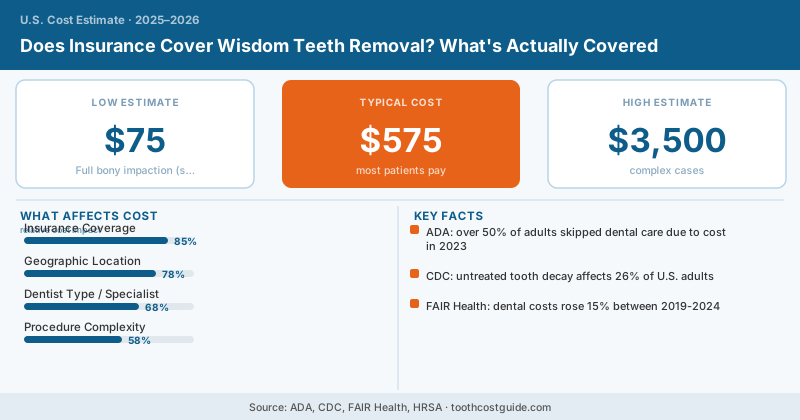
Roughly 5 million Americans get their wisdom teeth pulled every year, and the single biggest question they ask isn’t about pain — it’s about the bill. Will insurance pay? The short answer: usually, but rarely all of it.
Here’s the part that trips people up. Wisdom teeth removal sits in a weird zone between dental and medical insurance, and which one pays can swing your out-of-pocket cost by hundreds of dollars. Let’s untangle it.
What You’ll Actually Pay With Insurance
| Scenario | Total Cost | Your Cost With Insurance |
|---|---|---|
| Simple extraction (erupted tooth) | $75–$250 each | $20–$100 each |
| Soft-tissue impaction | $225–$600 each | $90–$300 each |
| Full bony impaction (surgical) | $350–$800 each | $175–$500 each |
| All four impacted + IV sedation | $1,500–$3,500 | $400–$1,200 |
| Anesthesia/IV sedation | $250–$800 | $0–$400 |
Most dental PPO plans treat extractions as a “basic” or “major” service. Basic procedures are typically covered at 70–80%, while surgical extractions of impacted teeth often fall to the 50% major-service tier. That difference matters: a $600 impacted extraction at 80% costs you $120, but at 50% it’s $300.
Even with good coverage, your plan caps what it pays per year. The National Association of Dental Plans reports the typical annual maximum is around $1,500. Four impacted wisdom teeth with sedation can blow right through that, leaving you to pay full price on whatever spills over. If you also need a filling or crown that year, plan the timing carefully.
Dental vs. Medical: Who Pays?
This is the question that decides your bill. The rule of thumb:
- Asymptomatic, preventive removal (your dentist just wants them out before they cause trouble) → billed to dental insurance.
- Medically necessary removal (infection, cyst, tumor, jaw damage, or removal done in a hospital) → may be billed to medical insurance, which can cover anesthesia and facility fees your dental plan won’t touch.
If you have a genuine infection or your teeth are damaging the jaw, ask the oral surgeon’s office to submit to medical first. Medical plans don’t have that $1,500 dental cap, so the math can work heavily in your favor.
Don’t assume “medically necessary” means medical insurance auto-covers it. Surgeons code these claims carefully, and a wrong code can get the whole thing denied. Ask for the CPT and CDT codes in writing, then call both insurers yourself before the surgery. Five minutes on the phone can save you several hundred dollars.
Why the Cost Varies So Much
The price isn’t random. It tracks the difficulty of the extraction:
- Erupted teeth that have broken through the gum are simple pulls — quick and cheap.
- Soft-tissue impactions are partly covered by gum and need a small incision.
- Bony impactions are buried in the jawbone, sometimes requiring the surgeon to section the tooth and remove bone. These take longer and cost more.
Sedation choice stacks on top. Local anesthesia is cheap and usually covered. IV sedation or general anesthesia adds $250–$800, and that’s where coverage gets murky. If you’re nervous about the procedure, our guide to dental sedation costs breaks down each option.
Frequently Asked Questions
What if I don’t have any dental insurance at all? You’ll pay full freight — typically $1,000–$3,000 for all four impacted teeth. But you have options. Dental school clinics charge 40–60% less, and many oral surgeons offer in-house payment plans or accept CareCredit. See our rundown of dental emergency options without insurance for ways to soften the hit.
Can I just remove the teeth that hurt and leave the rest? Yes. There’s no rule that all four must come out at once. Removing only the problem teeth lowers your immediate cost and your insurance exposure. Many people split removal across two calendar years specifically to use two annual maximums.
Does Medicaid cover wisdom teeth removal? For adults, it depends entirely on your state — some cover medically necessary extractions, many don’t cover routine dental at all. For kids and teens under 21, Medicaid’s EPSDT benefit generally covers it. We cover the state-by-state picture in does Medicaid cover adult dental.
The bottom line: insurance almost always helps with wisdom teeth removal, but the real money question is whether your case qualifies as medical. Make that call before you sit in the chair.
Frequently Asked Questions
Yes, most dental PPO plans cover wisdom teeth extraction as an oral surgery benefit, usually paying 50–80% of the cost after your deductible. A simple extraction might be covered at 70–80%, while a surgical extraction of impacted teeth often drops to 50% coverage. You'll still owe the rest plus anything above your annual maximum, which the NADP reports averages around $1,500 per year.
Sometimes. If removal is medically necessary — say, the teeth caused an infection, cyst, or jaw damage — your medical plan may cover it, especially the anesthesia and facility fees for hospital-based surgery. Routine preventive removal of asymptomatic teeth is almost always billed to dental, not medical. Always ask the oral surgeon's office to verify both before scheduling.
With insurance, expect to pay roughly $200–$1,000 out of pocket for all four teeth, versus $1,000–$3,000+ without coverage. A single simple extraction runs about $75–$200 after insurance; impacted teeth requiring surgery and sedation cost far more. Your exact share depends on coverage percentage, deductible, and remaining annual maximum.
Often, yes. Many dental plans impose a 6–12 month waiting period before they'll cover oral surgery like extractions. If you enrolled recently and your wisdom teeth are bothering you now, call your insurer and ask exactly when surgical benefits kick in — emergency extractions sometimes bypass the wait.
Coverage for sedation is hit or miss. Local anesthesia is almost always included, but IV sedation or general anesthesia ($250–$800) is frequently only covered when documented as medically necessary for impacted teeth. Get the sedation billing code from the surgeon and confirm coverage with your plan before the appointment to avoid a surprise charge.