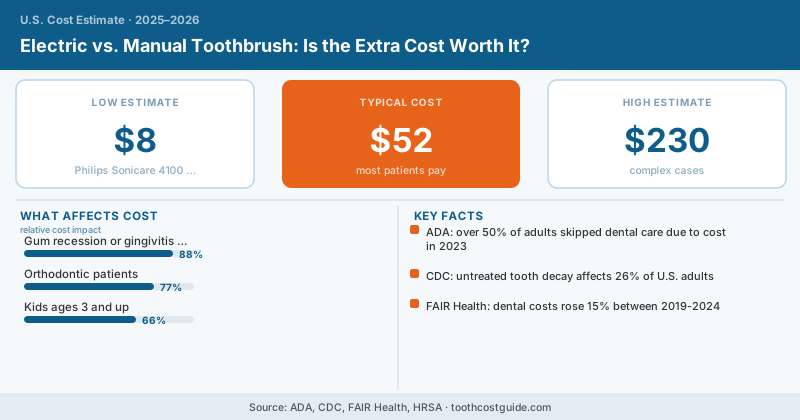
42% of American adults have never used an electric toothbrush. That number is striking when you consider that the Cochrane Collaboration — the gold standard for medical evidence synthesis — concluded in a 2019 review of 56 trials that electric toothbrushes are significantly more effective at reducing plaque and gingivitis than manual brushing.
But “significantly more effective” at $50–$100 versus $2–$5 is a question worth asking carefully. Is it worth it for you specifically?
What the Evidence Actually Shows
The 2019 Cochrane review analyzed data from 5,068 participants across 56 randomized controlled trials. Key findings:
- 21% reduction in plaque with electric toothbrushes vs. manual at 3 months
- 11% reduction in gingivitis with electric vs. manual at 3 months
- 6% fewer sites with bleeding at 3 months
The effect was consistent across oscillating-rotating and sonic designs. The authors noted the evidence quality was “moderate” — not because the results are uncertain, but because of heterogeneity across study designs.
Importantly: the 21% plaque reduction isn’t a ceiling. For patients who brush incorrectly — pressing too hard, rushing through a quadrant, using a scrubbing motion — an electric toothbrush’s automatic timer, pressure sensor, and consistent motion can produce even larger gains.
The Five-Year Cost Comparison
Let’s do the math that toothbrush ads skip.
| Option | Year 1 Cost | Years 2–5 (Annual) | 5-Year Total |
|---|---|---|---|
| Manual (soft, replaced every 3 months) | $8–$20 | $8–$20/yr | $40–$100 |
| Oral-B Pro 1000 (electric, budget) | $35–$50 | $24–$32/yr heads | $131–$178 |
| Philips Sonicare 4100 (electric, mid) | $45–$60 | $28–$40/yr heads | $157–$220 |
| Oral-B iO Series 9 (electric, premium) | $200–$230 | $40–$60/yr heads | $360–$470 |
The honest upshot: a budget electric toothbrush costs about $100–$130 more than a manual toothbrush over five years. A premium electric costs $300–$400 more.
Now ask: what does one prevented cavity cost? A composite filling runs $150–$300 per surface. One crown runs $1,000–$1,800. The electric toothbrush pays for itself if it prevents a single filling in five years.
When Electric Is Clearly Worth It
Electric toothbrushes aren’t universally superior for every person in every situation. But there are specific scenarios where the upgrade is unambiguous:
Gum recession or gingivitis history. If your dentist has mentioned gum recession, bleeding on probing, or early periodontitis, a pressure sensor on an electric brush is more valuable than any supplement or mouthwash. Aggressive brushing causes irreversible gum and enamel damage; the feedback loop of a pressure sensor breaks that habit.
Orthodontic patients. Manual brushing around brackets is genuinely difficult. An electric toothbrush with a round head or the right tip geometry navigates bracket contours more consistently than most people achieve manually. Patients with braces who use manual toothbrushes have measurably higher rates of white spot lesions (decalcification) post-treatment.
Kids ages 3 and up. Children lack the fine motor coordination and sustained attention for thorough manual brushing. Pediatric electric models — Oral-B Kids ($35–$50), Sonicare for Kids ($45–$60) — include timers and characters that genuinely improve compliance. The first dental visit guide addresses when to introduce a toothbrush, but most pediatric dentists recommend electric from the moment a child has enough teeth to justify a 2-minute routine.
Adults with arthritis or dexterity limitations. Manual brushing requires wrist rotation, grip strength, and fine control. Electric brushes do the motion for you. For patients with rheumatoid arthritis, Parkinson’s, or other conditions affecting dexterity, an electric toothbrush isn’t an upgrade — it’s medically indicated.
Anyone who can’t maintain a consistent 2-minute habit. Most adults brush for 46–70 seconds, not 120. An electric brush with a 2-minute timer and 30-second quadrant alerts is a behavioral intervention disguised as a consumer product.
Research consistently shows people underestimate how long they’ve been brushing by 50–100%. A timer that runs for exactly 2 minutes and divides into four 30-second segments standardizes something most people have been doing inconsistently for decades. This alone — not the brush motion — accounts for a significant portion of the electric toothbrush effect in clinical trials.
When Manual Is Probably Fine
Honest answer: if you brush correctly for two full minutes twice a day, use fluoride toothpaste, floss or use interdental cleaning tools daily, and your dentist reports no active decay or gum problems — a manual toothbrush is doing the job.
The ADA doesn’t mandate electric toothbrushes. The evidence shows that technique and consistency matter more than the tool. A dentist who brushes correctly with a $2 soft-bristle manual toothbrush will have better outcomes than someone rushing through 45 seconds with a $200 Oral-B iO.
The problem is that most people don’t brush correctly or consistently. Electric toothbrushes compensate for human inconsistency in a way that’s hard to replicate with patient education alone.
The Brush Head Problem
This is where electric toothbrush economics get complicated. Replacement heads for brand-name brushes — Oral-B CrossAction, Sonicare DiamondClean — run $8–$15 per head. At the recommended 3-month replacement schedule, that’s $32–$60/year just on heads.
Compatible third-party heads from brands like Fairywill, Lepow, and Generic cost $2–$5 each. They fit standard brush handles and clean comparably. Using third-party heads on a solid $40 electric brush is a legitimate cost-reduction strategy.
Don’t skip replacement, though. Frayed bristles lose up to 50% of their effectiveness. A worn head on an electric brush is worse than a fresh manual toothbrush.
Never buy a “rechargeable” toothbrush with a non-replaceable brush head. After 3 months the bristles are worn and the entire device becomes suboptimal — you either replace the whole unit or brush with worn bristles. Stick to models with replaceable heads.
The Bottom Line
For the average adult who doesn’t brush for the full two minutes and has any history of cavities or gum issues: yes, an electric toothbrush is worth the cost difference.
The budget case is straightforward: an Oral-B Pro 1000 at $35–$50 costs about $2.50–$3 more per month over five years than a manual toothbrush. For that delta, you get a pressure sensor, a timer, and proven superior plaque removal. The preventive care savings potential dwarfs the cost difference.
The premium case is harder to justify on clinical grounds alone. The iO Series 9 at $200+ isn’t meaningfully better for gum health than the Pro 1000. Buy premium if the app coaching or aesthetic matters to you — not because you’ll get dramatically better dental outcomes.
Frequently Asked Questions
Manual toothbrushes typically cost $1–$5 per brush, while electric toothbrushes range from $25–$230 depending on the brand and features. Entry-level oscillating electric models start around $25–$50, mid-range models cost $50–$100, and premium brands with advanced features can reach $150–$230.
Most standard dental insurance plans do not cover toothbrushes—electric or manual—as they are considered basic hygiene supplies rather than medical devices. Some employer-sponsored dental plans or flexible spending accounts (FSAs) may allow you to use pre-tax dollars to purchase an electric toothbrush, but coverage varies by plan.
Electric toothbrush replacement heads should be changed every 3 months and typically cost $3–$8 per head, or $12–$32 annually. If you choose a manual toothbrush instead, replacement costs only $1–$5 per brush every 3 months, making the annual maintenance cost significantly lower.