In 2010, the best-looking tooth-colored crown still had a faint dark line at the gum from the metal underneath. Today, an e.max crown has no metal at all — just a single block of glassy ceramic that catches light almost exactly like real enamel. That leap is why e.max became the go-to for front teeth. It’s also why it costs a bit more than a standard crown. Here’s whether that premium is worth it for your tooth.
E.max Crown Costs at a Glance
| Scenario | Typical Cost |
|---|---|
| E.max crown, no insurance | $1,000–$3,000 |
| E.max crown with 50% insurance | $500–$1,500 |
| Same-day milled e.max (CEREC) | $1,100–$2,500 |
| Standard PFM crown (for comparison) | $800–$1,800 |
| Monolithic zirconia (for comparison) | $900–$2,200 |
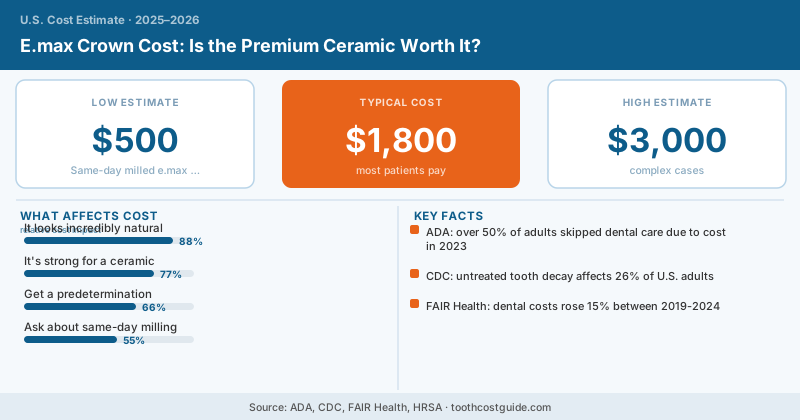
E.max usually runs $200–$500 above a basic crown. Most patients pay $1,200–$1,800 without insurance. The premium buys aesthetics and a metal-free build — not necessarily more strength than zirconia.
What E.max Actually Is
E.max is a brand name for lithium disilicate ceramic. Instead of porcelain baked over a metal cap, it’s a single solid block of strong glass-ceramic. Two things make it special:
It looks incredibly natural. Lithium disilicate is translucent the way enamel is, so light passes through it instead of bouncing off an opaque metal core. That’s why dentists reach for it on front teeth.
It’s strong for a ceramic. Lithium disilicate has good flexural strength — enough for front teeth, premolars, and many single back teeth. It’s not as bulletproof as zirconia, but it’s far tougher than old all-porcelain crowns.
For a visible front tooth, e.max usually wins on looks — its translucency reads as more natural. For a heavily loaded back molar or a grinder’s tooth, zirconia wins on raw strength. Many dentists use e.max from the front teeth back to the premolars, then switch to zirconia or gold on the molars. If your tooth shows when you smile, the e.max premium is often money well spent. If it’s a hidden molar, it usually isn’t.
When E.max Is Worth the Premium
Pay for e.max when aesthetics matter — front teeth, canines, premolars that show when you smile or talk. The natural translucency is genuinely hard to replicate, and on a visible tooth that’s exactly what you’re buying.
It’s also a smart pick if you want a metal-free crown for sensitivity reasons or personal preference, and if you like the idea of a single-block restoration with no porcelain to chip off a metal substructure.
When to Skip It
Skip e.max — and save the premium — on a hidden back molar where nobody will ever see it. A monolithic zirconia or gold crown is tougher and costs the same or less. Spending extra on translucency for a tooth no one sees is paying for a feature you can’t use.
Heavy grinders should talk to their dentist too. While e.max handles normal chewing fine, severe bruxism on a back tooth may be better served by zirconia or gold. Our gold vs porcelain crown guide breaks down the durability trade-offs.
How to Pay Less for E.max
Get a predetermination. Most dental PPO plans cover crowns at 50% of the allowable fee, which can cut a $1,600 e.max crown to roughly $800 out of pocket. The free predetermination tells you the exact number before you commit — and flags any “alternate benefit” downgrade. See how dental insurance works for the details.
Ask about same-day milling. A CEREC e.max crown skips the temporary and the second visit, which can save time and sometimes money.
Dental school clinics offer supervised work at 40–60% below private fees. Uninsured patients can also lean on a dental savings plan or finance through CareCredit.
Confirm your quote specifies “e.max” or “lithium disilicate” and not a generic “ceramic crown,” which could be a cheaper material billed at a premium price. Get a written, itemized treatment plan listing the material and procedure code, and submit it for predetermination so you know your real out-of-pocket before any prep.
Bottom Line
An e.max crown costs $1,000–$3,000, usually $200–$500 above a basic crown, with most patients paying $1,200–$1,800 before insurance. The premium buys lifelike translucency and a metal-free build, which makes it the top pick for visible front teeth. For hidden molars, a tougher, cheaper zirconia or gold crown is the better deal. Match the material to the tooth, get a predetermination, and you’ll only pay the e.max premium where it actually shows. If decay went deep, factor in a filling buildup or root canal on the estimate too.
Frequently Asked Questions
An E.max crown typically costs between $1,000 and $3,000 per tooth, which is $200–$500 more than a standard porcelain-fused-to-metal crown. The exact price depends on your location, dentist experience level, and whether additional procedures like a root canal or buildup are needed.
Most dental insurance plans cover 50% of crown costs up to a set annual maximum (usually $1,000–$1,500 per year), but they typically reimburse based on the cost of a standard crown rather than the premium E.max price. This means you'll likely pay the $200–$500 difference out-of-pocket, plus any remaining balance after your plan's deductible and annual maximum are applied.
The E.max crown process typically requires two dental visits: the first appointment involves tooth preparation and taking impressions (1–2 hours), and the second visit 1–2 weeks later is for placement (30–60 minutes). E.max crowns generally last 10–15 years with proper care, making them a durable option for front teeth where appearance matters most.