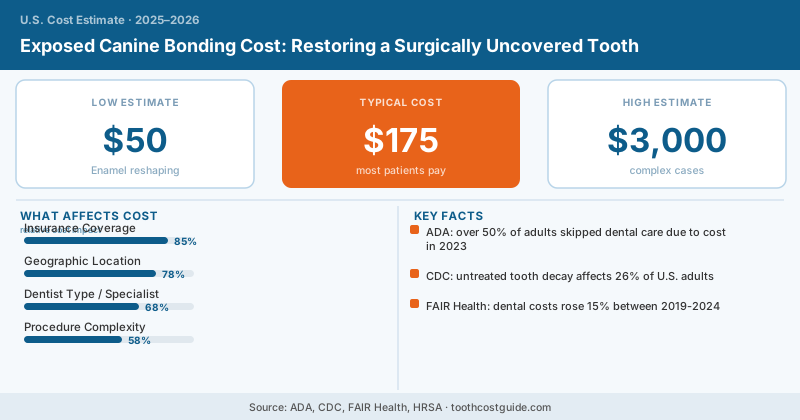
Your child’s impacted canine finally got pulled into place after months of orthodontics — and now it looks a little different from its neighbors. Restoring that surgically exposed canine with bonding costs $150–$600 per tooth, and it’s the finishing touch many families don’t see coming.
When an upper canine is impacted, an oral surgeon exposes it and an orthodontist guides it down into the arch. By the time it arrives, the tooth’s enamel can be slightly worn, oddly shaped, or off-color from its long journey through the bone. Cosmetic bonding reshapes and color-matches it to blend in.
What the Bonding Costs
| Item | Detail | Cost Per Tooth |
|---|---|---|
| Composite bonding | Reshape and color-match | $150–$600 |
| Enamel reshaping | Minor contouring | $50–$300 |
| Prior surgical exposure | Reference (separate) | $1,500–$3,000 |
| Orthodontic traction | Reference (separate) | varies |
Impacted canines are surprisingly common — the American Association of Orthodontists has long noted that the maxillary canine is one of the most frequently impacted teeth after wisdom teeth. That’s why the exposure-traction-bonding sequence is a well-worn path in orthodontic offices, not some exotic one-off.
Why Bonding, Not a Crown or Veneer
For a young patient whose canine just needs a little reshaping and color blending, composite bonding is the conservative, affordable choice. It removes little to no natural tooth and costs a fraction of a dental crown or porcelain veneer. Crowns and veneers are usually reserved for adults or more severely damaged teeth.
Bonding is the last and cheapest step in a long sequence. The expensive parts came earlier: the surgical exposure of the canine ($1,500–$3,000) and the orthodontic traction over many months. By the time you reach bonding, you’re spending a few hundred dollars to perfect a result you’ve already invested heavily in. Don’t cut this corner.
How Long Bonding Lasts
Composite bonding typically lasts several years before it may need a touch-up, especially on a tooth that takes biting force like a canine. It can chip or stain over time. The upside is repairs are cheap and quick compared with redoing a crown.
A surgically exposed canine sometimes erupts with weaker enamel or gum recession around it. Bonding can mask appearance, but the underlying gum health still needs monitoring. If the gum line looks uneven, ask your dentist whether it’s purely cosmetic or signals something that needs treatment first.
Insurance and Cost
Cosmetic bonding is frequently considered elective by dental insurers, meaning limited or no coverage — though restoring function on a previously impacted tooth may qualify on some plans. Checking how dental insurance works clarifies whether your situation counts as cosmetic or restorative.
Saving on the Bonding
No coverage? A dental savings plan trims 15% to 25% off cosmetic procedures with no waiting period, and dental schools perform bonding at reduced supervised rates. For the larger surgical exposure step earlier in the process, CareCredit can spread the bill over interest-free months.
Bottom Line
Bonding a surgically exposed canine is the affordable cherry on top of a long, costly orthodontic journey. It blends the tooth in for a fraction of a crown’s price, holds up for years, and is easy to repair. After everything it took to get that canine into place, spending $150–$600 to make it look right is the easy part — far easier than the tooth extraction route a stuck canine could have led to.
Frequently Asked Questions
Bonding a surgically exposed canine typically costs between $150 and $600 per tooth, depending on the extent of shaping and color matching needed. This procedure is usually performed after orthodontic treatment has guided the impacted tooth into the arch.
Most dental insurance plans classify cosmetic bonding as a non-covered or partially covered service, meaning you'll likely pay the full $150–$600 out-of-pocket. Some plans may cover a portion if the bonding is deemed functionally necessary rather than purely cosmetic, so check your specific policy before treatment.
Bonding is typically performed 3–6 months after the tooth has been fully guided into the arch, allowing time for the gum to settle and the tooth to stabilize. Your orthodontist will let you know when the tooth is ready for bonding to achieve the best color and shape match with adjacent teeth.