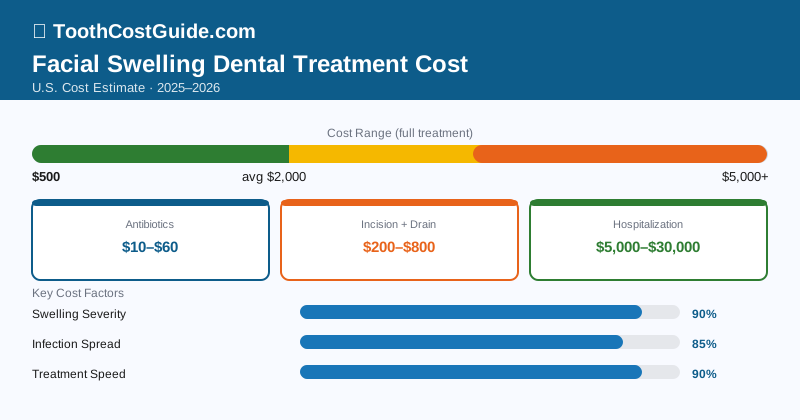
Facial swelling from a dental infection is one of those symptoms where the right call genuinely depends on how bad it is. A cheek swollen near one tooth: see a dentist today, probably $700–$2,500 to treat. Swelling extending toward your neck or making it hard to swallow: go to an emergency room now, cost irrelevant. The difference between those two scenarios is not subtle.
| Cause of Facial Swelling | Treatment | Cost (No Insurance) |
|---|---|---|
| Periapical abscess (localized) | Root canal or extraction + antibiotics | $700–$2,500 |
| Pericoronitis (wisdom tooth) | Antibiotics + extraction | $300–$900 |
| Gum abscess | Drainage + deep cleaning | $500–$1,500 |
| Salivary gland infection | Antibiotics + heat/massage | $150–$800 |
| Spreading cellulitis (soft tissue) | Hospital + IV antibiotics | $5,000–$20,000 |
| Deep space infection | Surgery + ICU + IV antibiotics | $15,000–$50,000+ |
| Allergic reaction (dental material) | Antihistamines + monitoring | $100–$500 |
| Post-operative swelling (expected) | Ice, ibuprofen, monitoring | $0–$100 |
Assessing Your Swelling — Four Scenarios
Scenario 1: Soft swelling, localized to the cheek near one tooth, no fever.
This is the most manageable situation. Call a dentist immediately for a same-day appointment. Take ibuprofen 400–600 mg every 6 hours. Apply cold packs — 15 minutes on, 15 off — to the outside of the cheek. Don’t apply heat. The dentist will likely find an abscess, either treat the tooth or extract it, drain any accessible pus, and prescribe antibiotics. Cost: $700–$2,500.
Scenario 2: Firm swelling, extending below the cheekbone, low fever of 100–101°F.
Still manageable but needs to be seen today without exception. Call ahead and describe what you’re seeing. If your dentist can’t accommodate you same-day, go to urgent care for antibiotics and get a dental referral for the next morning. Still don’t apply heat. Don’t eat or drink in case IV sedation or surgery becomes necessary.
Scenario 3: Swelling reaching toward the neck or chin, fever above 102°F, difficulty opening your mouth.
This is beyond what a dental office can safely manage. Go to an emergency room — bring someone to drive you. Take ibuprofen en route for fever control. Don’t eat or drink. The ER will order CT imaging to map the extent of the infection, administer IV antibiotics, and consult an oral surgeon.
Scenario 4: Rapidly spreading swelling, difficulty breathing or swallowing.
Call 911. Lay in the position that’s most comfortable for breathing. Tell EMS you suspect a dental infection. This can progress to complete airway obstruction within hours.
Why Swelling Matters Beyond the Pain
The jaw and face contain a network of fascial spaces — connective tissue planes that link different anatomical compartments. Once an infection breaks through cortical bone, it can travel those planes with alarming speed.
Upper teeth infections can spread toward the eye and sinuses. Lower teeth infections — especially molars — spread into the submandibular, sublingual, and parapharyngeal spaces along the floor of the mouth. When infection fills both submandibular spaces and the sublingual space simultaneously, it pushes the tongue upward and backward. That’s Ludwig’s angina, and it can close the airway within hours.
This is why swelling that doubles in size over 12 hours is not the same as swelling that’s been stable for 48 hours. Rate of change matters as much as extent.
Treatment Costs by Severity
Dental-office management — $700–$2,500
For swelling confined to the cheek adjacent to the offending tooth, the dentist removes the infection source (root canal or extraction), drains any accessible abscess, prescribes antibiotics. Swelling usually begins to improve within 24–48 hours.
Incision and drainage — $150–$400
When a fluctuant (pus-filled) swelling is palpable in the gum or cheek, draining it under local anesthesia provides immediate relief and speeds resolution alongside antibiotics and definitive dental treatment.
ER evaluation — $800–$3,000+
CT imaging maps infection extent. IV antibiotics for severe or systemic cases. The ER doesn’t treat the tooth — that’s still a dentist’s job — but it stabilizes patients too sick for the dental chair.
Hospitalization for cellulitis — $5,000–$20,000
Diffuse soft tissue infection without a defined abscess to drain requires IV antibiotics and close monitoring. Typical hospital stay: 2–5 days.
Surgical drainage for deep space infection — $15,000–$50,000+
When pus reaches the submandibular or parapharyngeal spaces, neck incisions under general anesthesia are required. Drains placed, spaces irrigated, multiple drain changes. ICU monitoring standard.
Insurance Coverage
Dental insurance covers the dental side — root canal (patient owes roughly $400–$900), extraction ($20–$150), and abscess drainage ($30–$100).
Medical insurance covers the hospital side. ER visits are subject to your ER copay ($150–$500) plus deductible and coinsurance. For hospitalization, most ACA-compliant plans cap individual out-of-pocket at $8,700 for 2024.
No insurance: Hospital charity care is available at most nonprofit hospitals for patients below 200–400% of the federal poverty level. For severe infections requiring hospitalization, applying immediately is critical — bills for a deep-space infection can be reduced to near-zero for qualifying patients.
The Cost of Waiting
The single most effective cost-reduction strategy is treating dental infections before they cause facial swelling. A $1,200 root canal completed when the tooth first ached is 20 times cheaper than a $25,000 hospitalization for a deep space infection. That’s not a rough estimate — that’s the realistic cost differential.
If cost has been the barrier, FQHCs and dental schools offer the same treatment for 40–80% less. A $300 extraction at a community health center prevents the hospitalization. GoodRx cuts antibiotic cost to $4–$12. The access options exist.
Facial swelling that involves the neck, causes difficulty swallowing, alters your voice, or makes you feel like your airway is narrowing is a life-threatening emergency. Call 911 immediately. Do not drive yourself. Do not wait for a dental appointment. This type of swelling can progress to complete airway obstruction within hours.
Dental-related facial swelling costs $700–$2,500 to treat at the dental level — and that’s where treatment belongs. The cost jumps to $15,000–$50,000 when infection reaches deep fascial spaces. Assess your swelling honestly against the four scenarios above. When you’re unsure, go to the ER. The cost of evaluation is nothing compared to the risk of an unrecognized spreading infection.
Frequently Asked Questions
A simple dental abscess with localized facial swelling typically costs $700–$2,000 to treat, usually involving antibiotics, drainage, and possible root canal or extraction. If the infection spreads to surrounding tissues (cellulitis), hospital admission and IV antibiotics can push costs to $5,000–$30,000 depending on severity and length of stay.
Most dental insurance plans cover emergency treatment for infections, including antibiotics and drainage procedures, typically at 50–80% after your deductible. However, if you require emergency room or hospital care for spreading cellulitis, this falls under medical insurance rather than dental, and your out-of-pocket cost depends on your medical plan's emergency coverage and deductible.
Go to the ER immediately if swelling extends toward your neck, affects your ability to swallow, or makes breathing difficult—these are signs of spreading infection that require urgent IV antibiotics and possible hospitalization. Swelling limited to one cheek near a single tooth can typically wait for a same-day dental appointment, which costs far less ($700–$2,500) than an emergency room visit.