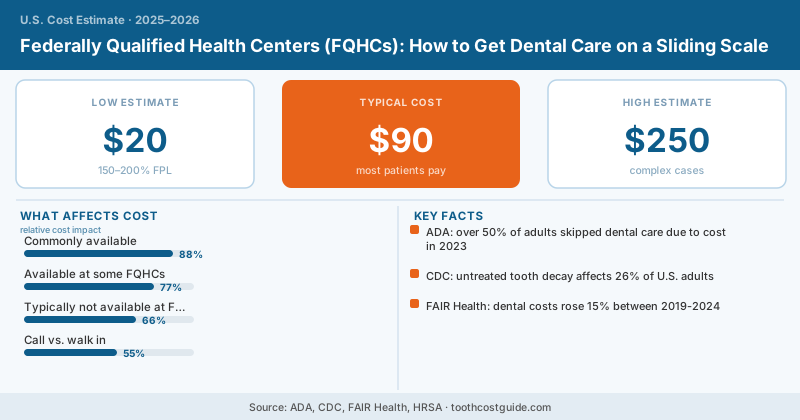
Most people have never heard of Federally Qualified Health Centers. That’s a gap in public knowledge worth fixing — because if you’re uninsured, underinsured, or paying for dental care out of pocket, FQHCs represent some of the most affordable professional dental care available in the U.S., and there are more than 1,400 of them across the country.
A cleaning at an FQHC might cost you $25. A filling, $60. These aren’t charity handouts — they’re federally funded community clinics that charge based on what you can actually afford.
What FQHCs Are
Federally Qualified Health Centers are community-based healthcare organizations that receive federal funding through the Health Center Program, administered by the Health Resources and Services Administration (HRSA). They’re required by law to serve everyone in their community regardless of insurance status or ability to pay.
The “federally qualified” designation is a specific federal certification that comes with:
- Funding from the federal Section 330 grant program
- Enhanced Medicaid and Medicare reimbursement rates
- Requirement to offer a sliding fee discount schedule based on household income
- Requirement to serve all patients regardless of ability to pay
As of 2024, HRSA reported that over 31 million patients receive care at FQHCs annually across more than 14,000 service delivery sites. Dental care is one of the core services many FQHCs provide.
How the Sliding Scale Fee Works
The sliding scale is based on your household income compared to the Federal Poverty Level (FPL). FQHCs are required to offer discounts to patients earning below 200% of the FPL, and to provide services at nominal cost (often $0–$20) to patients below 100% of the FPL.
In practice, the fee schedule looks roughly like this (actual fees vary by center):
| Income Level | Cleaning | Basic Filling | Extraction |
|---|---|---|---|
| Below 100% FPL (full discount) | $0–$25 | $20–$60 | $20–$50 |
| 100–150% FPL | $25–$50 | $40–$100 | $30–$80 |
| 150–200% FPL | $50–$100 | $80–$150 | $60–$120 |
| Above 200% FPL (full fee) | $80–$150 | $100–$250 | $100–$250 |
These are rough ranges — every FQHC sets its own fee schedule. Call and ask directly. Most will tell you exactly what you’d pay based on your income before you even schedule.
Who Qualifies
Everyone. FQHCs serve patients regardless of insurance status. That includes:
- Uninsured patients (pay sliding scale out of pocket)
- Medicaid and CHIP enrollees (billed to Medicaid at the enhanced rate)
- Medicare patients
- Patients with private insurance (billed to insurance; sliding scale may cover copays/deductibles)
- Undocumented immigrants — FQHCs are required to serve all patients regardless of immigration status
You don’t have to prove poverty to walk in. But to qualify for the sliding fee discount, you’ll typically need to document your income (pay stubs, tax return, or a self-declaration form if you have no income documentation).
What Dental Services FQHCs Offer
Services vary by location — not every FQHC has full dental capabilities. Call ahead and ask specifically what dental services they provide. Generally, FQHC dental departments offer:
Commonly available:
- Comprehensive oral exams
- Dental X-rays
- Professional cleanings (prophylaxis and periodontal scaling)
- Composite and amalgam fillings
- Simple extractions
- Emergency dental care (pain, infection, swelling)
Available at some FQHCs:
- Root canals (anterior and sometimes posterior)
- Crowns (usually metal or porcelain-fused-to-metal)
- Partial and complete dentures
- Pediatric dental care
- Oral surgery referrals
Typically not available at FQHCs:
- Cosmetic dentistry (veneers, teeth whitening, Invisalign)
- Dental implants
- Orthodontics (some FQHCs have limited ortho programs for children)
Some FQHCs only offer basic dental or emergency dental. If you need more complex care, ask the FQHC staff for a referral — they often have relationships with local dental schools and community resources. Also check findahealthcenter.hrsa.gov to see if there’s another FQHC in your area with fuller dental services.
How to Find Your Nearest FQHC
The official HRSA finder tool is at findahealthcenter.hrsa.gov. Enter your zip code or address. The map shows all nearby health centers with contact information.
Call before visiting to confirm:
- Do they have a dental department?
- Are they accepting new dental patients?
- What’s the current wait time for a new patient appointment?
- What income documentation do you need to bring for the sliding scale?
Wait times at FQHCs are the most common complaint — popular urban centers can have 4–8 week waits for routine dental appointments. If you have a dental emergency (pain, swelling, possible abscess), call and explain that — most FQHCs have same-day or next-day emergency slots.
Getting an Appointment: Practical Tips
Call vs. walk in: Most FQHCs prefer phone appointments. Walk-ins are sometimes accepted for urgent dental issues, but calling ahead dramatically improves your experience.
Bring income documentation: Even if you’re bringing it to potentially qualify for the sliding scale, it speeds up registration. A recent pay stub, W-2, or tax return works. If you have no income, many FQHCs have a self-declaration form.
Ask about payment plans: FQHCs can’t always bill for complex procedures at the sliding scale rate (insurance billing rules are complicated), but many will work out a payment arrangement for larger procedures.
Dental schools as backup: If your nearest FQHC has a long wait and you’re not in acute pain, dental school clinics are an excellent alternative. Both serve patients at reduced rates with the primary difference being that dental school work is performed by supervised students (slower appointments, same supervision) while FQHCs use licensed dental professionals.
FQHC dental departments often have limited hours and appointment slots compared to private practices. Don’t wait for a dental problem to become an emergency before looking up your nearest FQHC — identify it in advance so you know exactly where to go and what to bring when you need it.
FQHC vs. Other Low-Cost Options
| Option | Who It’s For | Approximate Savings |
|---|---|---|
| FQHC | Uninsured / low income | 50–90% off private practice rates |
| Dental school | Anyone who can wait | 30–50% off private practice |
| Dental discount plan | Those who earn too much for FQHC but want ongoing savings | 20–50% off at member dentists |
| State Medicaid | Income-eligible (varies by state) | Near-zero cost for covered services |
If you’re eligible for Medicaid, enrolling is always worth doing — it covers dental at state Medicaid rates, which at an FQHC are even lower than the standard sliding fee. Many FQHC patients qualify for Medicaid without knowing it; the FQHC staff can often help with enrollment.
The bottom line: 1,400+ FQHCs exist precisely for situations where you need professional dental care and can’t afford private practice prices. Use them.
Frequently Asked Questions
A professional dental cleaning at a Federally Qualified Health Center typically costs $20–$50, depending on your income level and the specific center's sliding scale fee schedule. Most FQHCs charge based on your household income, so uninsured or low-income patients often pay at the lower end of this range.
Yes, most dental insurance plans cover FQHC services since they are fully licensed dental providers. However, if you're uninsured or have a high deductible, FQHCs are specifically designed to serve you—they offer sliding scale fees regardless of insurance status, meaning you'll pay based on your income rather than your policy limitations.
A typical filling appointment at an FQHC takes 30–60 minutes from start to finish, including numbing, decay removal, and filling placement. You can resume normal eating and drinking once the anesthetic wears off (usually 2–3 hours), and there is no recovery time needed—you can return to work or daily activities immediately after.