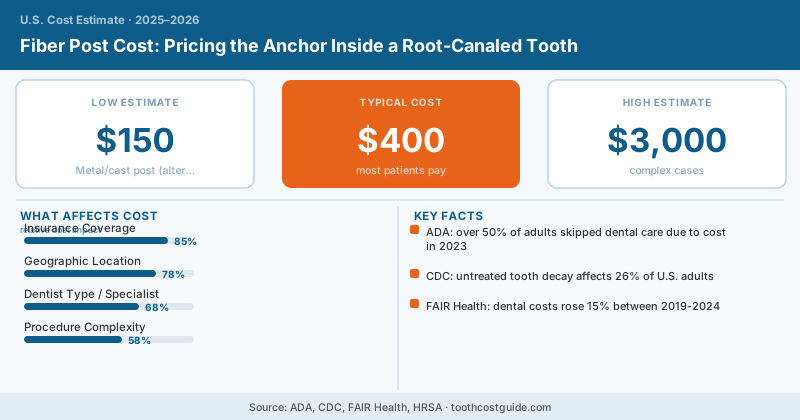
After a root canal, the tooth is hollow. The nerve and pulp are gone, the inside is cleaned out, and what’s left is a shell that’s surprisingly easy to crack. A fiber post is the small reinforcing pin your dentist cements into the root canal to anchor a rebuild before the crown goes on. It costs less than you’d think — but skipping it on the wrong tooth can be costly. Here’s the breakdown.
Fiber Post Costs at a Glance
| Item | Typical Cost |
|---|---|
| Fiber post alone | $150–$500 |
| Fiber post + core buildup (common combo) | $300–$800 |
| Metal/cast post (alternative) | $200–$600 |
| Post + core + crown (full restoration) | $1,300–$3,000 |
The post is rarely billed by itself. It’s almost always paired with a core buildup — the filling material packed around it to rebuild the tooth’s shape so a crown can seat on top. Together they typically run $300–$800.
What a Fiber Post Actually Does
A root-canaled tooth that’s lost a lot of structure can’t reliably hold a crown on its own — there isn’t enough tooth left to grip. A fiber post fixes that:
- It’s cemented down into the cleaned-out root canal for retention
- A core buildup is then bonded around it to rebuild the tooth’s missing bulk
- The crown seats over the rebuilt core, restoring full chewing function
Fiber posts are made of glass or carbon fiber in resin. They’re tooth-colored, flexible, and bond to the tooth — which is why many dentists prefer them over older metal posts for front teeth and many back teeth.
Fiber posts flex a little like natural dentin, so if the tooth is overstressed, the post tends to loosen rather than splitting the root — a failure that’s repairable. Rigid metal/cast posts are stronger but can transfer force into the root and cause a vertical fracture, which often means losing the tooth. For most root-canaled teeth today, dentists lean toward fiber posts for that safer failure mode. Metal posts still have a place in severely damaged teeth. Ask which your tooth needs and why.
When You Need a Post — and When You Don’t
You don’t always need a post. The rule of thumb: the more natural tooth structure remains after the root canal, the less likely a post is needed. A molar with thick walls and only a small access hole may hold a crown with just a buildup and no post at all.
A post becomes necessary when:
- The tooth has little crown structure left above the gumline
- A front tooth needs extra retention for its crown
- The core filling needs something to anchor to
If your estimate lists a post on a tooth that’s still mostly intact, it’s fair to ask whether it’s truly needed — some teeth do fine without one.
Where the Post Fits in Your Total Bill
A fiber post is a small piece of a larger restoration. The full sequence after deep decay or a cracked tooth often looks like this:
- Root canal to remove the infected nerve — $700–$1,500 on a molar
- Fiber post + core buildup to rebuild the tooth — $300–$800
- Crown to cap and protect it — $800–$2,500
That’s a $1,800–$4,800 project all in. It sounds like a lot, but saving the natural tooth is usually cheaper than extracting it and replacing it with an implant or bridge.
How to Pay Less
Most dental PPO plans cover posts and core buildups at 50% of the allowable fee as a major service. A free predetermination shows your exact share — see how dental insurance works. Dental school clinics handle post-and-core work under supervision at 40–60% below private fees. Uninsured patients can use a dental savings plan or finance the larger restoration through CareCredit.
A post is sometimes billed when the tooth doesn’t truly need one. If your tooth still has substantial structure above the gumline, ask your dentist whether the post is essential or precautionary. Always request a written, itemized treatment plan listing the post, core buildup, and crown as separate codes, and submit it for predetermination.
Bottom Line
A fiber post costs $150–$500 on its own, or $300–$800 bundled with the core buildup it almost always comes with. It anchors a rebuild inside a root-canaled tooth so a crown can hold. Not every tooth needs one — the more structure that’s left, the less likely it is — so ask whether yours truly requires it. As part of the full root-canal-to-crown restoration, it’s a small line item that helps you keep a natural tooth instead of paying far more to replace it.
Frequently Asked Questions
A fiber post typically costs $150–$500, depending on tooth location, complexity, and your dentist's fees. This cost is usually bundled with a core buildup (the filling material that rebuilds the tooth structure above the post), so you may see them billed together on your invoice.
Many dental insurance plans cover fiber posts as part of post-endodontic restoration, typically at 50% coinsurance after you meet your deductible. However, some plans classify it as a cosmetic or elective service and exclude it entirely, so you should contact your insurer before treatment to confirm your out-of-pocket responsibility.
A fiber post is necessary when a root-canaled tooth has lost significant structure and needs reinforcement before a crown, but it's not required for every root canal. If your tooth still has enough natural tooth structure remaining, your dentist may skip the post and place only a core buildup, saving you $150–$300.