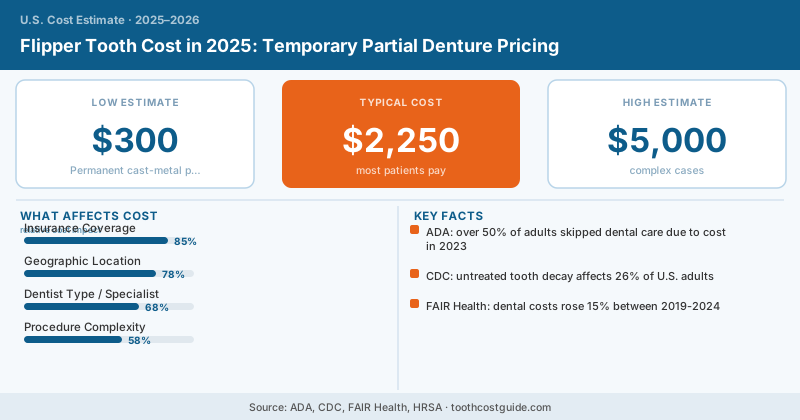
In 2010, patients who lost a tooth and couldn’t afford an implant had few options: a removable partial denture costing $1,200–$2,000, or walking around with a gap. Today, a flipper tooth fills that same space for $300–$500 — fabricated in about a week, covered at 50% by most dental insurance plans. It’s not a permanent fix. But it’s a practical one.
Here’s what a flipper costs, when it makes sense, and what to plan for next.
Flipper Tooth Costs at a Glance
| Option | Estimated Cost (No Insurance) |
|---|---|
| Flipper tooth — 1 tooth | $300–$500 |
| Flipper tooth — 2 to 3 teeth | $500–$900 |
| Permanent cast-metal partial denture | $1,500–$3,000 |
| Single dental implant | $3,000–$5,000 |
| Fixed 3-unit bridge | $2,700–$4,500 |
Prices vary based on how many teeth the flipper replaces, your location, and the dental lab your dentist uses. Urban practices in high cost-of-living cities tend to run toward the top of these ranges.
What a Flipper Tooth Actually Is
A flipper is a removable acrylic partial denture — gum-colored base, one or more prosthetic teeth, and small wire clasps that clip onto adjacent teeth for support. You pop it in, it fills the gap. You take it out at night to clean it and let your gum tissue breathe.
The name fits: you can flip it in and out with your tongue, much like a retainer. That convenience is also its limitation. It doesn’t stay rigid under real chewing forces the way a permanent restoration does. It flexes. Bite into something hard, and you risk cracking the acrylic.
Turnaround is fast — most dentists deliver a flipper in 1–2 weeks because it’s fabricated at an outside lab from a simple impression. Compare that to an implant, which requires months of healing after the extraction before placement can even begin.
When a Flipper Makes Sense
The ADA’s guidance on removable partial dentures recognizes temporary appliances as an appropriate transitional option — particularly when a patient’s extraction site needs time to heal before a permanent restoration can be placed.
In practical terms, a flipper works well when:
- Your extraction site needs 3–6 months to heal before implant placement
- You’re waiting 2–3 weeks for a permanent bridge to come back from the lab
- Budget is the primary constraint and a permanent option isn’t currently feasible
- You’re a teenager whose jaw bone hasn’t finished developing (implants require skeletal maturity, typically around 18–20)
CDC survey data shows that roughly 120 million Americans are missing at least one tooth — and the gap between wanting a permanent solution and being able to afford one is exactly where flippers fit. They’re a legitimate clinical tool, not just a compromise.
What Insurance Covers
Most dental insurance plans classify a flipper as a “partial denture” under major restorative — typically covered at 50% after your deductible. If your plan has a $1,500 annual maximum and you haven’t used much of your benefit, you might pay as little as $50–$150 out of pocket.
A few things to know:
- Waiting periods: New dental insurance enrollees often face a 12-month waiting period before major restorative coverage kicks in
- Frequency limits: Many plans won’t replace a covered partial denture for 5–7 years — so if you lose or break your flipper, you may owe the full cost again
- Insurance codes: Flippers are billed as D5820 (maxillary arch) or D5821 (mandibular arch) — interim partial denture codes. Make sure your dentist uses these, not the permanent partial denture codes, which can affect benefit calculation
Request a predetermination before having the flipper made — it’s a written estimate from your insurer, takes 1–2 weeks, and eliminates billing surprises.
Before leaving with a flipper, ask your dentist: “Is this temporary, and what’s the timeline for a permanent replacement?” Some patients end up wearing a flipper for years when the original plan was six months. A clear follow-up plan — implant, bridge, or permanent partial — is worth establishing from the start.
How Long Does a Flipper Last?
With proper care, 1–5 years — though most are intended for far shorter use. The acrylic base can crack if dropped or stressed. Clasps loosen over time. As gum tissue changes post-extraction, the fit shifts and adjustments ($50–$150 each) become necessary.
The ADA notes that tooth loss leads to bone resorption at the extraction site over time — a process a flipper doesn’t stop. It sits on top of the gum tissue; it doesn’t integrate with bone the way an implant does. That’s the core reason flippers are designed as temporary: the longer the gap goes without a permanent restoration, the more bone volume is lost, which can complicate future implant placement.
Nightly removal is non-negotiable. Wearing a flipper overnight restricts blood flow to the gum tissue, accelerating bone loss beneath the appliance. Take it out, soak it in denture cleanser, store it in water to prevent warping.
What to Avoid
Don’t eat hard, crunchy, or sticky foods while wearing a flipper. Bagels, hard candy, raw carrots, caramel — any of these can snap the acrylic base. The prosthetic teeth are cosmetic; they’re not built for structural chewing. Remove it before eating if you’re unsure.
A flipper is not a permanent solution. Using it for years without pursuing permanent tooth replacement risks progressive bone loss at the extraction site, which can ultimately complicate — and increase the cost of — future implant placement. Build a timeline for what comes next before that window narrows.
How to Get the Best Price
Dental school clinics typically fabricate flippers for $150–$250 — roughly half of private practice rates. The process takes more appointments and longer scheduling windows, but the work is faculty-supervised and the savings are real. Search “[your city] dental school clinic partial denture” to find nearby programs.
If you’re staying with a private practice, ask whether fabrication is done in-house or sent to an outside lab. In-house can mean faster turnaround and sometimes a lower fee.
Bottom Line
A flipper tooth costs $300–$500 and takes about a week to deliver. It’s the fastest, most affordable way to fill a visible gap post-extraction — and most insurance plans cover it at 50% under major restorative. Treat it as a placeholder, know its limits, and have a clear plan for the permanent restoration that comes next.
Frequently Asked Questions
A flipper tooth typically costs $300–$500 out of pocket, making it one of the most affordable tooth replacement options available. Most dental insurance plans cover about 50% of the cost, reducing your immediate expense to $150–$250 in many cases.
Yes, most dental insurance plans cover flipper teeth at 50%, though some plans may classify them as major restorative work with a deductible. You should verify your specific plan's coverage before scheduling, as a few plans exclude temporary partial dentures or have waiting periods for new coverage.
A flipper tooth can be fabricated and fitted in about one week, making it the fastest solution for filling a gap while you heal from an extraction or save for a permanent option like an implant. This quick turnaround is one of the main advantages over traditional partial dentures, which typically take 2–3 weeks.