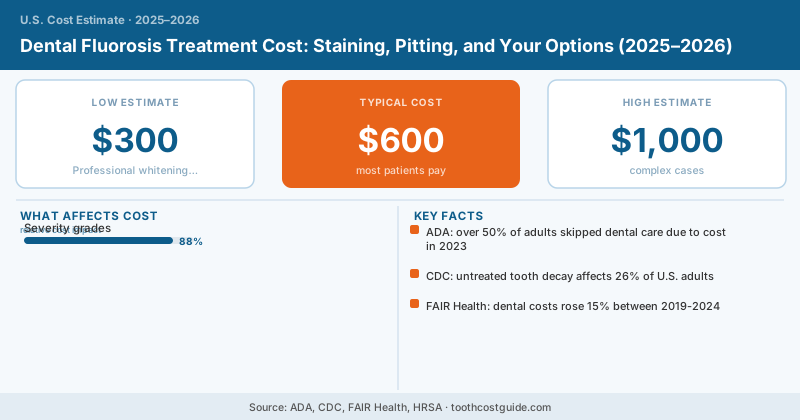
What does a dental fluorosis treatment actually cost? That depends almost entirely on how severe your fluorosis is — and the range runs from $150 for a simple whitening session to $3,500 per tooth for porcelain veneers. The right treatment for you depends on whether you’re dealing with faint white streaks or deep brown staining with surface pitting.
Fluorosis affects an estimated 20–30% of American adolescents in some form, according to the CDC — most cases are so mild they’re barely visible. But for the 2–3% with moderate to severe fluorosis, the cosmetic impact is significant enough to seek treatment as adults.
Understanding Dental Fluorosis
Fluorosis occurs when children consume too much fluoride during the years their permanent teeth are developing (typically ages 0–8). It doesn’t affect tooth health — fluorosed teeth aren’t weaker or more cavity-prone (they may actually be slightly more resistant to decay) — but the cosmetic appearance bothers many people.
Severity grades:
- Questionable/Very Mild: Faint white flecks or spots. Affects most of the tooth surface minimally.
- Mild: White opaque areas covering less than 25% of the tooth surface.
- Moderate: White opaque areas covering 25–50% of the tooth. Surface remains intact.
- Severe: All enamel surfaces affected, with brown staining, pitting, and enamel breakdown. Teeth may look “corroded.”
Fluorosis Treatment Options and Costs
| Treatment | Severity | Low | Typical | High |
|---|---|---|---|---|
| Professional whitening (in-office) | Mild | $300 | $600 | $1,000 |
| Enamel microabrasion | Mild–Moderate | $150 | $300 | $600 |
| Microabrasion + whitening | Mild–Moderate | $450 | $800 | $1,400 |
| Dental bonding (per tooth) | Moderate | $300 | $450 | $800 |
| Porcelain veneer (per tooth) | Moderate–Severe | $1,000 | $1,800 | $3,500 |
| Composite veneer (per tooth) | Moderate–Severe | $400 | $700 | $1,200 |
| Dental crown (per tooth, severe) | Severe | $1,000 | $1,500 | $2,500 |
Option 1: Professional Teeth Whitening ($300–$1,000)
For very mild to mild fluorosis — the kind with faint white spots — professional whitening is often the first thing people try. The results are mixed. Whitening works by bleaching the yellow/brown pigment in the surrounding enamel, which can make the overall tooth color more uniform and less noticeably spotted.
However, for true white-spot fluorosis, whitening can make white lesions more visible against a now-whiter tooth. In these cases, your dentist may recommend microabrasion first or instead.
In-office whitening (Zoom, GLO, KöR) runs $300–$1,000 and delivers results in a single visit. Take-home trays from your dentist cost $200–$400 and take 2–4 weeks.
Option 2: Enamel Microabrasion ($150–$600)
Microabrasion is a non-invasive procedure where your dentist applies a mildly abrasive acidic compound to the tooth surface to mechanically remove superficial fluorosis stains. It removes a tiny amount of enamel — typically 0.1–0.3 mm — along with the discoloration.
It’s most effective for fluorosis confined to the outer enamel layers. Mild and some moderate cases respond well. Cost runs $150–$300 per tooth for microabrasion alone, though dentists often treat multiple teeth in one session.
Microabrasion is frequently combined with whitening afterward for best results — together, $450–$1,400 for a full smile zone treatment.
A newer technique called resin infiltration (Icon, by DMG) can mask white-spot fluorosis without removing enamel. A low-viscosity resin is infiltrated into the porous lesion, changing how it reflects light. Results can be dramatic for mild-to-moderate cases. Cost runs $200–$400 per tooth and isn’t covered by insurance, but it’s one of the most conservative options available.
Option 3: Composite Bonding ($300–$800 Per Tooth)
For moderate fluorosis with visible brown staining or surface irregularity, dental bonding applies tooth-colored composite resin over the affected surface. Your dentist etches the enamel, applies bonding agent, and sculpts the composite to cover the discoloration.
It’s quicker and less expensive than veneers and requires minimal tooth reduction. Bonding lasts 5–10 years on average before it needs refinishing or replacement — and it can chip or stain over time with coffee, red wine, and tobacco.
Cost: $300–$800 per tooth. For a 6–8 tooth smile zone, total bonding treatment runs $2,000–$5,000+.
Option 4: Porcelain Veneers ($1,000–$3,500 Per Tooth)
Veneers are the gold standard for moderate to severe fluorosis. A thin porcelain shell covers the front surface of the tooth, completely masking underlying discoloration and surface irregularity. Results are durable (10–20 years with proper care) and highly aesthetic.
The trade-off: veneers require removing 0.3–0.5 mm of enamel from the front surface — an irreversible procedure. Once you’ve had veneers, you’ll always need veneers (or crowns) on those teeth.
Cost per tooth: $1,000–$3,500. A full 8-tooth veneer case runs $8,000–$25,000 — a significant investment, but one that lasts.
Composite veneers ($400–$1,200 per tooth) cost significantly less, but their lifespan is shorter (5–7 years) and they’re more susceptible to staining and chipping.
Option 5: Dental Crowns (Severe Cases)
Severe fluorosis with extensive enamel breakdown and structural compromise may require crowns rather than veneers. A crown encases the entire tooth, restoring both appearance and strength. Cost: $1,000–$2,500 per tooth.
This is typically reserved for the most severe cases — where the enamel is pitted, cracked, or structurally compromised — rather than purely cosmetic fluorosis.
Does Insurance Cover Fluorosis Treatment?
Almost never. Dental insurance classifies fluorosis treatment as cosmetic, which means standard plans don’t cover whitening, bonding, microabrasion, or veneers for cosmetic reasons. If crowns are needed due to structural breakdown, some insurers may cover 50% of the crown cost — but they’ll often apply a “cosmetic exclusion” if the crown isn’t medically necessary.
The CDC’s 2019–2020 NHANES survey confirmed that fluorosis affects roughly 30% of U.S. adolescents — predominantly the mildest categories. For those with moderate to severe fluorosis, the cost of cosmetic correction falls almost entirely on the patient.
Before committing to veneers or bonding for fluorosis, get at least two opinions. Treatment aggressiveness should match severity — don’t let a cosmetic-focused provider recommend veneers for mild fluorosis that microabrasion would resolve just as well for a fraction of the price.
Financing Fluorosis Treatment
Since insurance doesn’t cover cosmetic procedures, financing options matter:
- CareCredit / Sunbit: Dental financing with promotional 0% interest periods (12–24 months for qualified applicants)
- In-office payment plans: Many cosmetic dentists offer internal installment plans
- HSA funds: You can use HSA dollars for dental work, though “cosmetic” procedures occupy a gray area — check with your HSA administrator
Choosing the Right Treatment
Work with a dentist experienced in cosmetic dental treatment. A simple fluorosis case may be completely resolved with microabrasion and whitening for $600 total. A severe case may genuinely need veneers or crowns. The key is getting an honest assessment from someone who will recommend the least invasive option that achieves your goals — not automatically push toward the highest-margin procedure.
Bottom Line
Fluorosis treatment costs $150–$3,500 per tooth depending on severity and method. Mild cases often respond beautifully to microabrasion, resin infiltration, or whitening — conservative options costing a few hundred dollars per session. Moderate to severe cases typically require bonding or veneers, with full smile treatment running $4,000–$25,000. Insurance almost never covers it. Go conservative first, and only escalate to more invasive approaches if simpler methods don’t achieve your goals.
Frequently Asked Questions
Dental fluorosis treatment ranges from $150 to $3,500 per tooth depending on severity and treatment type. Minor cases with faint white streaks typically cost $150–$500 for professional whitening or microabrasion, while moderate-to-severe cases with deep staining and pitting may require bonding ($300–$1,000 per tooth) or porcelain veneers ($1,500–$3,500 per tooth).
Most dental insurance plans classify fluorosis treatment as cosmetic and do not cover it, leaving patients responsible for 100% of costs out-of-pocket. However, some plans may partially cover microabrasion or bonding if the fluorosis significantly affects tooth structure rather than appearance alone—contact your insurer to review your specific policy.
Professional tooth whitening is the quickest and most affordable option for mild fluorosis with faint white streaks, costing $150–$300 and taking just one or two office visits. If whitening doesn't provide satisfactory results, microabrasion can be performed in the same visit for an additional $200–$400 per tooth to gently remove surface discoloration.