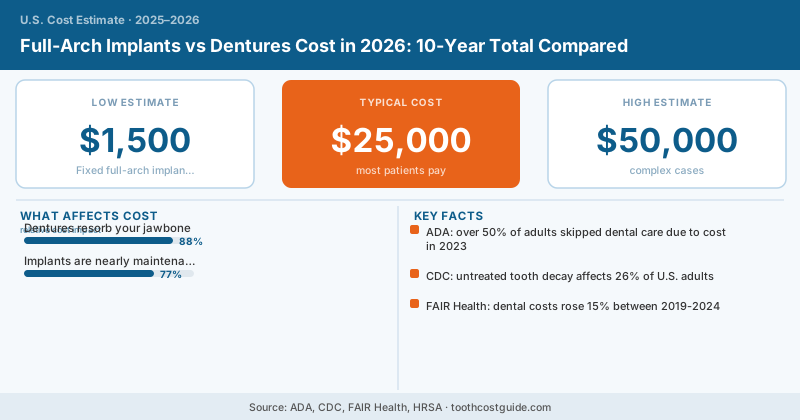
In 1990, a full set of dentures was the default fix for losing all your teeth, and implants were rare and astronomically priced. Today the choice is real: a fixed full arch on implants runs $20,000–$30,000, while conventional dentures cost $1,500–$4,000. That’s a huge gap — but it shrinks once you stretch the math across ten years.
Let’s compare both honestly, including the costs nobody mentions at the consultation.
Upfront Pricing
| Option | Upfront Cost (per arch) |
|---|---|
| Conventional full dentures | $1,500–$4,000 |
| Implant-supported overdenture (snap-on, 2–4 implants) | $6,000–$15,000 |
| Fixed full-arch implants (4–6 implants, non-removable) | $20,000–$30,000 |
| Premium fixed full arch (zirconia bridge) | $30,000–$50,000 |
On day one, dentures win by a landslide. But day one isn’t the whole story.
The 10-Year Total Cost
Dentures are cheap to buy and expensive to maintain. Here’s why the gap narrows:
Dentures resorb your jawbone. Without tooth roots, the jaw shrinks — a well-documented process. That means dentures need relining every 1 to 2 years ($300–$600 each) and full replacement every 5 to 8 years ($1,500–$4,000). Over a decade, that adds up.
Implants are nearly maintenance-flat. A well-placed fixed arch needs cleanings and occasional component swaps, but the implants themselves have survival rates above 95% at 10 years in long-term studies. No relines, no bone shrinkage at the implant sites.
Over 10 years, conventional dentures can total $4,000–$10,000 once you add relines and a replacement set, while fixed implants stay closer to their original $20,000–$30,000 plus modest maintenance. Implants still cost more long-term — but the gap is smaller than the sticker prices suggest, and the function is in a different league.
The Middle Path: Implant Overdentures
There’s a smart compromise a lot of people don’t know about. An implant overdenture snaps onto two to four implants — far more stable than a conventional denture, far cheaper than a fixed full arch at $6,000–$15,000. It stops the worst of the jaw shrinkage, doesn’t slip when you eat, and you remove it to clean. For many patients on a budget, this is the sweet spot.
Function and Quality of Life
This isn’t just dollars. Conventional dentures cover the roof of your mouth, can slip, and reduce bite force significantly — many wearers avoid certain foods entirely. Fixed implants feel close to natural teeth, preserve taste (no palate coverage), and let you eat almost anything.
The American College of Prosthodontists has long noted that edentulous (toothless) patients report substantially higher satisfaction with implant-supported options than with conventional dentures. That matters, even if it’s hard to price.
“Free implant arch in a day” ads usually quote the temporary, not the final restoration, and may exclude extractions, sedation, or the final zirconia bridge. Get an itemized quote covering extractions, implants, the temporary, and the permanent prosthesis before comparing it to a denture price. The real number is often higher than the ad.
Who Should Choose What
- Tight budget, need teeth now: Conventional dentures, eyes open about relines and replacements.
- Want stability without the full price: Implant overdenture — the value pick.
- Want the closest thing to real teeth and can finance it: Fixed full arch.
- Severe bone loss: May need bone grafting or zygomatic implants first, which changes the math.
Paying for It
Implant arches are rarely covered by insurance beyond a token $1,000–$1,500 cap. Most patients finance through CareCredit for dental or in-house plans. Dentures are sometimes partially covered, so check how dental insurance works for your plan’s prosthetic benefit.
Bottom Line
Full-arch implants cost $20,000–$30,000 versus $1,500–$4,000 for conventional dentures — but over 10 years, denture relines and replacements close part of that gap, and implants protect your jawbone and function far better. If the fixed price is out of reach, an implant overdenture splits the difference. Match the choice to your budget and how much daily function is worth to you.
Frequently Asked Questions
Full-arch implants typically cost $20,000–$30,000 upfront, while conventional dentures range from $1,500–$4,000. Over 10 years, the cost gap narrows significantly because dentures require ongoing adjustments, relines, and replacements, whereas implants are a one-time investment with minimal maintenance.
Most dental insurance plans cover 50% of dentures (after deductibles), capping out around $1,000–$1,500 per plan year, but rarely cover implants since they're considered cosmetic or elective. You should verify your specific plan, as coverage varies widely and many implant patients pay the full $20,000–$30,000 out-of-pocket.
Dentures are typically ready in 2–4 weeks after tooth extraction and impressions are taken. Full-arch implants require 4–12 months total because the jawbone must integrate with the implant posts before the final bridge is attached, though you can wear temporary dentures during this healing period.