You went in for a cleaning. The hygienist looked in your mouth, disappeared to get the dentist, and you were told you need a “full mouth debridement” before they can even properly examine you. And it costs extra.
That scenario frustrates a lot of patients. Here’s what’s actually happening — and what it costs.
| Service | Typical Cost |
|---|---|
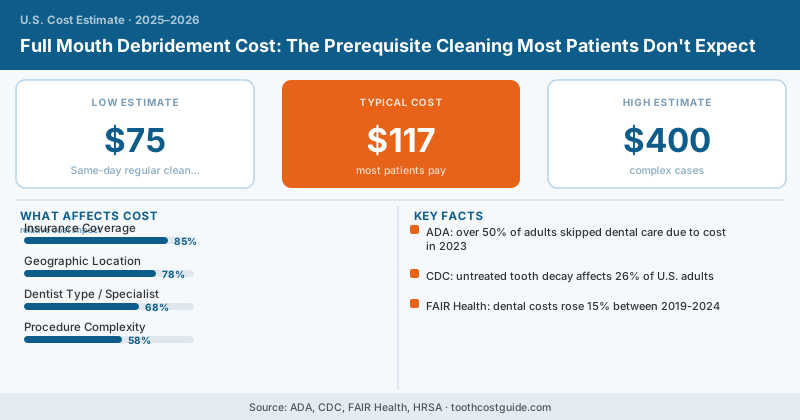
| Full mouth debridement (D4355) | $100–$200 |
| With nitrous oxide sedation | Add $75–$150 |
| Same-day regular cleaning (if debridement is light) | $85–$150 additional |
| Follow-up regular cleaning (next visit, after healing) | $85–$150 |
| Follow-up SRP if gum disease is diagnosed | $200–$400 per quadrant |
Why This Procedure Exists
When calculus (hardened tartar) has built up to the point where the dentist can’t accurately probe your gum pockets or take diagnostic X-rays, they can’t safely diagnose what’s going on. Probing through thick calculus gives inaccurate pocket depth readings. It’s like trying to measure the depth of a lake through ice.
Full mouth debridement removes enough gross buildup to allow a proper examination. It’s not a substitute for a thorough cleaning — it’s a prerequisite step. After the debridement, the hygienist or dentist can accurately assess your gums, measure pocket depths, and determine what treatment you actually need next.
The ADA procedure code is D4355. It’s distinct from both a prophylaxis (D1110 — regular cleaning) and scaling and root planing (D4341 — deep cleaning). It exists as its own category because it’s neither: it’s clearing the decks so that real diagnosis can begin.
Who Typically Needs It
- Patients who haven’t seen a dentist in 3+ years
- Adults who’ve avoided dental care due to anxiety or cost
- New patients with visibly heavy calculus deposits at the initial exam
- Anyone whose gum health can’t be accurately evaluated without removing gross buildup first
If you’ve had regular cleanings every six months, you’ll almost never hear this recommendation. It’s specifically for mouths where long-term buildup has accumulated.
What the Procedure Feels Like
It’s a deep cleaning under local anesthesia or, for sensitive patients, with nitrous oxide. The hygienist uses an ultrasonic scaler to break up and remove the heaviest deposits. It’s loud and somewhat uncomfortable, but not painful if you’re properly numbed.
Duration: 60–90 minutes for the full mouth, usually in a single visit.
Some practices do it in one long appointment. Others split it into two visits (upper and lower arch). Either approach is clinically acceptable.
Most patients who need a full mouth debridement leave that first appointment without a final treatment plan. That’s intentional — the dentist genuinely can’t see what’s going on until the buildup is cleared and your gums have had 4–6 weeks to heal and rebound. The real diagnosis happens at the follow-up visit. Don’t be alarmed if no plan is given that day.
Does Insurance Cover It?
Most dental PPO plans cover full mouth debridement, usually at the same percentage as basic services (often 70–80% after deductible). The ADA code D4355 is well-established and recognized by insurers.
However, plans that haven’t seen you as a patient before will sometimes require the claim to include documentation that debridement was truly necessary — typically a note that standard probing or radiographs couldn’t be completed accurately. Your dentist’s office handles this; just make sure they’re submitting the clinical notes.
A 2022 report from the CDC found that among U.S. adults aged 65 and older, 68% had periodontitis — and many hadn’t had dental care in years. Full mouth debridement is often the entry point back into regular dental care for this demographic.
What Comes After?
After the debridement, expect one of two paths:
Path 1 — Healthy gums: You come back in 4–6 weeks, the hygienist re-examines everything, pocket depths are normal, and you schedule regular 6-month prophylaxis cleanings going forward.
Path 2 — Gum disease diagnosed: Pocket depths of 5mm or more with bone loss and bleeding on probing indicate periodontitis. The dentist recommends scaling and root planing ($200–$400 per quadrant), followed by periodontal maintenance every 3–4 months.
The debridement cost is almost always a small fraction of whatever comes next. Think of it as the diagnostic entry fee.
Avoiding the Surprise Bill
Call ahead. When scheduling a new-patient appointment after a long gap in care, ask the receptionist whether debridement might be needed. They’ll note it in your file. Some offices will pre-authorize D4355 with your insurer before the visit so you know your out-of-pocket upfront.
If the cost is a barrier, dental school clinics perform full mouth debridement for $40–$80 in most markets — supervised by faculty who are often licensed periodontists.
Frequently Asked Questions
Full mouth debridement typically costs $100–$200 without sedation. If you opt for nitrous oxide sedation to stay comfortable during the procedure, add an additional $75–$150 to your total bill.
Most dental insurance plans classify full mouth debridement (procedure code D4355) as a preventive or periodontal service and cover 50–80% of the cost after your deductible. However, many plans exclude it if you've had a regular cleaning within the past 12 months, leaving you responsible for the full $100–$200 out-of-pocket.
A full mouth debridement appointment typically takes 30–45 minutes to remove heavy tartar and plaque buildup. Your dentist can often perform a regular cleaning on the same day after the debridement is complete, though some offices schedule it as a follow-up visit within 1–2 weeks.