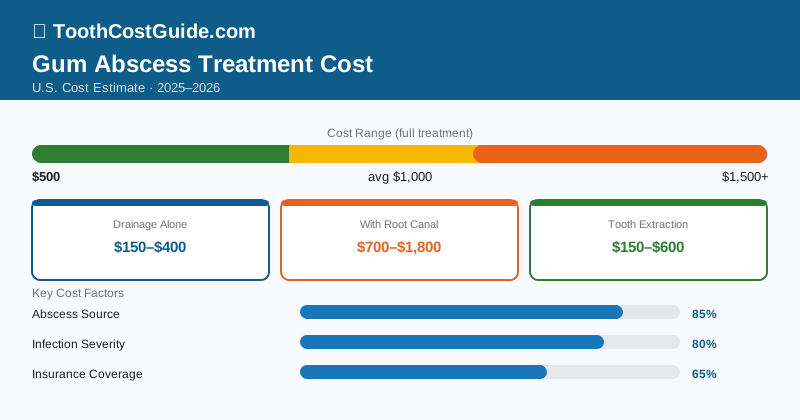
That painful swelling on your gum isn’t just a nuisance. It’s a periodontal abscess — a bacterial infection in the soft tissue and bone structures that support your tooth — and it won’t resolve on its own. Treatment costs $500–$1,500 for most cases. The acute part (draining the abscess and prescribing antibiotics) runs $150–$400. The part that actually prevents it from coming back — scaling and root planing, the deep cleaning that treats the underlying gum disease — costs $200–$400 per quadrant, or $800–$1,600 for the full mouth.
Skipping the deep cleaning almost guarantees you’ll be back with another abscess.
| Treatment Component | Cost (No Insurance) |
|---|---|
| Emergency exam + X-rays | $100–$250 |
| Abscess drainage (incision and drainage) | $150–$400 |
| Antibiotics (amoxicillin 10 days) | $10–$60 |
| Scaling and root planing (per quadrant) | $200–$400 |
| Full-mouth deep cleaning (4 quadrants) | $800–$1,600 |
| Periodontal maintenance visit | $100–$200 |
| Tooth extraction (if non-salvageable) | $150–$600 |
| Guided tissue regeneration (if bone loss) | $1,000–$3,000 |
What’s Really Happening — and Why the Cost Varies
Not all gum abscesses are the same. A gingival abscess is superficial — trapped food debris or a foreign object lodged under the gum tissue creates a localized infection that usually drains and clears with minimal treatment ($150–$400 total). A periodontal abscess involves the deeper bone-supporting structures and is typically a sign of active periodontitis. This requires more extensive treatment ($500–$1,500) and, importantly, long-term periodontal management to prevent recurrence.
The gum disease underneath is the real driver of cost. Periodontal abscesses don’t form in healthy gums. They happen because existing periodontitis has created deep pockets — spaces between the tooth and gum where bacteria accumulate, calculus builds up, and bone slowly erodes. The acute abscess is an acute event on top of a chronic disease. Treating the acute event without addressing the chronic disease is like draining a flood without fixing the broken pipe.
Whether the tooth can be saved matters. Some periodontal abscesses occur on teeth where bone loss is so advanced that extraction makes more clinical sense than trying to save the tooth. If extraction is the decision, the abscess resolves — but you’re now looking at tooth replacement costs. An implant runs $3,500–$6,000 all-in. That changes the financial picture significantly.
Specialist involvement adds cost. Complex periodontal cases are often referred to a periodontist, whose fees run 20–30% higher than a general dentist for comparable procedures. For aggressive or advanced periodontitis, that specialist knowledge is worth it — periodontists have training and tools (including surgical access techniques) that general dentists don’t.
Bone loss and regeneration. If the abscess has caused significant bone destruction, guided tissue regeneration (GTR) or bone grafting may be recommended to rebuild the support structure. These run $1,000–$3,000 per site and are classified as major periodontal surgery by most insurance plans.
Q&A: What Each Treatment Does
Q: What does draining the abscess actually involve? The dentist numbs the area with local anesthetic, makes a small incision in the swollen gum tissue, evacuates the pus, and irrigates with saline or chlorhexidine to flush the pocket. It’s fast — often done at the same appointment as your emergency exam. Relief is usually immediate. Cost: $150–$400.
Q: Why do I also need antibiotics? Antibiotics (amoxicillin or clindamycin for 7–10 days, $10–$60 with GoodRx) control the systemic spread of infection, especially if you have fever or swelling extending beyond the immediate tooth area. They don’t cure the underlying gum disease — that requires the physical removal of calculus from root surfaces. Think of antibiotics as managing the fire, not eliminating the fuel.
Q: What is scaling and root planing, really? It’s a deep cleaning performed below the gumline under local anesthesia. Using ultrasonic instruments and hand scalers, the dentist or hygienist removes calculus (hardened tartar) from root surfaces deep in the periodontal pocket, then smooths the root to discourage future bacterial adhesion. Done by quadrant over one or more appointments. This is the cornerstone treatment for periodontitis — without it, the abscess is almost certain to recur. Cost: $200–$400 per quadrant.
Q: What if the pockets are too deep for non-surgical treatment? Severe cases with deep pockets (7mm or more) that don’t respond adequately to scaling and root planing may require periodontal surgery — flap surgery to surgically access and clean root surfaces more thoroughly. This is typically done 4–8 weeks after initial SRP. Cost: $1,500–$5,000 depending on the number of sites.
With vs. Without Insurance
Gum abscess treatment spans multiple ADA codes:
- Drainage/abscess treatment (D7510): Covered at 50–80% by most plans under oral surgery benefits
- Scaling and root planing: Covered at 70–90% as a basic periodontal procedure by most PPO plans; frequency limitations typically allow one course of SRP every 2–3 years
- Periodontal maintenance after SRP: Covered at 70–90%; typically limited to 2–4 visits per year
- Periodontal surgery: Covered at 50–80% under major periodontal benefits
- Locally applied antibiotics (Arestin): Variable coverage; some plans exclude, others cover at 50–70%
Out-of-pocket with insurance example:
- Drainage + exam: $300 → patient pays $60–$90
- Two quadrants SRP: $700 → insurance pays 80%, patient pays $140
- Total patient share: ~$200–$250
Without insurance: Full-mouth deep cleaning + drainage + antibiotics totals $1,000–$2,000. Dental schools provide SRP at $100–$200 per quadrant. FQHCs treat periodontal disease on sliding-scale fees.
What To Do
- See a dentist the same day if you have a visible swelling on the gum, especially if it’s growing, tender, or you have a fever.
- Do not pop or squeeze the abscess yourself — this risks introducing more bacteria into the tissue.
- Rinse with warm salt water (1/2 teaspoon in 8 oz water) every 1–2 hours to help draw surface infection and provide comfort.
- Take ibuprofen (400–600 mg every 6 hours) for pain and to reduce inflammation.
- Complete the full course of antibiotics if prescribed — don’t stop when you feel better.
- Follow through with deep cleaning. The abscess will likely recur if the underlying periodontitis isn’t treated with thorough scaling and root planing.
Spending Less Without Compromising Care
Dental schools for the deep cleaning phase. Dental school periodontics clinics charge $100–$150 per quadrant for scaling and root planing versus $200–$400 at private practices. Full-mouth SRP: $400–$600 at a dental school versus $800–$1,600 at a private office. The procedures are performed by dental students under faculty supervision — the process is slower, but the quality is supervised.
FQHCs for ongoing periodontal care. Federally Qualified Health Centers provide scaling and root planing at sliding-scale fees based on income. For patients below 200% of the federal poverty level, these are among the most affordable periodontal services available anywhere. Find locations at findahealthcenter.hrsa.gov.
Prevention is the cheapest treatment. A routine cleaning costs $100–$200. Full-mouth scaling and root planing costs $800–$1,600. Regular maintenance cleanings and early periodontal treatment prevent the buildup that leads to abscesses. According to NADP data, patients who maintain regular dental visits have dramatically lower rates of acute dental emergencies than those who avoid routine care.
Check frequency limits before scheduling. If you had SRP within the past 2–3 years, your insurance may not cover it again. Confirm what’s covered and when the benefit resets before you book the appointment.
A gum abscess with fever, swelling spreading to the jaw or neck, or swelling that is rapidly enlarging is no longer a simple periodontal problem — it may be a spreading infection requiring emergency care. Seek dental care the same day or go to an emergency room if a dentist isn’t immediately available.
Bottom Line
Gum abscess treatment runs $500–$1,500 for the complete course of care — acute drainage plus the deep cleaning that treats the underlying periodontitis. With insurance, out of pocket drops to roughly $200–$400. Dental schools and FQHCs make treatment accessible at lower cost points. Don’t stop at drainage and antibiotics: the scaling and root planing is what actually prevents the next abscess.
Frequently Asked Questions
Abscess drainage typically costs $150–$400, depending on the infection's severity and whether additional procedures like imaging or tooth extraction are needed. This acute treatment removes the infection but must be followed by scaling and root planing ($200–$400 per quadrant) to prevent recurrence.
Most dental insurance plans cover gum abscess treatment as a necessary procedure, typically at 50–80% after your deductible is met. However, coverage depends on your specific plan; some may classify deep cleaning (scaling and root planing) as preventive (covered at higher percentages) while others classify it as periodontal (covered at lower percentages).
The acute phase—drainage and antibiotic prescription—can be completed in one appointment, but complete treatment takes 2–4 weeks as antibiotics work and the infection clears. Scaling and root planing is typically scheduled 1–2 weeks after drainage once the acute infection subsides, and may require multiple visits depending on the extent of periodontal disease.