“You have a gummy smile.” Maya’s dentist said it casually — almost offhand. She’d noticed it for years, the way her upper gums dominated her smile in photos, showing more than 4mm of tissue above her front teeth. But hearing it out loud made her want to do something about it.
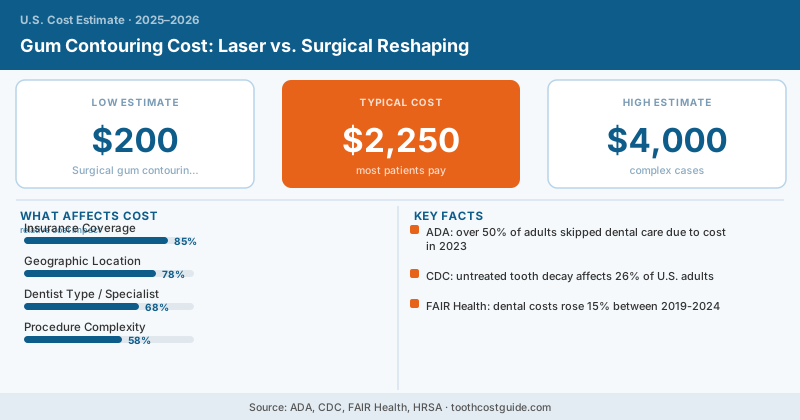
Gum contouring can fix that. The procedure trims, reshapes, or re-levels uneven or excessive gum tissue — and the cost ranges from $300 to $3,000 depending on how many teeth are involved, which technique is used, and whether you’re seeing a general dentist or a specialist.
Here’s how that number breaks down.
What Gum Contouring Actually Does
Your gum line is supposed to follow a gentle arc that frames your teeth. When gums sit too high — covering a significant portion of the crown — the teeth look short and the smile looks “gummy.” When the gum line is uneven, certain teeth look mismatched in length. Gum contouring reshapes that tissue to create symmetry and expose more of the natural tooth.
It’s done two main ways: laser or scalpel.
| Procedure | Cost Range | Notes |
|---|---|---|
| Laser gum contouring — 1–2 teeth | $300–$600 | Mild reshaping, faster healing |
| Laser gum contouring — full upper arch | $1,000–$2,000 | 6–10 teeth treated |
| Surgical (scalpel) contouring — per tooth | $200–$400 | May include bone reshaping |
| Surgical gum contouring — full arch | $1,500–$3,000 | Periodontist, includes osseous work |
| Crown lengthening (functional) | $1,000–$4,000 | Insurance may partially cover |
| Gingivectomy (disease-related) | $200–$400 per tooth | Sometimes covered by insurance |
Laser vs. Surgical: Which Is Right for You?
Laser gum contouring uses a diode or Nd:YAG laser to precisely vaporize excess tissue. The laser simultaneously seals the tissue, which means less bleeding, less post-op soreness, and faster healing — most people are fully recovered in 3–7 days. It’s excellent for patients with mild-to-moderate excess gum tissue and a relatively uniform gum line that just needs some trimming.
Surgical contouring (gingivoplasty or crown lengthening with osseous surgery) involves a scalpel and, in many cases, reshaping of the underlying bone. If you have a condition called “altered passive eruption” — where the jawbone sits too close to the crown of the tooth, anchoring the gum too high — laser alone won’t solve it. The bone itself needs to be recontoured for the new gum line to stay put. Recovery is longer (1–2 weeks), but the results are more dramatic and stable.
The right choice depends on how much tissue needs to come off and whether the underlying bone architecture is the root issue. Your periodontist will determine this during your consultation, usually with a probe and X-rays.
Why Periodontists Charge More
You can get laser gum contouring done by a general dentist with the right equipment — and the cost is usually lower, $300–$800 for a few teeth. But for extensive reshaping, uneven bone levels, or cases involving the lower gum line and posterior teeth, a periodontist — a specialist who completed 3 additional years of training focused exclusively on gum tissue and bone — is the better choice.
Periodontists charge more because they’re managing more complex anatomy, and because any procedure involving bone is better handled by someone who operates in that environment every day. The typical fee from a periodontist for full-arch surgical gum contouring runs $1,500–$3,000. It’s worth the premium for cases that aren’t straightforward.
Is It Covered by Insurance?
Here’s the honest answer: purely cosmetic gum contouring is almost never covered. The insurance language is blunt — if the procedure is performed to improve appearance, it’s excluded.
But there’s a real exception. A gingivectomy performed to treat active periodontal disease — removing diseased tissue, reducing bacterial pockets, improving access for cleaning — is coded differently and is often covered at 50–80% after your deductible under major restorative benefits. The ADA CDT code matters: a cosmetic procedure code signals elective; a disease-related code signals medical necessity.
If your periodontist documents that your gum tissue is diseased, overgrown due to medication (some blood pressure medications cause gingival hyperplasia), or that the procedure is required to achieve proper oral health — coverage becomes a real possibility. Push your provider to submit a predetermination to your insurer before committing to the procedure.
Ask your periodontist whether any portion of your case can be documented as medically necessary — especially if you have any signs of gum disease, crowding that makes cleaning difficult, or medication-induced gum overgrowth. A predetermination letter from your insurer, requested before the procedure, tells you exactly what they’ll pay before you’re committed to anything.
Are Results Permanent?
Mostly, yes — with important caveats.
Once gum tissue is removed and the underlying anatomy is stable, the gum line typically stays where it was placed. But gums can recede over time due to aggressive brushing, gum disease, or aging. And in some cases where bone wasn’t addressed, the gums can slowly creep back toward their original position.
Your dentist’s job post-procedure is to ensure you’re maintaining excellent hygiene so you’re not creating conditions that would drive tissue changes. Regular periodontal maintenance (every 3–4 months after a surgical procedure) helps catch any regression early.
The other factor: orthodontics. If you’re considering braces or Invisalign, the tooth movement can shift your gum levels. Most periodontists recommend completing orthodontic treatment first, then doing gum contouring as a finishing step — not the other way around.
Recovery: What to Expect
Laser contouring is genuinely easy. Mild soreness, sensitivity to hot and cold, some slight swelling. Over-the-counter ibuprofen usually handles it. Soft foods for 3–5 days, salt water rinses, and you’re done.
Surgical contouring is more significant. Expect 7–14 days of recovery, with some swelling and soreness peaking around day 2–3. Your periodontist will prescribe chlorhexidine rinse and possibly a short course of antibiotics if bone was modified. You’ll need to protect the site from trauma — no chips, crackers, or anything that could disturb the healing tissue.
Either way, the final aesthetic result isn’t visible immediately. Gum tissue swells and then retracts during healing. The final gum line position isn’t fully stable until 4–6 weeks post-procedure — sometimes longer when bone was modified.
Don’t judge the result in the first two weeks. Swelling makes the gum line look higher and uneven immediately after the procedure. The true cosmetic outcome won’t be visible until healing is complete — typically 4–8 weeks. If you’re concerned at week 2, ask your provider, but don’t panic. This is normal.
Finding the Right Provider
For simple laser recontouring of 1–3 teeth, a general dentist with laser training is often fine and more affordable. Ask specifically what laser system they use and how many gum contouring cases they do per month.
For full-arch work, significant asymmetry, or any case involving bone, you want a board-certified periodontist. Find one through the American Academy of Periodontology’s provider finder at perio.org. Look for someone who performs crown lengthening and osseous surgery regularly — gum contouring for cosmetic purposes is a natural extension of their surgical skill set.
Frequently Asked Questions
Laser gum contouring typically heals in 3–7 days. Surgical scalpel-based contouring takes 1–2 weeks for the gums to fully close and settle. You'll want to stick to soft foods, avoid anything spicy or crunchy, and rinse with warm salt water. Most people return to normal activities the next day, though some soreness and minor bleeding are normal for the first few days.
Laser contouring uses a diode or Nd:YAG laser to vaporize excess gum tissue with minimal bleeding and faster healing. Scalpel (surgical) contouring allows the periodontist to remove more tissue and, if needed, recontour the underlying bone — which is required when the gum is covering too much of the tooth root or when bone reshaping is part of the cosmetic plan. Laser is ideal for mild-to-moderate cases; surgery is better for more extensive reshaping.
Pure cosmetic gum contouring is almost never covered by dental insurance. However, a gingivectomy performed to treat active gum disease — removing diseased tissue, reducing periodontal pockets, or improving access for cleaning — is a different procedure and may be covered at 50–80% under major restorative benefits after your deductible. If your periodontist documents a functional or medical reason for the procedure, coverage becomes more likely. Always call your insurer and ask specifically whether the CDT code your provider plans to use is a covered benefit under your plan.