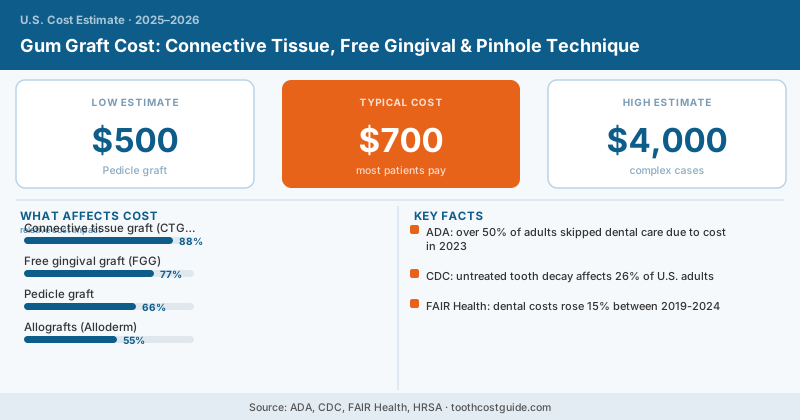
CDC surveillance data shows that gum recession affects more than 50% of adults over age 30 — and in many cases, it’s not periodontal disease doing the damage. It’s the toothbrush.
Aggressive scrubbing with a stiff-bristled brush, applied with more force than the teeth actually need, gradually wears away the gum margin. Year after year. The recession is slow enough that most people don’t notice it until they’re sitting in a periodontist’s chair being told they need grafting on three or four teeth.
That’s the frustrating reality of gum recession: it’s largely preventable, it’s silent until it’s advanced, and the fix — once recession has progressed — is surgical. Here’s what grafting actually costs, which technique fits which situation, and when your insurance will chip in.
Gum Graft Cost by Type and Scope
| Graft Type / Approach | Cost Per Tooth | Notes |
|---|---|---|
| Connective tissue graft (CTG) | $600–$1,200 | Gold standard; palatal donor harvest |
| Free gingival graft (FGG) | $600–$1,100 | Thicker tissue; often lower gumline teeth |
| Pedicle graft | $500–$900 | Adjacent tissue only; no second surgical site |
| Allograft / Alloderm | $700–$1,300 | Donor tissue; avoids palatal harvest |
| Pinhole surgical technique | $1,500–$4,000 | Multiple adjacent teeth; no harvest site |
Multi-tooth cases at the same visit are usually discounted. Treating 3 adjacent teeth might cost $1,400–$2,500 with traditional grafting rather than $1,800–$3,600 for individual pricing. Ask your periodontist about per-arch pricing for widespread recession.
Types of Gum Grafts — Which One and Why
Not all grafts are the same, and the right choice depends on your anatomy, how much tissue you have adjacent to the recession site, and how important cosmetic outcome is.
Connective tissue graft (CTG) is considered the gold standard. The periodontist takes a small piece of tissue from beneath the surface of your palate (not the surface itself — a tunnel is made and connective tissue is harvested from underneath). This connective tissue is then sutured at the recession site, covered by the existing gum margin. Because it uses your own tissue, it integrates reliably and matches your natural gum color well. It does involve two surgical sites — the palate and the recession area — which means two sites of post-op discomfort.
Free gingival graft (FGG) harvests a strip of tissue directly from the surface of the palate. The resulting tissue is thicker and tougher — more keratinized — which makes it ideal when the goal is to create a band of attached gingiva rather than cover root surface. Commonly used for lower anterior teeth. The color match is sometimes less ideal than CTG.
Pedicle graft uses tissue from adjacent to the recession site — it’s rotated or advanced to cover the exposed root. This avoids a second surgical site entirely, but it only works when there’s sufficient tissue right next to the problem area. Not always possible.
Allografts (Alloderm) use processed donated human tissue (acellular dermal matrix) instead of your own palatal tissue. No palatal harvest = no second surgical site, which means significantly more comfortable recovery. The tradeoff: some studies show slightly less predictable root coverage compared to autogenous (your own) tissue. For patients who have multiple recession sites or who really can’t tolerate a palatal harvest, allografts are a legitimate option.
If you need grafting on 4 or more teeth, the palate has physical limits to how much tissue can be harvested in one procedure. Many periodontists will use a combination of autogenous tissue and Alloderm for widespread recession cases — or use Alloderm for all sites. The recovery is meaningfully more comfortable, and outcomes are clinically acceptable per current literature.
The Pinhole Surgical Technique ($1,500–$4,000 for Multiple Adjacent Teeth)
The Chao Pinhole Surgical Technique (PST) is a newer approach — FDA cleared and increasingly available — that achieves root coverage without a harvest site or sutures. Instead of grafting new tissue, the periodontist makes a small pinhole in the gum, uses specialized instruments to loosen and advance the existing gum tissue over the exposed roots, then holds it in position with collagen strips threaded through the pinhole.
What it offers:
- No incisions, no sutures, no palatal harvest
- Multiple adjacent teeth treated in one session
- Recovery measured in hours to days, not weeks
- Cosmetically excellent outcomes in ideal candidates
The tradeoffs:
- Costs more per session for multi-tooth cases ($1,500–$4,000 depending on how many teeth)
- Not every patient is a candidate — requires adequate existing gum tissue to advance
- Fewer long-term data compared to CTG; most studies show comparable 1–3 year outcomes
- Not all periodontists are trained in the technique
For patients with mild-to-moderate recession across multiple adjacent front or lower teeth who have sufficient existing gum tissue, PST is worth asking about. For isolated severe recession or recession with very thin tissue, traditional CTG may still be the better choice.
Recovery: What to Expect After Grafting
Traditional connective tissue graft recovery takes 2–3 weeks before you’re eating normally. The first week involves soft foods, no chewing on the grafted side, and protecting both surgical sites. The palate typically heals faster than the graft site because it’s covered by a protective stent or putty-like material some periodontists place.
Pinhole technique recovery is dramatically faster — 24–48 hours before most patients resume normal activities, soft diet for 3–5 days. No palatal soreness because there’s no palatal harvest.
Both techniques produce comparable final outcomes in well-selected patients, which makes the PST recovery advantage meaningful.
What Causes Gum Recession?
Understanding the cause matters — because grafting without addressing the cause produces recession that returns. Common drivers:
- Aggressive toothbrushing — The most common. Horizontal scrubbing with a medium or firm brush wears gum tissue over years.
- Periodontal (gum) disease — Bacterial infection destroys the attachment between gum and root.
- Orthodontic treatment — Moving teeth outside the bony envelope can cause recession, particularly in lower front teeth.
- Genetics — Some patients have naturally thin gum tissue that’s more susceptible to recession.
- Bruxism — Chronic grinding creates lateral forces that stress gum attachment.
- Tooth malposition — Teeth that are naturally positioned more outward in the arch have less bone support and are prone to recession.
After grafting, your periodontist should identify and address the underlying cause — usually with a soft-bristled brush and improved technique, periodontal maintenance, or a night guard.
When Does Insurance Cover Gum Grafting?
The key distinction insurers make is medically necessary vs. cosmetic recession.
Likely covered (50–80% after deductible):
- Recession causing root sensitivity interfering with function
- Recession with associated progressive bone loss
- Recession following periodontal disease treatment
- Recession causing tooth instability
Typically not covered:
- Recession that’s purely cosmetic with no functional symptoms
- Elective grafting to improve appearance without documented clinical need
The specific CDT codes used matter. D4270 (pedicle soft tissue graft), D4273 (autogenous connective tissue graft), and D4283 (non-autogenous connective tissue graft) are the most common. Request a pre-authorization from your insurer using the exact procedure code and your diagnosis documentation before scheduling.
Don’t wait until recession becomes severe before treating it. Mild-to-moderate recession is easier to correct and produces more predictable root coverage than advanced recession. The American Academy of Periodontology notes that Miller Class I and II recession defects (where supporting bone is still intact) have significantly better graft outcomes than Class III and IV defects. Earlier treatment means better results and often lower total cost.
Frequently Asked Questions
Most patients describe the procedure itself as pain-free — you're under local anesthesia, so you feel pressure but not pain. The recovery is where discomfort shows up. The donor site (the palate, if a connective tissue graft was taken) tends to be sorer than the recipient site for the first 3–7 days. Most patients manage well with prescription ibuprofen or acetaminophen. If a palatal harvest was involved, eating is restricted to soft foods for 1–2 weeks. The pinhole technique is significantly more comfortable — most patients return to normal eating within 24–48 hours.
If the underlying cause of recession is addressed, yes — grafted tissue integrates permanently and doesn't re-recede on its own. But if you continue the aggressive brushing, untreated grinding, or uncontrolled gum disease that caused the recession initially, new recession can occur elsewhere. The graft itself is permanent; your habits and ongoing periodontal maintenance determine long-term stability.
It depends on the diagnosis. When recession is causing root sensitivity, tooth instability, or is secondary to active periodontal disease, many plans cover gum grafting at 50–80% as a periodontal surgical service. When recession is primarily cosmetic — no root exposure, no symptoms, just an appearance concern — it's usually not covered. Call your insurer with the specific CDT procedure code (D4270 or D4273) and your documented diagnosis to get a pre-authorization estimate before the procedure.