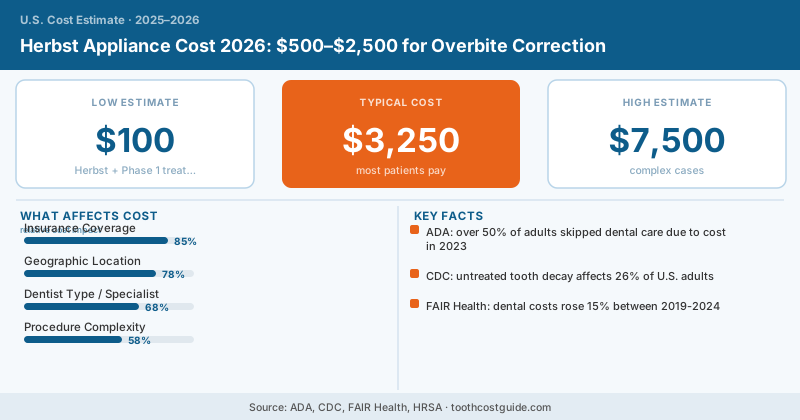
What does a Herbst appliance actually cost? On its own, roughly $500 to $2,500 — but here’s the thing most parents don’t realize: it’s almost never sold alone. It’s usually folded into a full braces treatment, so the real question is what it adds to your total bill.
The Herbst appliance is a fixed device that corrects overbites by gently holding the lower jaw forward. It’s a workhorse for growing kids and teens whose lower jaw sits too far back, and because it’s cemented in place, there’s no compliance battle — your child can’t “forget” to wear it.
| Scenario | Typical Cost | Notes |
|---|---|---|
| Herbst appliance alone | $500–$2,500 | Rarely billed separately |
| Herbst bundled with full braces | $4,500–$7,500 total | Most common scenario |
| Herbst + Phase 1 treatment | $2,000–$4,500 | Early intervention cases |
| Repair / re-cement if dislodged | $100–$300 | Occasional |
How a Herbst Works (and Why Parents Like It)
The Herbst connects the upper and lower jaws with small telescoping arms on each side. Those arms hold the lower jaw in a forward position, and over months, the jaw grows into that improved alignment. It’s most effective during a growth spurt, which is why it’s a teen and pre-teen appliance rather than an adult one.
The big selling point is that it’s fixed. Removable overbite correctors — like headgear or elastics — only work if the patient actually wears them, and teenagers are notoriously inconsistent. A Herbst is cemented in, working 24/7 whether your kid cooperates or not. That reliability is a real cost saver in disguise: fewer wasted months means a shorter, cheaper overall treatment.
A Herbst corrects the jaw relationship, but it doesn’t straighten teeth. That’s why it’s paired with braces — the Herbst fixes the bite, the brackets align the teeth. When you get a quote, ask whether the price is for the appliance alone or the full treatment package.
Why Use It Instead of Surgery?
This is the appliance’s secret superpower. For a teenager still growing, a Herbst can correct an overbite that, left until adulthood, might require jaw surgery costing $20,000 or more. The American Association of Orthodontists has long emphasized that catching skeletal problems during growth is far less invasive — and far cheaper — than waiting.
Timing is everything. The CDC notes that malocclusion (bad bites) is among the most common dental conditions in American children, and overbites are one of the most frequent types. Treating during the growth window with a Herbst can sidestep the surgical route entirely. Miss the window, and surgery may become the only option.
What Drives the Final Number
Whether the Herbst is custom-fabricated in a lab or a prefabricated model affects the price. Custom appliances cost more but fit better. Your orthodontist’s market matters too — big metros price higher.
The largest cost factor is what it’s bundled with. A Herbst inside a comprehensive treatment for a teen will sit in the $4,500–$7,500 total range, similar to standard teen braces pricing. And every treatment ends with retention — budget $150–$500 for a retainer to lock in the corrected bite.
Insurance and Paying
Because it’s part of orthodontic treatment, the Herbst falls under your ortho benefit if you have one — usually a lifetime cap of $1,000–$2,500. It isn’t billed as a separate medical item the way jaw surgery sometimes is.
For the balance, an FSA for dental expenses covers the appliance as eligible orthodontic care, and a CareCredit dental plan can spread a bundled treatment over monthly payments.
Herbst appliances occasionally come loose or break, especially with hard or sticky foods. Each repair can run $100–$300 and may extend treatment. Stick to your orthodontist’s food rules — a few snapped appliances can quietly add hundreds to your total.
Bottom Line
A Herbst appliance is one of the smartest investments in growing-patient orthodontics: $500–$2,500 of hardware that can prevent five figures of jaw surgery later. If your child’s overbite stems from a recessed lower jaw and they’re still growing, ask your orthodontist whether a Herbst belongs in the plan — sooner rather than later.
Frequently Asked Questions
A Herbst appliance typically costs $500 to $2,500 as a standalone device, but it's almost never charged separately. Instead, it's bundled into your full braces treatment plan, so you'll see it added to your total orthodontic bill rather than as a line item.
Most dental insurance plans cover 50% of orthodontic treatment, including Herbst appliances, up to a lifetime maximum of $1,500 to $2,000. This means you'd typically pay 50% out-of-pocket after your insurance benefit is used, though some plans exclude appliances altogether, so always check your specific policy first.
A Herbst appliance is usually worn for 12 to 24 months, depending on how much jaw correction is needed and how well your jaw responds to treatment. It's a fixed device that stays in your mouth constantly, unlike removable retainers, and works best for growing children and teens whose lower jaws are still developing.