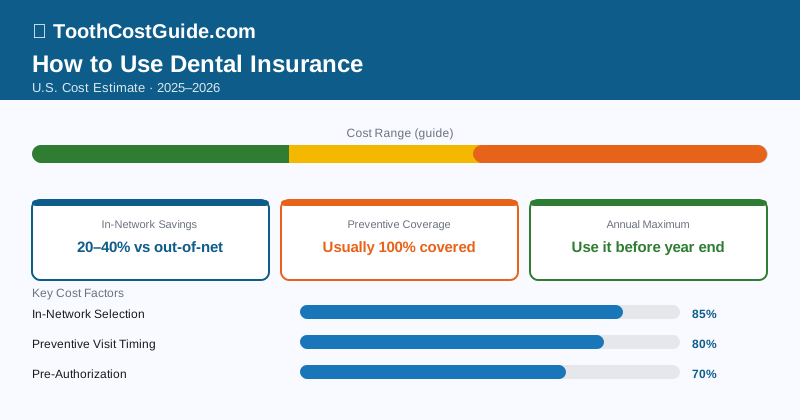
Dental insurance isn’t complicated — but it does require active management. The policyholders who get the most from their plans aren’t the ones with the best coverage; they’re the ones who know how the system works and use it intentionally.
According to ADA Health Policy Institute surveys, nearly 40% of people with dental coverage miss at least one annual cleaning they’re entitled to. That’s $100–$200 in free preventive care left uncollected — every year. And that’s the smallest mistake. The bigger ones involve out-of-network surprises, unclaimed benefits before year-end, and major work started without a pre-authorization.
Here’s the complete playbook.
| Insurance Task | When to Do It | Why It Matters |
|---|---|---|
| Understand your benefits | Before first visit | Avoid surprise bills |
| Find in-network dentist | Before scheduling | Save 20–40% on negotiated rates |
| Call to verify coverage | Before treatment | Confirm current network status |
| Use preventive benefits | Twice yearly | Free care; catches problems early |
| Request pre-authorization | Before major work | Know exact cost before committing |
| Submit claims (if needed) | Within 90–365 days | Gets you reimbursed |
| Track annual maximum | Throughout year | Strategically schedule remaining work |
| Schedule year-end work | October–November | Maximize benefits before reset |
Protocol 1: Know Your Benefits Before You Set Foot in a Dental Office
This step takes 20 minutes and prevents 80% of bill surprises. Here’s what to look for in your plan documents.
Your Summary of Benefits and Coverage (SBC). Every dental plan must provide this document. It lives in your member portal. Read it before your first appointment — not after you get a bill.
The three service tiers and their cost-sharing:
- Preventive: Cleanings, exams, X-rays — covered at 100% from day one with no deductible on virtually every plan
- Basic: Fillings, simple extractions, periodontal scaling — typically 70–80% after your deductible
- Major: Crowns, bridges, dentures, root canals — typically 50% after deductible and waiting period
Your deductible. The amount you pay before insurance starts covering basic and major services. Usually $50–$100/year per person. Preventive care typically bypasses this entirely.
Your annual maximum. The total the insurer will pay in a calendar year — usually $1,000–$2,000. Once you hit it, you pay 100% of remaining costs. This number is more constraining than most people expect.
Your waiting periods. The required time before certain services are covered. Major services frequently require 6–12 months. This matters enormously if you need a crown soon after enrolling.
Your coinsurance percentages. If the plan pays 80% for fillings, you pay 20%. Straightforward, but make sure you know it before you sit in the chair.
Protocol 2: Find and Verify an In-Network Dentist
This is the single most financially impactful action you can take with dental insurance.
Here’s why it matters so much. In-network dentists have signed fee contracts with your insurer — typically setting their rates 20–40% below standard market prices. When your insurance pays 50% of a crown, it pays 50% of that contracted rate. You pay 50% of the contracted rate. The dentist cannot charge more. You’re protected from balance billing.
Out-of-network dentists operate differently. Insurance pays its percentage of a limited “allowable amount” — a number the insurer sets, often based on outdated local benchmarks. The dentist can charge anything above that allowable. You pay the difference. A single out-of-network crown can cost you $500–$1,000 more than the same procedure in-network.
How to find in-network dentists:
- Log in to your insurer’s member portal
- Use the “Find a Dentist” or “Provider Search” tool
- Filter by your specific plan name — not just carrier name
- Confirm specialty if you need more than general dentistry
The most important step most people skip: Call the dental office before booking. Online directories are often out of date by 6–12 months. Dentists join and leave networks frequently. Say specifically: “I have [Insurer Name] [Plan Name]. Are you currently in-network for that plan?” Ask about the exact plan type — a dentist might be in Delta Dental PPO but not Delta Dental Premier. These aren’t the same network.
If your current dentist is out-of-network: ask them directly whether they’d be willing to join your plan. Many dentists will apply to join a network to retain an established patient. It’s worth asking before assuming you need to switch.
Protocol 3: Use Your Preventive Benefits Immediately — and Twice
Preventive care is where dental insurance delivers its clearest, most consistent value. Two routine cleanings per year are covered at 100% on virtually every plan — no deductible, no waiting period, no cost to you.
What “preventive” typically includes:
- Two routine cleanings (prophylaxis)
- Annual comprehensive exam
- Bitewing X-rays (usually annually; full series every 3–5 years)
- Fluoride treatments for children (sometimes adults)
- Sealants for children
- Oral cancer screenings
Why to use these immediately: Finding a cavity when it’s small costs $100–$200 and is covered at 80%. Letting it grow into a crown costs $1,000–$1,800 and is covered at only 50%. Early-caught gum disease: $200 in treatment. Advanced gum disease missed: $2,000 in deep cleaning. Preventive care isn’t just a free benefit — it’s how you avoid expensive benefits later.
Schedule your first cleaning within 30 days of coverage starting. You’re paying premiums from day one. Start collecting benefits immediately.
Protocol 4: Get a Pre-Authorization Before Major Work
For any procedure estimated at over $200, request a pre-authorization (also called a predetermination or pre-treatment estimate) from your dentist’s office before treatment begins.
How the process works:
- Your dentist submits the planned procedure codes and tooth numbers to your insurer
- The insurer reviews the request and responds with a written Explanation of Benefits
- You see exactly what they’ll pay and what you’ll owe before you’re committed to treatment
- The pre-auth isn’t a payment guarantee — circumstances can change — but it’s a strong and reliable indicator
Always get pre-authorization for:
- Crowns ($1,000–$1,800): Insurance covers 50% — the exact amount matters
- Root canals ($700–$1,400): Generally covered, but some plans have exclusions
- Dentures ($1,000–$3,500/arch): Expensive, multi-appointment, worth confirming coverage before starting
- Implants ($3,000–$5,000): Coverage varies widely; pre-auth is essential here
- Orthodontics: Verify lifetime benefit remaining and waiting period status before starting treatment
If the pre-authorization comes back showing less coverage than you expected, don’t accept it passively. Ask your dentist’s billing coordinator to explain the discrepancy. Call the insurer to understand whether a waiting period is still active or whether the claim can be appealed. Sometimes pre-auth amounts are adjustable.
Protocol 5: Read Every Explanation of Benefits
After a dental claim processes, your insurer sends an Explanation of Benefits — by mail or digitally through your member portal. This is not a bill. It’s a record of what happened with your claim.
The fields that matter:
- Billed amount: What the dentist charged
- Allowable amount: The contracted rate (in-network) or UCR rate (out-of-network) the insurer uses as its basis
- Plan paid: The insurer’s payment
- Member responsibility: Your deductible + coinsurance — what you actually owe
- Remark codes: Short codes explaining adjustments or denials
Common problems to catch:
- Denied — not covered: The service may be excluded or still in a waiting period. Check your plan documents.
- Denied — not medically necessary: This can be appealed with supporting documentation from your dentist. Don’t accept it without questioning.
- Paid at reduced amount: Common for OON claims or when “least expensive alternative treatment” provisions applied.
- Pending — information required: Call the insurer immediately to prevent delays.
Cross-reference every EOB against your dentist’s bill. Errors occur. Catching them is your job.
Protocol 6: Track Your Annual Maximum and Time Major Work Strategically
Your member portal shows remaining benefits. Check it quarterly — more often if you’ve had expensive work done.
Year-end optimization tactics:
October: Review how much of your annual maximum you’ve used. If you have $800 remaining on a $1,500 max, identify any deferred dental work — a filling, a night guard, a second cleaning — and schedule it before year-end.
November: Your target for scheduling any identified work. Leaving it to December risks year-end scheduling crunches.
December + January split billing: For major two-stage work (implant post placement + crown restoration; or a multi-tooth bridge requiring several appointments), plan stage one in December and stage two in January. Two separate procedures, two separate plan years, two separate annual maximums. This strategy is legitimate, commonly recommended by dentist billing coordinators, and can double the insurance contribution on large treatment plans.
December: Book your second cleaning if you haven’t had it. Two free cleanings per year means one should fall in the first half and one in the second half. Don’t let the second one lapse.
What doesn’t roll over: Unused annual maximum benefits expire at year-end. If your plan covers $1,500 and you’ve only collected $400 in benefits, the remaining $1,100 potential is gone on January 1.
Protocol 7: File Claims for Out-of-Network Care
If you see an out-of-network dentist, you may need to file the claim yourself (though many offices will do this for you — always ask first).
Filing an OON claim:
- Get a detailed receipt with CDT procedure codes, tooth numbers, and the dentist’s NPI number
- Download your insurer’s claim form from the member portal
- Complete the form and attach the receipt
- Submit by mail or digitally — most insurers now accept digital submissions
- Keep copies of everything
- Processing takes 2–4 weeks; track via your member portal
The Money Moves That Actually Add Up
Use both cleanings, every year, without exception. Two free cleanings at $0 copay represent $150–$300 in annual benefit. Set calendar reminders for May and November.
Get every major treatment plan in writing. Before any work over $500 begins, ask for a written treatment plan with procedure codes and estimated costs. Take it home. Call your insurer and verify. Understand your liability before signing anything.
Use FSA funds for dental out-of-pocket. If your employer offers a Flexible Spending Account, elect enough to cover your expected dental cost-sharing. Dental copays, deductibles, and out-of-pocket costs are qualified FSA expenses. Paying them with pre-tax dollars reduces your effective cost by 22–37% depending on your bracket.
Never assume a dental procedure is covered without verifying. Even “cleanings” can be billed differently (preventive vs. periodontal maintenance) and may have different coverage rates. Ask your dentist’s billing coordinator exactly what CDT code they’ll use for each service before the appointment.
Using dental insurance well is a skill: find in-network dentists (and verify current status), use 100%-covered preventive care twice a year, always get pre-authorizations before major work, track your annual maximum, and schedule remaining work before year-end reset. These steps alone save most policyholders $200–$500 more per year than passive insurance use.
Bottom Line
Dental insurance only pays off when you run it actively. Verify your dentist’s network status by phone before every appointment. Use both free preventive cleanings every year. Get written pre-authorizations for major work before you commit. Read every EOB for errors. Track your annual maximum and schedule deferred work before December 31. Fund an FSA for pre-tax dental spending. These aren’t complex moves — they’re just consistent habits that add up to $200–$500 more in value from the same plan, year after year.
Frequently Asked Questions
A routine professional cleaning (prophylaxis) typically costs $75–$200 without insurance, depending on your location and dentist. In-network rates through dental insurance plans are usually negotiated lower, often $0–$50 after you meet your deductible, making insurance valuable for preventive care.
Yes, most dental insurance plans cover two preventive cleanings per year at 100% after you meet your deductible, or sometimes with no deductible required. However, nearly 40% of insured patients skip at least one annual cleaning they're entitled to, missing out on $100–$200 in covered benefits.
Call your dentist's office and ask them to verify your benefits, then request a pre-authorization (also called a pre-determination) for any major work like fillings or crowns—this shows what your insurance will actually pay before treatment. Getting pre-authorization typically takes 3–5 business days and prevents surprise bills by clarifying your out-of-pocket responsibility upfront.