Most parents hear “impacted wisdom teeth” and don’t think twice. But impacted canines — the upper eyeteeth — are a different animal. They can’t just be removed. You need to guide them into the correct position through months of combined surgery and orthodontic treatment. And yes, it costs more than a simple extraction.
Here’s the honest breakdown of what you’re looking at.
What Does Treatment Cost?
| Procedure Component | Typical Cost |
|---|---|
| Surgical exposure (oral surgeon/periodontist) | $800–$2,200 |
| Bracket bonding (attached at exposure) | $200–$500 |
| Full orthodontic treatment (braces/Invisalign) | $4,000–$8,500 |
| Canine-specific traction (orthodontist fee) | Often included in ortho fee |
| Extraction of retained baby canine (if needed) | $150–$400 |
| CBCT 3D scan (common for diagnosis) | $250–$600 |
| Total out-of-pocket (typical case) | $5,000–$10,000+ |
Many families pay $2,000–$4,000 after insurance coverage kicks in for both the surgical and orthodontic components.
What Is an Impacted Canine?
Canine teeth (the “eyeteeth” or “cuspids”) are the pointy ones on either side of your front teeth. They’re among the last permanent teeth to erupt, typically between ages 11–13. When there isn’t enough room — or the tooth is tilted at a bad angle — it gets stuck in the bone.
The American Association of Orthodontists estimates that about 2% of the population has an impacted upper canine, making it the second most commonly impacted tooth after wisdom teeth. Unlike wisdom teeth, canines are essential for bite function and facial aesthetics. They’re almost always worth saving.
The Two-Phase Treatment
Phase 1: Surgical exposure. An oral surgeon or periodontist makes a small incision in the gum over the impacted tooth, removes any obstructing bone, and bonds a tiny gold chain and bracket to the exposed tooth. The gum is sutured back (sometimes leaving the tooth slightly visible, sometimes covering it entirely).
Phase 2: Orthodontic traction. Your orthodontist attaches the chain to the braces wire and applies gentle, steady tension — essentially pulling the canine slowly through the bone into its correct position. This process takes 12–24 months on average.
The American Academy of Pediatric Dentistry recommends X-ray screening for canine eruption between ages 10–11. Treatment started at age 11–13 is significantly faster and cheaper than treatment started at 17–25, when bone density is higher and the tooth is harder to move. If your child’s panoramic X-ray shows a developing canine headed the wrong direction, consult an orthodontist immediately — waiting costs more money and more time.
What Affects Cost?
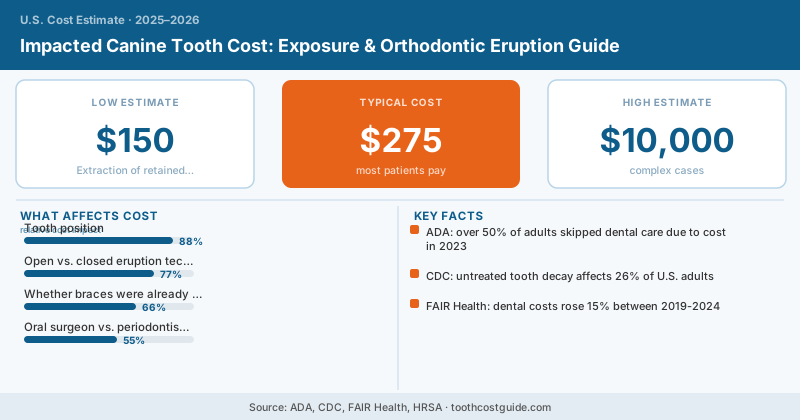
Tooth position. A canine sitting high in the palate requires more complex surgery than one positioned near the gum surface. Palatal (roof-of-mouth) impactions typically cost 20–30% more to expose.
Open vs. closed eruption technique. With the open technique, the tooth is left exposed through the gum during traction. With the closed technique, the gum is sutured fully closed after bonding the bracket. Closed eruption produces better gum tissue outcomes but may cost slightly more initially.
Whether braces were already planned. If the patient needs braces anyway, the orthodontist can work the canine traction into the overall treatment. If braces are only needed because of the impacted canine, that changes the cost calculus.
Oral surgeon vs. periodontist. Both perform canine exposures. Periodontists may offer a slight advantage for closed-technique exposures due to their expertise in soft-tissue management; fees are similar.
Geographic location. Oral surgery fees in major metros run 30–50% higher than in smaller cities.
Insurance Coverage
Most dental insurance plans classify canine exposure as oral surgery, covered at 50–80% after deductible. Orthodontic coverage, if available, usually provides a lifetime benefit of $1,000–$2,500 — not nearly enough for full treatment, but meaningful.
Check your plan’s definition of “medical necessity” for orthodontics. Impacted canines causing structural problems sometimes qualify for higher coverage under medical (not just dental) policies.
If an impacted canine is left untreated for years, it can slowly resorb (dissolve) the roots of adjacent teeth — often with no symptoms until significant damage is done. In severe cases, multiple teeth may need extraction. Treating an impacted canine costs thousands; replacing multiple teeth lost to root resorption costs tens of thousands. Don’t delay.
Alternatives and When They Apply
Extraction without replacement. Only considered when the canine is severely ankylosed (fused to bone and immovable), the patient is older with dense bone, or there’s significant root resorption. After extraction, the space must be closed with braces or restored with an implant.
Transplantation. In rare cases, an oral surgeon can surgically reposition the canine into its correct socket. This is technically demanding and not widely offered, but can be considered for specific cases.
No treatment. Not a good option. Impacted canines don’t resolve on their own, and waiting increases complexity and cost.
Saving on Treatment
Start the consultation with an orthodontist, not just the oral surgeon. The orthodontist needs to be involved in planning before the surgery — they direct where the tooth needs to go and communicate that to the surgeon. Getting the teamwork right from day one prevents costly do-overs.
Ask about combined orthodontic billing. Some orthodontists include the post-exposure traction in the overall braces fee. Others bill separately. Clarify this before signing contracts.
Dental school clinics. Both oral surgery and orthodontic departments at accredited schools treat impacted canines. Prices are 40–60% lower, though treatment timelines may be longer.
The canine isn’t just another tooth — it’s the cornerstone of your bite and the anchor of your smile. It’s almost always worth treating, and the earlier you start, the less it costs.
Frequently Asked Questions
Total treatment costs range from $1,200 to $4,500 or more, depending on the complexity of the impaction and your orthodontist's fees. The surgical exposure typically runs $800–$2,000, while the subsequent orthodontic guidance to erupt and position the tooth adds another $400–$2,500 over 6–12 months of treatment.
Many dental insurance plans cover 50–80% of the surgical exposure if deemed medically necessary, but orthodontic fees are often subject to separate ortho deductibles and annual maximums (typically $1,000–$2,000 per year). Your out-of-pocket cost will depend on your plan's coverage limits; you should verify with your insurer before treatment begins.
After the surgical exposure, it typically takes 6–12 months of active orthodontic treatment to guide the canine into its proper position, though some cases may extend longer depending on how deeply impacted the tooth is. Early intervention (ideally during the teenage years) tends to produce faster and more predictable results than waiting until adulthood.