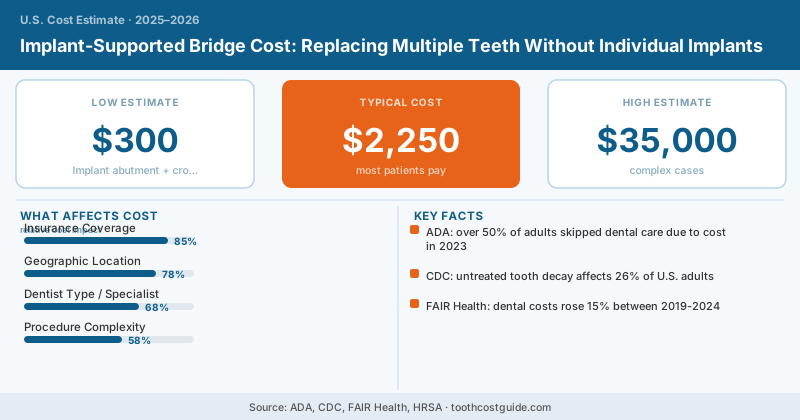
You’re missing three adjacent teeth. You could get three individual implants at $3,000–$5,000 each — a $9,000–$15,000 project. Or you could get two implants supporting a 3-unit bridge for $5,000–$10,000. That’s the core appeal of an implant-supported bridge: fewer implants, spanning more teeth.
| Implant-Supported Bridge Scenario | Typical Cost |
|---|---|
| 3-unit bridge on 2 implants (3 teeth) | $5,000–$10,000 |
| 4-unit bridge on 2 implants (4 teeth) | $6,000–$13,000 |
| 3-unit bridge on 2 implants (front teeth) | $6,500–$12,000 |
| Implant abutment + crown only (single tooth) | $1,500–$3,000 |
| Full arch bridge on 4 implants (All-on-4) | $20,000–$35,000 |
| Bone graft (if needed, per site) | $300–$800 |
How an Implant-Supported Bridge Works
A traditional tooth-supported bridge relies on the teeth on either side of the gap to anchor the bridge. Those anchor teeth must be ground down and crowned. If those neighboring teeth are healthy, that’s permanent enamel sacrifice.
An implant-supported bridge uses titanium implant posts surgically placed in the jawbone — not natural teeth — as anchors. Two implants can support a span of 3–4 missing teeth without touching or altering any remaining natural teeth.
The process:
- Implant placement: Titanium posts surgically placed in the jaw (one on each end of the gap, or at strategic intervals for longer spans)
- Osseointegration: 3–6 months for the implants to fuse with bone
- Abutment placement: Metal connectors attached to the implants
- Bridge fabrication and delivery: The bridge is made and seated; usually 2–3 weeks after abutment placement
Total timeline: 4–9 months from first surgery to final bridge.
When an Implant-Supported Bridge Makes Sense
The ideal candidate has:
- 2–4 consecutive missing teeth: Too many for a single implant, not enough to justify full-arch replacement
- Sufficient bone volume: Enough jaw bone at both implant sites to achieve osseointegration
- Healthy adjacent natural teeth: No need to crown them for bridge support
- Good overall health: No contraindications to implant surgery
It’s a particularly good fit when:
- The adjacent natural teeth are intact and the patient doesn’t want them altered
- The patient wants fixed (non-removable) tooth replacement
- Individual implants for each missing tooth would be prohibitively expensive
- The patient is not a candidate for a full-arch solution
Implant-supported bridges are not removable by the patient — that’s usually a feature, not a bug. But it means oral hygiene access between the bridge and gum tissue requires specialized tools: an interproximal brush, a floss threader, or a water flosser. Inadequate cleaning around implant-supported bridges leads to peri-implantitis (implant gum disease), which is expensive to treat and can cause implant failure. Before committing, have an honest conversation with your dentist about your willingness and ability to maintain the restoration.
Cost Comparison: Why Fewer Implants Saves Money
Three individual implants for three missing teeth: $3,500–$5,000 per implant × 3 = $10,500–$15,000.
Two implants + bridge spanning those three teeth: $5,000–$10,000.
The savings come from:
- One fewer implant post ($1,500–$2,000 savings)
- One fewer implant surgery ($300–$800 savings)
- One fewer healing period
- Bridge fabrication (3-unit bridge) rather than three individual crowns
There are tradeoffs. An implant-supported bridge concentrates bite forces on two implant sites rather than three — increasing per-implant stress. It also means that if one implant fails, the entire bridge is affected. Individual implants are independent: a failure affects only one tooth.
Insurance Coverage
Most dental PPO plans cover some portion of implant costs — often at 50% of a “conventional” alternative, capped at the plan’s annual or lifetime maximum. Implants are almost always classified as “major” procedures.
The ADA’s 2023 data shows that implants remain one of the most under-covered dental procedures, with fewer than 40% of commercially insured patients receiving any implant benefit. Many plans specifically exclude implants.
When coverage exists, it’s typically applied to:
- The implant abutment crown (at 50% of D6065-D6067 allowable)
- Sometimes the surgical placement (D6010)
- Rarely the bone graft (D7953)
Get a predetermination from your insurer before starting. The office submits the treatment plan; the insurer responds with what they’ll cover before you commit.
Many patients who’ve had missing teeth for more than 6–12 months have experienced bone resorption at the extraction site. Before implants can be placed, that bone may need to be rebuilt with a bone graft. Cost: $300–$800 per site. This adds 3–6 months to the timeline and significantly to the total bill. A CBCT scan (3D X-ray, $150–$500) performed before treatment planning will reveal whether grafting is needed — ask for it before agreeing to a treatment plan and price.
Finding Value in a High-Cost Procedure
- Prosthodontist vs. oral surgeon vs. general dentist: All can place implants; prosthodontists typically have the most training in complex multi-unit restorations; fees vary widely
- Dental school oral surgery and prosthodontics programs: Supervised residents place implant-supported bridges at significant discounts; cases take longer but quality is supervised
- All-inclusive pricing vs. itemized: Some practices quote everything bundled; others itemize implant, abutment, crown, and surgery separately — get an itemized quote to compare across providers
- Medical insurance: If tooth loss resulted from a covered accident or medical condition, some medical plans contribute to implant costs; rare but worth checking
Frequently Asked Questions
An implant-supported bridge typically costs $5,000–$10,000 for a 3-unit bridge on 2 implants, or $6,000–$12,000 for a 4-unit bridge on 2 implants. The total cost depends on the number of teeth being replaced, implant material (titanium vs. zirconia), and your geographic location, with a full range of $3,500–$16,000 across all bridge scenarios.
Most dental insurance plans classify implant-supported bridges as a major restorative procedure and cover 40–50% of the cost after your deductible is met, though many plans cap annual benefits at $1,000–$1,500. You should expect to pay $3,000–$8,000 out-of-pocket for a typical 3-unit bridge, and verify with your insurer whether they cover the bridge crown itself, since some plans only cover the implant portion.
The complete treatment timeline typically spans 4–8 months: implant placement takes 1–2 hours, followed by 3–6 months of osseointegration (bone healing), and then 2–4 weeks for the bridge crown to be fabricated and placed. During the healing period, you can wear a temporary prosthetic to maintain function and appearance.