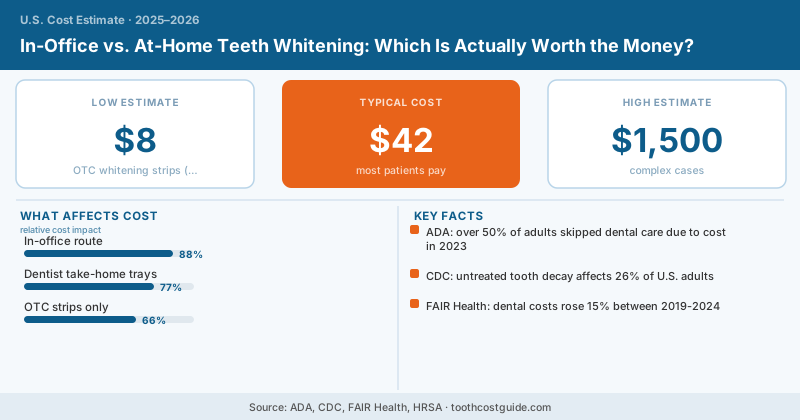
Here’s something your dentist’s marketing brochure won’t tell you: the $1,000 in-office whitening treatment fades faster than the $350 take-home trays.
That finding comes from multiple clinical studies, and it’s counterintuitive enough that it changes how most patients should be spending their whitening budget. Before you book that Zoom appointment, understand what you’re actually buying — and why the most expensive option isn’t always the best long-term value.
What Each Option Costs
| Whitening Method | Typical Cost |
|---|---|
| In-office whitening (Zoom, KöR, Opalescence Boost) | $500–$1,500 |
| Dentist-dispensed take-home trays + gel | $300–$600 |
| OTC whitening strips (Crest 3D Whitestrips, etc.) | $25–$60 per kit |
| Whitening toothpaste | $8–$20 per tube |
| OTC whitening trays (not custom-fitted) | $30–$80 |
The price gap between in-office and take-home is real — and largely driven by the time and equipment required in the dental chair, not the superiority of the result.
The H₂O₂ Concentration Difference
Hydrogen peroxide is the active whitening agent in every option. The concentration varies dramatically:
- In-office gels: 15–40% hydrogen peroxide (or equivalent carbamide peroxide)
- Dentist take-home gels: 10–22% carbamide peroxide (equivalent to roughly 3.3–7.3% H₂O₂)
- OTC strips: 6–10% hydrogen peroxide (Crest 3D Whitestrips Professional Effects: 10%)
- OTC whitening toothpaste: Less than 1% hydrogen peroxide, mostly abrasive whitening
The high concentration used in-office is why a dentist activates the gel with a UV or LED light — it accelerates the reaction. The result is dramatic same-day whitening, often 6–10 shades lighter in a single 90-minute appointment.
High-concentration gels penetrate enamel rapidly, but that speed comes with a cost: the whitening is primarily in the enamel layer and fades as the enamel rehydrates over the following days. Lower-concentration gels applied over a longer period penetrate more thoroughly and produce more durable results. This is why clinical studies consistently show dentist take-home trays maintaining better whiteness at 6 months than in-office treatments.
What the Research Actually Shows About Duration
A 2019 study published in the Journal of Dentistry compared in-office vs. dentist-prescribed take-home trays and found that while in-office treatment produced faster initial whitening, take-home tray patients maintained significantly better color stability at both 3 months and 6 months post-treatment.
The ADA’s consumer guidance on whitening similarly notes that at-home products used consistently over two to four weeks often achieve results comparable to in-office treatment with better retention — because the longer treatment window allows more thorough penetration of the whitening agent.
This doesn’t make in-office whitening a waste of money. It makes it the right choice for specific situations — not the default assumption.
Sensitivity: The Overlooked Factor
Both in-office and take-home whitening cause temporary tooth sensitivity. In-office treatment tends to produce more intense sensitivity during the procedure and for 24–48 hours after, due to the high H₂O₂ concentration. Take-home trays at lower concentrations cause milder, more spread-out sensitivity.
OTC strips fall in the middle — 10% H₂O₂ is enough to cause sensitivity in people prone to it, but the shorter contact time limits it.
If you’ve had significant sensitivity with whitening before, take-home trays with 10% carbamide peroxide applied for 2-hour intervals (rather than overnight) are typically the most tolerable approach. Some dentists also offer desensitizing gel to apply before or after whitening sessions.
Whitening doesn’t work on crowns, veneers, or bonding. If you have visible dental restorations on front teeth, those will stay the same color while your natural teeth whiten — creating a mismatch. Talk to your dentist before starting any whitening regimen if you have restorations in your smile zone.
Do OTC Strips Actually Work?
Yes — but with limitations. The 10% H₂O₂ in Crest 3D Whitestrips Professional Effects is clinically significant. A 2022 review in Operative Dentistry found that OTC strip products at this concentration produced measurable whitening results, though typically 2–4 shades rather than the 6–10 possible with professional products.
The limitations: strips don’t conform well to teeth, leaving the areas between teeth (interproximal zones) and near the gumline less whitened. Custom-fitted dentist trays cover every surface evenly. For mild whitening maintenance on a budget, strips are legitimate. For meaningful whitening or correction of significant discoloration, they’re not enough.
The 2-Year Cost of Maintaining White Teeth
Whitening isn’t permanent regardless of method. Coffee, red wine, tea, and dark foods restain enamel over time. Here’s what maintaining results realistically costs over two years:
In-office route: Initial treatment $1,000 + one touch-up at 12 months ($500) + OTC strip maintenance ($60/year) = ~$1,620 over 2 years
Dentist take-home trays: Initial trays and gel $400 + two gel refills at $75 each ($150 total) = ~$550 over 2 years
OTC strips only: Four kits per year at $50 each = ~$400 over 2 years
The take-home tray approach delivers the best combination of whitening effectiveness and 2-year cost efficiency. OTC strips work well for maintenance if you start from a reasonably white baseline.
When In-Office Whitening Makes Sense
Despite the cost and faster fade rate, there are clear situations where in-office treatment is the right call:
- Event-driven timing: You need visibly whiter teeth in 1–2 days for a wedding, photo shoot, or interview. Take-home trays take 2–4 weeks to show peak results.
- Stubborn tetracycline staining: Some intrinsic discoloration requires high-concentration professional treatment to penetrate. Your dentist can advise whether in-office or KöR extended take-home protocol is appropriate.
- Starting point dramatically discolored: If your teeth are very dark, in-office provides the jumpstart that makes the take-home maintenance phase more manageable.
- You simply won’t stick with a 4-week at-home protocol: One appointment and you’re done. There’s real value in that for some patients.
Which Should You Choose?
For most people seeking whiter teeth: dentist-dispensed take-home trays are the best value. You get custom-fitted trays (unlike the one-size-fits-all OTC options), professional-strength gel, better long-term retention than in-office, and a cost that’s 40–60% less than chair time.
For budget-conscious patients with mild discoloration: OTC strips work and there’s no shame in using them. Keep your dentist’s teeth cleaned professionally every 6 months — that alone removes surface stains that make teeth look darker.
For urgent timelines or severe staining: in-office whitening earns its premium. Just follow up with take-home maintenance gel to preserve the results.
Frequently Asked Questions
In-office whitening treatments like Zoom cost between $500–$1,500, while dentist-prescribed take-home trays range from $300–$600, and over-the-counter whitening strips are the most affordable at $25–$60. Despite the higher upfront cost, research shows that take-home trays actually maintain results longer than expensive in-office treatments, making them a better value for many patients.
Most dental insurance plans do not cover cosmetic teeth whitening, whether in-office or at-home, since it is considered an elective cosmetic procedure rather than medically necessary treatment. You can expect to pay the full cost out-of-pocket, though some dental offices offer payment plans or discounts for cash-pay patients.
In-office whitening results typically fade within 3–6 months despite higher costs, while dentist-prescribed take-home trays maintain results for 6–12 months or longer with occasional touch-ups. Over-the-counter strips provide the shortest duration, usually fading within 2–4 months, making professional take-home trays the longest-lasting option for your whitening investment.