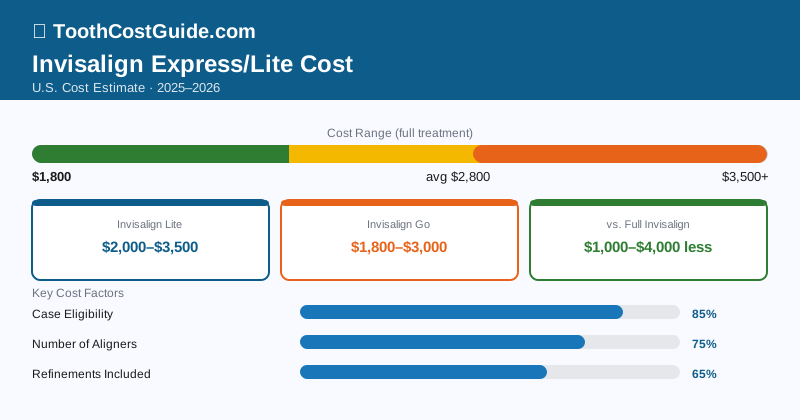
Not every mouth needs two years of braces. For adults with mild crowding, minor spacing, or a small relapse after prior orthodontic treatment, Invisalign’s limited-aligner programs — Express and Lite — deliver in-office clear aligner treatment at prices that rival mail-order alternatives. The question is whether your case actually fits.
Invisalign Express runs $1,800–$2,500 for 7-aligner treatment of very mild cases. Invisalign Lite runs $2,500–$3,500 for 14 aligners addressing mild-to-moderate concerns. Compare those to Invisalign Comprehensive at $3,000–$8,000, and the savings are meaningful — but only when your case genuinely belongs in a limited-aligner program.
| Invisalign Program | Aligners | Treatment Time | Cost Range |
|---|---|---|---|
| Invisalign Go (mild cases via general dentist) | 20 aligners | 5–7 months | $1,800–$3,000 |
| Invisalign Express | 7 aligners | 3–4 months | $1,800–$2,500 |
| Invisalign Lite | 14 aligners | 4–6 months | $2,500–$3,500 |
| Invisalign Moderate | 26 aligners | 7–12 months | $3,000–$5,000 |
| Invisalign Comprehensive | Unlimited | 12–24+ months | $3,000–$8,000 |
| Invisalign Teen | Unlimited + replacements | 12–24 months | $3,000–$8,000 |
What Moves the Price
Provider tier. Invisalign’s provider hierarchy — Bronze, Silver, Gold, Platinum, Platinum Elite, Diamond — reflects annual case volume submitted to Align Technology. High-volume Diamond providers receive better pricing from Align and sometimes pass savings along. In competitive urban markets, Diamond providers occasionally price limited programs below the ranges quoted here.
Where you live. The same 7-aligner Express case costs $500–$1,000 more in Manhattan than in a mid-size midwestern city. Geographic variation in dental fees applies equally here.
Refinement policy. Here’s the hidden variable that catches patients off guard: when teeth don’t move exactly as predicted, you need more aligner trays — refinements. Express programs typically include one refinement set. If you need more, costs rise. Some providers quote a low Express price but charge separately for each refinement at $500–$1,500 per set. Ask directly: “How many refinements are included, and what do additional ones cost?”
Retainers. Almost always billed separately from limited Invisalign programs. Budget $100–$300 per arch for post-treatment retainers, whether from the Invisalign provider or a local dentist.
Who These Programs Are Actually For
These aren’t appropriate for everyone who wants clear aligners. They’re designed for a specific patient profile.
Good candidates:
- Adults with mild crowding — roughly 1–3mm per arch for Express, up to 5mm for Lite
- Adults with minor gaps between front teeth
- Adults who completed orthodontic treatment years ago and experienced mild relapse (teeth drifted slightly after braces came off)
- Patients with a single cosmetic concern — one slightly rotated front tooth, a minor gap from a frenectomy
Not appropriate for:
- Any significant bite correction needs — overbite, underbite, crossbite
- Tooth rotations beyond 15–20°
- Substantial vertical movements
- Severe crowding (more than 5–6mm)
- Cases requiring molar repositioning
- Teenagers or children with remaining growth (Invisalign Teen is the right program)
Invisalign Express and Lite programs are specifically designed for mild cosmetic cases that can be resolved in a limited number of aligner trays. They’re an excellent value for the right patient — offering professional in-office clear aligner treatment at 30–50% below comprehensive Invisalign costs. The key is proper case selection; these programs fail when used for cases that require more aligners than the program includes.
Choosing Between Express, Lite, and Comprehensive
Invisalign Express (7 aligners): Best for a single cosmetic concern or very minor relapse — we’re talking about teeth that shifted a millimeter or two after years of not wearing a retainer. Treatment wraps up in 3–4 months. One refinement set included. If your case turns out to need more than 7 aligners, it gets upgraded to a higher program and the fee increases accordingly. Not suitable for any bite correction whatsoever.
Invisalign Lite (14 aligners): More flexibility than Express, and more likely to complete without needing an upgrade. Handles mild crowding or spacing resolvable in 4–6 months. Can address minor interarch issues that Express can’t. One or two refinements typically included.
Invisalign Go (20 aligners): A program specifically designed for general dentists (not just orthodontists) treating mild-to-moderate cases in their regular dental practice. Available through Invisalign-certified general dental offices. Limited to mild-to-moderate anterior tooth movement. Costs $1,800–$3,000.
Invisalign Comprehensive (unlimited aligners): The right choice when anything beyond mild is happening. No aligner limit, no refinement cap at most practices, and the ability to handle bite correction. The higher price is justified when your case actually needs it.
Express vs. Byte: Nearly the Same Price, Very Different Experience
| Feature | Invisalign Express | Byte All-Day |
|---|---|---|
| Cost | $1,800–$2,500 | $1,895 |
| In-person exam | Yes | No |
| Provider | Orthodontist/dentist | Remote support only |
| Case selection | Professional | Algorithm-based |
| Insurance coverage | Yes (lifetime max) | Generally no |
| FSA/HSA eligible | Yes | Check with provider |
| Refinements | 1 included | Lifetime guarantee |
| Complexity handled | Mild | Very mild only |
The price is nearly identical. The experience is not. With Invisalign Express, a licensed provider examines your teeth, takes X-rays, and makes a clinical judgment about whether your case fits the program. With Byte, an algorithm processes your home impressions. For mild, healthy-mouth cases, both can work — but Express comes with insurance coverage, professional oversight, and a provider who can catch problems Byte would miss.
Insurance Coverage
Invisalign Express and Lite carry the same insurance coverage as any Invisalign treatment — covered under dental insurance orthodontic benefits on the same terms as braces.
- Lifetime maximum: $1,000–$3,000
- Coverage: 50% up to the maximum
- Age limits: Under 18–19 for most plans (though these programs are primarily for adults)
Real-world example: $2,000 Invisalign Express case. Insurance lifetime maximum remaining: $1,500. Insurance pays 50% of the $2,000 = $1,000 (since $1,000 < $1,500 max, insurance pays $1,000). Patient pays $1,000 out of pocket.
One thing to check before starting: if you had orthodontic coverage in childhood and used part of the lifetime maximum, less may remain for adult treatment. Get the current remaining balance before scheduling.
Some providers quote Invisalign Express at a low price but charge separately for each refinement aligner set (up to $500–$1,500 per set). If your case requires a refinement (common even in simple cases), the total cost rises significantly. Ask: “How many refinements are included, and what do additional refinements cost?”
Financing
In-office payment plans: A $2,000 Express case typically wraps in 4 months — many providers offer a simple in-house plan over the treatment period. $500/month for 4 months.
CareCredit: 0% promotional financing for 12 months is widely available at Invisalign providers. $2,500 Lite plan over 12 months at 0% = about $208/month.
FSA/HSA: Fully eligible. This is actually a great use of year-end FSA funds — a $2,000 Express case can be covered by a single FSA contribution, saving $440–$740 in federal taxes compared to paying after-tax.
How to Pay Less
Get multiple consultations. Limited Invisalign program prices vary more than comprehensive case prices — providers have more discretion. Two providers may legitimately quote $1,800 and $2,800 for the same mild case.
Ask explicitly about program eligibility. Some providers quote Comprehensive as the default for any Invisalign case. Ask directly: “Could my case be treated with Express or Lite, and what would that cost?”
Compare with a new retainer first. For patients whose only concern is minor relapse after prior braces, a new retainer from the original orthodontist — using existing molds — costs $100–$300 and may be all that’s needed. Don’t pay $2,000 for Invisalign Express if a new retainer addresses the issue.
Dental school clinics. Some orthodontic residency programs offer Invisalign under faculty supervision at reduced rates for qualifying cases.
Bottom Line
Invisalign Express ($1,800–$2,500) and Lite ($2,500–$3,500) are the best value in in-office clear aligner treatment for adults with mild concerns. They cost 30–50% less than Comprehensive while delivering the same professional oversight, insurance coverage, and clinical quality. The program fails when a case that genuinely needs 30 aligners gets started as a 7-aligner Express — ending in a fee upgrade and extended timeline. Be honest about your case complexity during consultations, confirm the refinement policy in writing, and you’ll get excellent value for a fast, professional result.
Invisalign Express and Lite offer in-office professional aligner treatment at prices comparable to DTC brands — with the significant advantages of insurance coverage, professional oversight, and safer case management. For adults with mild crowding or post-treatment relapse, these limited programs represent the best value in in-office orthodontic treatment.
Frequently Asked Questions
Invisalign Express costs $1,800–$2,500 and is designed for simple cases requiring fewer aligners, while Invisalign Lite costs $2,500–$3,500 and handles slightly more complex corrections. Both are significantly cheaper than full Invisalign treatment, which typically runs $3,500–$8,000 depending on case complexity and treatment duration.
Many dental insurance plans cover Invisalign Express and Lite similarly to traditional braces, typically paying 50% of the cost after your deductible, with annual maximums usually capping out at $1,000–$1,500. However, some plans classify clear aligners as cosmetic and exclude them entirely, so you should verify your specific plan's orthodontic coverage before scheduling a consultation.
Invisalign Express is best for patients with very mild crowding, minor spacing, or a small relapse after previous orthodontic treatment and typically takes 3–6 months with fewer aligners. Invisalign Lite handles slightly more involved cases with moderate spacing or crowding issues and usually requires 6–12 months of treatment, making it the next step up when Express won't achieve your goals.