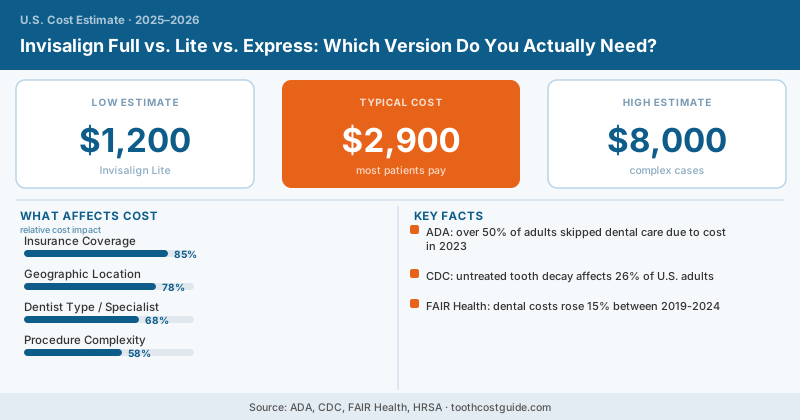
Not all Invisalign is the same product. There are four Invisalign tiers, and the difference between them isn’t just price — it’s how many aligners you get and whether your case can actually be completed with the version you’re sold.
The tier that matters for most straightforward adult cases is Invisalign Lite. Most providers default to quoting Full. Understanding the difference can save you $1,000–$3,000 on a product that would have produced identical results.
The Four Invisalign Tiers
| Product | Aligner Count | Typical Patient Cost | Best For |
|---|---|---|---|
| Invisalign Express 5 | Up to 5 aligners | $1,200–$2,000 | Very minor corrections only |
| Invisalign Express 10 | Up to 10 aligners | $1,500–$2,500 | Mild crowding, minor relapse |
| Invisalign Lite | Up to 14 aligners (standard) or 26 (extended) | $1,800–$4,000 | Mild to moderate cases |
| Invisalign Full | Unlimited aligners | $3,000–$8,000 | Complex, severe, or comprehensive cases |
| Invisalign Comprehensive | Unlimited + refinements included | $4,000–$8,000+ | Most complex adult cases |
Note: Align Technology (Invisalign’s manufacturer) has periodically updated its tier names and aligner limits. Your provider’s office will have the current product lineup.
What the Aligner Count Actually Means
Aligner count is the core variable. Each aligner moves your teeth a fraction of a millimeter. Invisalign’s software determines how many aligners are needed to get your teeth from current position to target position. Complex cases with significant crowding, spacing, or bite correction need more steps — more aligners. Simple cases need fewer.
Express is designed for straightforward cosmetic corrections where tooth movement is limited. Lite handles mild to moderate cases. Full handles comprehensive treatment.
Here’s the catch: the case complexity required to justify Full isn’t always as high as providers imply. Many adults seeking alignment for aesthetic purposes — slight crowding, a few rotated teeth, minor spacing — fall squarely in Lite territory. But Full generates higher revenue, and some providers default to quoting it.
How Providers Determine Your Tier
The provider submits photos and impressions (or a digital scan) to Invisalign’s ClinCheck treatment planning system. ClinCheck generates a 3D simulation showing the projected movement sequence. From that simulation, the number of aligners needed is determined.
A truly transparent provider will show you the ClinCheck simulation and explain how many aligners your case requires before recommending a tier. If the simulation shows 18–22 aligners, you’re in Lite/lower Full territory. If it shows 40+ aligners, Full or Comprehensive makes sense.
- “How many aligners does my ClinCheck simulation show?”
- “Would Invisalign Lite cover my full treatment, or would I run out of aligners before completion?”
- “If we start with Lite and need more aligners, what would a mid-course correction cost vs. starting with Full?”
- “What bite correction or jaw movement is included in this plan that requires Full?”
If the provider can’t answer these concretely, or if the answers reveal that your ClinCheck requires only 12–20 aligners, Lite may well be appropriate for your case.
What Happens If Lite or Express Isn’t Enough
Mid-course corrections are Align Technology’s solution for cases that run out of aligners before treatment is complete. These are additional aligner series ordered after the initial set finishes.
For Invisalign Full, mid-course corrections (also called “refinements”) are included at no additional lab cost. For Lite, some providers include one refinement in their package price; others charge $300–$600 for additional aligners.
This is the legitimate argument for Full: if there’s uncertainty about whether your case will fully resolve with the aligner count in a Lite plan, spending the extra $1,000–$1,500 upfront to include unlimited refinements may make more financial sense than paying for corrections later.
But — and this matters — if your case clearly falls within Lite’s aligner range based on the ClinCheck simulation, that argument doesn’t apply to you.
Invisalign Lite: The Sweet Spot for Most Adults
A 2022 study in the American Journal of Orthodontics and Dentofacial Orthopedics found that a significant proportion of adult Invisalign cases involve mild to moderate crowding and spacing corrections that can be effectively addressed within 14–20 aligner stages. These patients are clinically appropriate for Lite.
The AAO estimates that approximately 4 million Americans begin orthodontic treatment each year as adults, and that cosmetic (non-bite-correction) cases represent a substantial portion. For this patient population, the clinical distinction between Lite and Full is often minimal — it’s the aligner count, not the technology, that differs.
Regional and Provider Price Variation
Invisalign pricing varies significantly by geography and provider experience tier. Align Technology classifies providers as Preferred, Platinum, and Elite based on case volume — higher-tier providers pay less for aligners from Align, and some pass those savings on while others pocket them as margin.
General dentists certified to provide Invisalign often charge less than orthodontists. The tradeoff is experience volume — orthodontists who complete hundreds of cases per year have pattern recognition that general dentists may not. For simple Lite cases, a general dentist is often appropriate. For complex Full cases, an orthodontist is worth the premium.
Always get at least two quotes, and make sure both quotes specify the same tier. A $3,200 quote for Lite and a $4,800 quote for Full aren’t comparable — verify what you’re being quoted.
Getting the Most for Your Budget
If you need braces or aligners and budget is a primary concern:
- Dental school orthodontic clinics offer Invisalign at 30–50% reduced rates in some programs — call and ask
- CareCredit offers 12–24 month 0% financing at most Invisalign providers
- Dental insurance with orthodontic benefits typically pays $1,000–$2,000 lifetime for all aligner systems — ask your insurer specifically if Invisalign is covered (most plans cover it like traditional braces)
- Dental discount plans like Careington sometimes include orthodontic discounts — compare the annual fee math
The bottom line: know your aligner count before you accept a tier recommendation. If your ClinCheck shows 14–20 aligners and you’re being quoted Full, ask explicitly why Lite isn’t sufficient. The answer might be legitimate (bite correction, undisclosed refinement plan) — or it might not be.
Frequently Asked Questions
Invisalign Express starts at $1,200, Invisalign Lite ranges from $1,800–$4,000, and Invisalign Full costs $3,000–$8,000. The tier you qualify for depends on the complexity of your case and how many aligners you'll need, not just provider preference.
Most dental insurance plans cover Invisalign similarly to traditional braces, typically paying 50% of the cost after your deductible, up to a lifetime maximum of $1,000–$2,000. You'll need to check your specific plan, as some insurers classify Invisalign as orthodontics (often covered) while others treat it as cosmetic (rarely covered).
Your orthodontist determines this based on your bite complexity and tooth movement requirements, not based on upselling—Invisalign Express handles minor crowding, Lite works for straightforward cases, and Full is needed for complex misalignments. Ask your provider to explain why they're recommending a specific tier and whether a lower-cost option could still achieve your results.