You’ve finished your last aligner tray. You pop it out, look in the mirror, and… something’s not quite right. A tooth that should be straight isn’t fully rotated. A gap that was supposed to close is still slightly open. Your orthodontist agrees — you need refinements.
For most Invisalign patients, refinements aren’t a surprise. They’re a normal part of the process. What is a surprise, for many people, is whether or not they’re covered — and if not, how much they’ll cost.
What Are Invisalign Refinements?
Refinements are additional sets of aligners made after your initial series is complete. Align Technology (Invisalign’s manufacturer) takes new digital scans or impressions, reassesses your tooth movement progress, and fabricates new trays to finish the job.
They’re needed in roughly 30–60% of cases, according to orthodontic practitioners — more commonly in complex cases involving rotations, deep bites, or significant crowding. Even with Invisalign’s ClinCheck software predicting tooth movement, teeth don’t always move exactly as planned.
How Much Do Invisalign Refinements Cost?
| Scenario | Low | Typical | High |
|---|---|---|---|
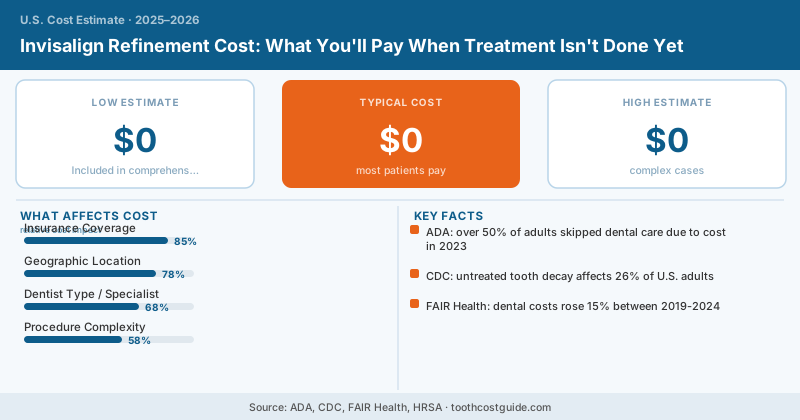
| Included in comprehensive plan | $0 | $0 | $0 |
| One round, add-on fee | $200 | $500 | $1,000 |
| Multiple rounds, no coverage | $500 | $1,200 | $2,500 |
| Mid-course correction (major replan) | $800 | $1,500 | $3,000 |
| Retainer after refinements | $100 | $300 | $600 |
The most important factor: what your original contract says.
Included vs. Not Included — Read Your Contract
Invisalign treatment contracts vary significantly. There are two basic models:
Comprehensive plans with unlimited refinements. Many orthodontists include unlimited refinements for the life of treatment — often up to 5 years. If your teeth aren’t where they should be at the end of your aligner series, they’ll keep making new sets at no additional charge. This is the more patient-friendly approach.
Limited or no refinement coverage. Some providers — particularly general dentists who offer Invisalign as an add-on service — don’t include refinements or cap them at one additional round. Once you’ve used your included refinements (or if you received none), any additional work costs extra.
The mid-tier trap. Invisalign Lite (a shorter, less expensive product designed for mild cases) doesn’t include refinements at all. If your case turns out to be more complex than expected, refinements become an out-of-pocket expense. This catches patients off guard when they chose Lite to save money upfront.
Before starting Invisalign, ask your provider directly: “Does my contract include unlimited refinements? For how many years? What’s the cost if I need refinements beyond what’s included?” Get the answer in writing. This single question can save you hundreds — or thousands — of dollars.
Why Do Teeth Need Refinements?
Refinements aren’t a sign that something went wrong. Tooth movement is biological, and individual variation means teeth don’t always cooperate perfectly with a pre-planned digital sequence. Common reasons refinements are needed:
- Residual rotations — molars and premolars can be stubborn to rotate fully
- Open contacts — small gaps that remain between teeth
- Overbite or overjet — vertical and horizontal discrepancies that need more time
- Attachment issues — if an attachment fell off during treatment, a tooth may not have moved as planned
- Patient compliance gaps — trays worn less than 20–22 hours per day move teeth more slowly and less predictably
Does Insurance Cover Refinements?
Dental insurance that covers orthodontics typically pays a lifetime orthodontic benefit — say, $1,500–$2,500 — regardless of what happens mid-treatment. If you’ve already used that benefit for your initial Invisalign trays, refinements are likely out of pocket.
That said, some insurers treat refinements as continuation of active treatment and apply any remaining orthodontic benefits. It’s worth calling your insurer before assuming you’ll owe the full amount.
The American Association of Orthodontists notes that clear aligner therapy has grown dramatically — orthodontists treated approximately 7.5 million patients with aligners in recent years, and the proportion continues to increase. With that growth has come more variation in treatment contracts, making it especially important to understand your specific terms.
Timing: When Do Refinements Happen?
At the end of your aligner series, your provider will take new photos, X-rays, and scans to assess your progress. There’s typically a 4–8 week wait while Align Technology fabricates your refinement trays. During that time, you wear your final aligner tray (or a retainer) to hold your teeth in place.
Refinements themselves can involve anywhere from 5 to 30+ new trays — depending on how much movement remains. Each tray is worn 1–2 weeks, so you could be looking at 2–3 more months of treatment, or up to a year in complex cases.
Don’t skip refinements if they’re needed. Stopping treatment early because you’re “close enough” often means misalignments that are harder to fix later and retainers that don’t seat properly. Finish the job — especially if refinements are already included in your contract.
How to Minimize Your Refinement Costs
Choose an experienced orthodontist. Orthodontists complete 2–3 years of specialty training beyond dental school. A board-certified orthodontist treats Invisalign cases day in and day out and is better positioned to plan treatment accurately — reducing the likelihood of multiple refinement rounds.
Wear your trays as directed. 20–22 hours per day, every day. Every hour you skip is borrowed time from your tooth movement schedule. Poor compliance is one of the most preventable causes of needing extra refinements.
Negotiate upfront. Some providers will add unlimited refinements to a contract for an additional $200–$500 upfront — a worthwhile premium if your case is complex.
Use your FSA or HSA. Orthodontic treatment — including refinements — is a qualified medical expense. Pay for refinements with pre-tax FSA or HSA dollars to reduce your effective cost by your tax rate.
Bottom Line
Invisalign refinements cost nothing if they’re included in your contract — and that should be the expectation for comprehensive treatment with an orthodontist. If they’re not included, expect to pay $200–$1,500 per round. Before you start Invisalign, the most valuable thing you can do is read your contract carefully and ask specifically about refinement policy. It’s not a fun conversation to have upfront, but it’s far better than having it after your last tray.
Frequently Asked Questions
Invisalign refinements typically cost $0–$1,500 depending on your original treatment plan and provider. Many patients have refinements included in their initial package at no extra charge, while others pay $500–$1,500 if they fall outside their plan's coverage limits.
Most dental insurance plans treat refinements the same as the original Invisalign treatment and cover 50% of the cost after your deductible, up to your annual maximum. However, some plans exclude orthodontics entirely or have separate orthodontic coverage limits, so you'll need to check your specific policy before starting treatment.
Refinement trays typically take 4–12 weeks to complete, depending on the number of additional aligners your orthodontist prescribes. You'll wear each tray for 1–2 weeks, just like your original treatment, and most patients see results within 2–3 months.