Every parent asking about Invisalign Teen ends up at the same question: “But will my kid actually wear them?” That’s the right question. The cost isn’t dramatically different from braces. The technology works. But Invisalign only works when it’s in your teen’s mouth — and that’s where the conversation gets real.
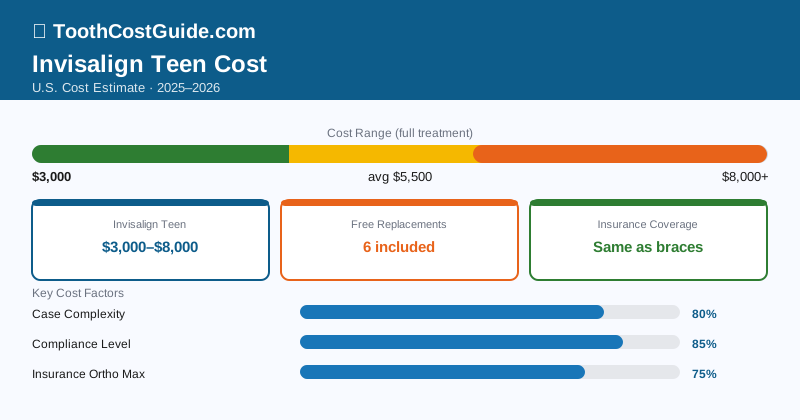
Invisalign Teen costs $3,000–$8,000, comparable to traditional metal braces ($3,000–$5,500) and ceramic braces ($4,000–$7,000). It uses the same aligner technology as standard Invisalign but includes features engineered specifically for the realities of treating teenagers: compliance monitoring, replacement aligner allowances, and accommodations for still-developing teeth.
| Teen Orthodontic Option | Cost Without Insurance |
|---|---|
| Invisalign Teen | $3,000–$8,000 |
| Invisalign Teen (Lite program, mild cases) | $2,500–$4,500 |
| Metal braces (teen) | $3,000–$5,500 |
| Ceramic braces (teen) | $4,000–$7,000 |
| Damon self-ligating braces | $3,500–$7,000 |
| Lingual braces (rarely for teens) | $8,000–$13,000 |
What Makes Invisalign Teen Different
Standard Invisalign works fine for adults who wear aligners reliably and have all their permanent teeth. Teenagers are a different clinical situation — and Align Technology designed Invisalign Teen to address the specific challenges.
Blue compliance indicators. Each aligner has a small blue dot on the back surface that fades with wear — losing approximately one-third of its color for every two weeks of recommended wear. Parents and orthodontists can check the dot without asking. If the dot is still vivid blue after two weeks, the aligners aren’t being worn. This is the most practical oversight tool for the program.
Six free replacement aligners. Teenagers lose things. Aligners end up in cafeteria trash cans, pockets run through the wash, and occasionally — let’s be honest — they get thrown away on purpose. Invisalign Teen includes six free replacement aligner sets at no additional charge. For standard Invisalign, lost aligners cost $50–$150 each to replace.
Eruption tabs. Spaces are built into the aligners to accommodate teeth that haven’t fully erupted — second molars still growing in, wisdom teeth emerging. This lets treatment proceed on a realistic timeline without waiting for every tooth to reach full eruption.
Mandibular Advancement (MA) feature. For teens with overjet (upper front teeth protruding) or Class II bite relationships, certain Invisalign Teen trays incorporate precision wings that hold the lower jaw in a slightly forward position during wear. This accomplishes, in clear aligner form, what a Herbst or Forsus appliance does in fixed braces. Simultaneous bite correction and tooth alignment — no additional appliance.
Vivera retainers. Upon completing treatment, Invisalign-compatible retainers designed for teen patients are available through the same system.
Cost Comparison: Invisalign Teen vs. Braces
For most comparable cases, the price gap is narrower than parents expect.
- Mild teen case: Metal braces $3,000–$4,000 vs. Invisalign Teen $3,000–$4,500 — essentially comparable
- Moderate teen case: Metal braces $4,000–$5,500 vs. Invisalign Teen $4,500–$6,500 — Invisalign somewhat more
- Complex case with bite correction: Metal braces $5,000–$7,000 vs. Invisalign Teen with MA $5,500–$8,000 — Invisalign slightly more
The gap narrows considerably at high-volume Invisalign practices. Platinum and Diamond tier providers — those who submit high case volumes annually — often receive better pricing from Align Technology and may price Invisalign Teen within a few hundred dollars of their braces fee for equivalent complexity.
Invisalign Teen costs similar to braces for most teen cases. The decision should be based on lifestyle fit (removable vs. fixed), case complexity, and compliance honesty — not price. The compliance indicator (fading blue dot) is the most important practical tool: if your teen isn’t wearing aligners 22 hours/day, treatment won’t progress and braces would have been the better choice.
Is Your Teen a Good Candidate?
Not every teenager is a good fit for clear aligners. The clinical appropriateness and the compliance question need to be answered separately.
Clinically appropriate for Invisalign Teen:
- Mild-to-moderate crowding, spacing, or overbite
- Cases that don’t require significant molar movement or complex vertical corrections
- Teens with most or all permanent teeth erupted
Lifestyle factors that favor Invisalign Teen:
- Plays wind instruments — aligners come out for practice, no bracket interference
- Plays contact sports — aligners removed before play, no bracket injury risk
- Appearance is a significant concern (braces affecting self-confidence)
- Has demonstrated responsibility in other areas of life
Cases where braces are likely the better call:
- Complex bite correction (severe overbite, underbite, crossbite)
- Significant molar movement needed
- Younger teens (11–12) with multiple teeth still erupting
- Any teen who tends to lose things, forgets routines, or needs external structure to complete tasks
The Compliance Conversation You Need to Have
Braces work whether your teen cooperates or not — they’re bonded to the teeth and working continuously. Invisalign requires 22 hours of daily wear to move teeth on schedule. When aligners sit in a case on the nightstand for most of the day, teeth don’t move. Money is spent. Time passes. Nothing changes.
Research on teen aligner compliance isn’t encouraging. Some studies report average wear times of 15–18 hours per day in teen populations — well below the 22-hour requirement. That’s not a reason to automatically avoid Invisalign Teen, but it’s a reason to be honest.
Practical strategies that work:
- Set phone reminders to replace aligners after meals
- Keep a case everywhere — every bag, the nightstand, the locker
- Never wrap aligners in a napkin at restaurants (that’s how they get thrown away)
- App-based tracking like DrTray Traytime builds accountability
- Agree on a clear parent-teen monitoring system before treatment starts — what will be checked, when, and what happens if compliance slips
The best filter: Ask your teen directly. Not “would you rather have Invisalign than braces?” — that’s an obvious answer. Ask “can you commit to putting these back in after every meal, every time, for the next 18 months?” If the honest answer is uncertain, braces are the more reliable investment.
Insurance Coverage
Invisalign Teen is covered by dental insurance orthodontic benefits on exactly the same terms as metal braces.
- Lifetime maximum: $1,000–$3,000
- Coverage: 50% up to the lifetime maximum
- Age cutoff: Under 18–19 for most plans
The six free replacement aligners are included in the Invisalign Teen fee — they’re not claimed separately through insurance.
Example calculation:
- Invisalign Teen fee: $5,500
- Insurance lifetime maximum: $1,500
- Insurance pays: $1,500 (50% of the first $3,000 = $1,500, matching the maximum)
- Family out-of-pocket: $4,000
Some insurers have a fee schedule for orthodontic coverage that caps the “allowable” at the cost of metal braces. If your Invisalign Teen case costs $5,500 but the insurer’s metal braces allowable is $4,500, they may base the 50% payment on $4,500 rather than $5,500. Ask your orthodontist’s billing team to verify before starting.
Financing Options
In-house orthodontic plans: Payment spread over the treatment period — typically 18–24 months. A $6,000 Invisalign Teen case over 24 months, after $1,500 insurance benefit = $4,500 at roughly $190/month.
CareCredit: Promotional 0% periods of 12–24 months. Useful for families who prefer managing their own payment schedule separately from the orthodontist’s billing.
FSA: Invisalign Teen is FSA and HSA eligible. Contributing the anticipated patient portion during open enrollment before treatment begins saves 22–37% in federal taxes on that amount.
Sibling discounts: Many orthodontic practices discount fees when multiple children from the same family are in treatment simultaneously or within a short window. Always ask about this — the savings can be $200–$500 per child.
Ways to Spend Less
Compare multiple Invisalign-experienced orthodontists. Platinum and Diamond providers sometimes offer more competitive pricing than lower-tier providers. Use the Invisalign doctor locator to find high-tier providers in your area.
Ask about Invisalign Lite for Teen. For mild teen cases, a limited-aligner Lite program costs $2,500–$4,500 — significantly less than a full Comprehensive program. Ask directly whether your teen’s case qualifies.
Use dental school clinics. Orthodontic residency programs offer Invisalign under faculty supervision at 30–50% discounts. Cases need to be appropriate for resident training, but many standard teen cases qualify.
Stack insurance and FSA. Apply the insurance lifetime maximum first. Pay the remaining balance with FSA funds during the year treatment begins.
Bottom Line
Invisalign Teen costs $3,000–$8,000 — landing in the same range as braces for most teen cases. The clinical advantages (bite correction via MA, eruption tab accommodation, six free replacements) address the specific challenges of treating teenagers. Insurance covers it identically to braces. Whether it’s the right choice comes down to two things: does your teen’s case complexity work for aligners, and will your teen actually wear them? Answer both honestly before committing.
Invisalign Teen is a legitimate alternative to braces for appropriate teen cases at comparable cost. The compliance requirement (22 hours/day) is the central variable — teens who wear aligners consistently get equivalent results to braces; teens who don’t wear them get no results. An honest assessment of your teen’s responsibility level is the most important factor in this decision.
Frequently Asked Questions
Invisalign Teen costs between $3,000 and $8,000, which is comparable to traditional braces. The final price depends on the complexity of your teen's case, treatment duration (typically 12–24 months), and your orthodontist's location and experience.
Most dental insurance plans cover Invisalign Teen at the same rate as traditional braces, typically covering 50% of orthodontic costs up to a lifetime maximum of $1,500–$2,000. Out-of-pocket costs usually range from $1,500–$4,000 after insurance, though this varies by plan and coverage details.
Invisalign Teen includes two replacement aligner sets if your teen loses them, built-in compliance indicators to track wear time, and is designed for mouths still developing. It works best for teens who are responsible about wearing aligners 20–22 hours daily; if your teen struggles with consistency, traditional braces may be a more effective option.