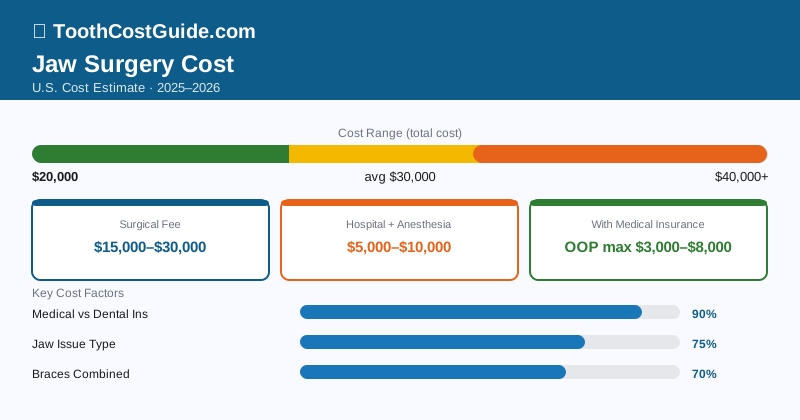
Here’s something that surprises most patients: orthognathic surgery is covered by medical insurance, not dental. That single fact changes the financial calculus dramatically. The complete treatment — pre-surgical braces, the surgery itself, and post-surgical orthodontics — runs $20,000–$40,000 before insurance. With proper medical pre-authorization, most patients land at $5,000–$15,000 out of pocket. What you actually pay depends heavily on how well your care team navigates the insurance process.
| Cost Component | Cost Range |
|---|---|
| Pre-surgical orthodontics (braces, 12–18 months) | $3,000–$6,000 |
| Oral surgeon fee — single-jaw surgery | $6,000–$10,000 |
| Oral surgeon fee — double-jaw surgery (bimaxillary) | $8,000–$15,000 |
| Hospital facility fee (inpatient) | $5,000–$20,000 |
| Anesthesia fee | $1,500–$4,000 |
| Post-surgical orthodontics (6–12 months) | $1,500–$3,000 |
| Imaging, diagnostic records, planning | $500–$2,500 |
| Total (single-jaw, with insurance) | $4,000–$15,000 out-of-pocket |
| Total (double-jaw, without insurance) | $30,000–$50,000+ |
When Jaw Surgery Is Actually Necessary
Orthognathic surgery isn’t a cosmetic upgrade. It corrects skeletal jaw discrepancies — problems with the bone structure of the upper jaw (maxilla), lower jaw (mandible), or both — that orthodontics alone can’t fix. Braces move teeth. They can’t move jaws.
The conditions that legitimately require surgery:
- Severe overbite (Class II): The lower jaw sits too far back. Surgery advances the lower jaw, sets back the upper, or both
- Severe underbite (Class III): Lower jaw protrudes. Surgery sets it back or advances the upper jaw
- Open bite: Upper and lower teeth don’t touch when you bite down. Surgery rotates the jaw to close the vertical gap
- Facial asymmetry: One side of the jaw is significantly longer than the other
- Obstructive sleep apnea: Maxillomandibular advancement (MMA) is one of the most effective surgical treatments for severe OSA — sometimes more effective than a CPAP machine
- Cleft palate sequelae, congenital abnormalities, and post-trauma reconstruction
The functional impairment angle matters enormously for insurance coverage. Difficulty chewing, speech problems, sleep apnea, and TMJ pain from skeletal misalignment are the arguments that get pre-authorization approved.
The Four Phases (and What Each Costs)
Phase 1 — Pre-surgical orthodontics ($3,000–$6,000) Braces go on 12–18 months before surgery. The counterintuitive part: this phase is supposed to make the bite look worse. The orthodontist removes dental compensation — the way your teeth have shifted over time to partially adapt to the jaw mismatch — to set up the jaw for proper repositioning. Patients often get frustrated at this stage because they can’t see progress. That’s normal.
Phase 2 — Surgical planning ($500–$2,500) Modern orthognathic surgery relies on 3D imaging (cone beam CT), digital planning software, and in many practices, 3D-printed surgical guides. The surgeon maps exactly how far and in what direction each jaw will move. This planning phase has gotten considerably more sophisticated in the past decade, which has improved outcomes.
Phase 3 — Surgery ($12,000–$35,000 total surgical and hospital costs) Done under general anesthesia, inpatient, with a 1–3 night hospital stay. Incisions are made inside the mouth — no external scars. The jaw bones are cut, repositioned to the planned coordinates, and held in place with titanium plates and screws. Single-jaw surgery takes 2–3 hours; bimaxillary (both jaws) takes 4–6 hours. You’re not wired shut in modern surgery — most patients can open their mouths within a few days for jaw exercises.
Recovery takes 4–6 weeks before returning to most activities. Full bone healing: 6–12 months.
Phase 4 — Post-surgical orthodontics ($1,500–$3,000) Six to twelve months of fine-tuning. Now that the jaw is in its new position, the orthodontist finishes aligning the teeth to match. Braces or aligners are used for this phase.
Jaw surgery must be performed by a board-certified oral and maxillofacial surgeon with specific orthognathic surgery training and volume. Not all OMS surgeons perform jaw repositioning surgery regularly — ask specifically how many orthognathic cases your surgeon performs per year and whether they use digital surgical planning. Volume and specialization matter significantly for outcomes.
How Medical Insurance Coverage Works
The surgical and hospital portions of orthognathic surgery are medical expenses, billed to your health insurance — not your dental plan. Most major medical plans cover them when the case is documented as medically necessary.
What medical insurance typically covers:
- Surgeon’s fee at the contracted rate (usually 70–90% after deductible/out-of-pocket max)
- Hospital facility fee under the inpatient surgical benefit
- Anesthesiologist fee as part of the surgical benefit
- Pre-operative imaging and planning under diagnostic benefits
Documentation required to get pre-authorized:
- Clinical photographs and X-rays showing the jaw discrepancy
- Dental models and bite records
- A detailed letter of medical necessity from your orthodontist
- A detailed surgical plan letter from your OMS
- Jaw discrepancy measurements in millimeters
- Description of functional impairments: chewing difficulty, speech problems, sleep apnea, TMJ pain
Dental insurance’s role: Your dental plan covers the orthodontic phases — pre-surgical and post-surgical braces — under the orthodontic benefit, typically up to a lifetime maximum of $1,000–$3,000.
What combined coverage looks like for a double-jaw case:
- Total surgical and hospital cost: $25,000
- Medical insurance pays (80% after $5,000 out-of-pocket max): $16,000
- Patient medical share: $5,000–$9,000
- Orthodontics (both phases): $5,000
- Dental insurance pays (up to $2,000 lifetime max): $2,000
- Patient orthodontic share: $3,000
- Realistic total out of pocket: $8,000–$12,000
Pre-authorization from medical insurance is mandatory before proceeding with jaw surgery. Insurance companies require a detailed letter of medical necessity and supporting documentation. Starting surgery without pre-authorization — or being denied and appealing after the fact — is extremely difficult. Ensure your surgeon’s billing team is experienced with orthognathic surgery pre-authorization. This process can take 30–90 days.
Cases Where Surgery Isn’t the Right Call
Not every Class II or Class III bite requires orthognathic surgery. Surgery isn’t appropriate when:
- The jaw discrepancy is mild enough that orthodontic camouflage (dental compensation) produces acceptable results
- The patient is under 18 with incomplete jaw growth — surgery before growth is finished risks relapse
- There’s no functional impairment — cosmetic dissatisfaction alone doesn’t justify the procedure
- Medical comorbidities make general anesthesia and hospital admission too risky
Genioplasty (chin repositioning) is sometimes confused with full orthognathic surgery. It’s a separate, simpler procedure addressing only the chin — useful for minor chin asymmetry or projection, costing $5,000–$10,000. It doesn’t correct the underlying jaw relationship.
Financing the Out-of-Pocket Balance
Getting medical insurance pre-authorization is the most important financial step. Your surgeon’s billing team should handle this — if they’re not experienced with orthognathic pre-auth, that’s a red flag.
For remaining out-of-pocket costs:
- Hospital payment plans: Hospitals typically offer 0% financing over 24–60 months for large balances
- Medical financing (CareCredit, Prosper Healthcare Lending): Healthcare-specific credit products for large expenses
- HSA funds: Every dollar of surgical expense is fully HSA-eligible — use yours
For orthodontic costs: standard dental practice financing through CareCredit or FSA/HSA funds works here.
Three Ways to Reduce the Total Cost
Academic medical centers. University hospital OMFS programs and affiliated orthodontic programs handle combined surgical cases at academic rates — frequently 20–40% below private practice. The procedures are performed by supervised residents, but attending faculty oversee everything. For patients with geographic flexibility, this is the most powerful cost-reduction option.
In-network verification before you start. In-network versus out-of-network can be a 40–60% difference in surgical fees. Verify that your surgeon, anesthesiologist, and hospital facility are all in-network — separately. Don’t assume.
Appeal denials with full documentation. Initial denials for orthognathic surgery are common. A well-prepared appeal including clinical photographs, measurements, functional impairment documentation, and a narrative from the surgeon has a meaningful success rate. Don’t accept the first no.
Bottom Line
The $20,000–$40,000 sticker price for complete orthognathic surgery comes down substantially with proper medical insurance management. Most patients with good insurance and thorough documentation end up at $5,000–$15,000 out of pocket. Academic medical center programs push costs even lower. Plan for a 2–3 year total treatment timeline, get pre-authorization before anything starts, and confirm in-network status for every provider involved.
Jaw surgery is a major investment but a life-changing procedure for patients with significant skeletal jaw discrepancies. Medical insurance covers the surgical component when properly documented. Plan 2–3 years for the full treatment process. Get pre-authorization before starting, choose in-network providers, and consider academic medical centers for maximum quality at the best total cost.
Frequently Asked Questions
The complete treatment including pre-surgical braces, the surgery itself, and post-surgical orthodontics costs $20,000–$40,000 total before insurance. With medical insurance pre-authorization, most patients pay $5,000–$15,000 out of pocket after their deductible and coinsurance are met.
Orthognathic surgery is covered by medical insurance, not dental insurance, which significantly reduces your out-of-pocket costs compared to cosmetic procedures. You'll need to obtain pre-authorization from your medical insurance company before surgery to ensure coverage and understand your specific deductible and coinsurance obligations.
The entire process typically takes 18–24 months, beginning with 12–18 months of pre-surgical braces to align your teeth, followed by the surgery itself, and then 6–12 months of post-surgical orthodontic refinement. Most surgeons recommend completing treatment during your teenage years or early adulthood when bone growth is stable.