You have about 30 minutes. That’s the window where getting a knocked-out tooth back in the socket has an 80–90% chance of success. After 60 minutes dry, those odds drop sharply. After 2 hours — you’re not saving the tooth.
This is one of the rare dental situations where what you do in the first 10 minutes determines whether you pay $1,500 or $6,000. Read the action steps first. The cost breakdown can wait.
What to Do Right Now (The 30-Minute Protocol)
Find the tooth. Pick it up by the crown — the white part — never by the root. The root has delicate periodontal ligament cells that make re-implantation possible. Touching the root damages them.
Don’t scrub it. If it’s dirty, rinse gently with water for 10 seconds. Leave any tissue fragments attached.
Try to re-insert it yourself. Gently reposition the tooth in its socket and bite down on a clean cloth or gauze. If you can do this successfully within 5 minutes of injury, you’ve dramatically improved the outcome.
If you can’t re-insert it: put it in milk. Milk is the gold-standard transport medium for avulsed teeth — the osmolarity and pH keep the root cells alive. Saline solution works too. Keeping it in the space between your gum and cheek (sublingually) also works. Do not store it in plain water — it’s hypotonic and destroys root cells.
Call your dentist on the way. Describe what happened. A good dental office can prepare for your arrival and get you into the chair immediately. If your dentist isn’t available, go directly to a hospital ER.
Do not take ibuprofen before being seen if possible — some protocols prefer no NSAIDs in the immediate trauma window, though this is a minor consideration compared to getting there fast.
The Cost Breakdown
| Treatment | Cost Without Insurance |
|---|---|
| Emergency exam + X-rays | $100–$250 |
| Tooth re-implantation | $500–$1,500 |
| Splinting (stabilizing the tooth, 2–4 weeks) | $200–$500 |
| Root canal (nearly always needed after) | $800–$1,500 |
| Follow-up monitoring | $200–$500 |
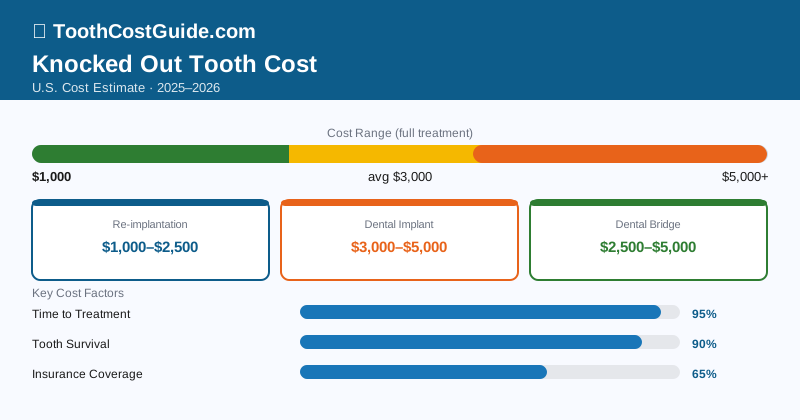
| Total if re-implantation succeeds | $1,800–$4,000 |
| Dental implant (if re-implant fails/not possible) | $3,500–$6,000 |
| Fixed bridge (3-unit alternative) | $3,000–$5,000 |
| Removable partial denture | $1,000–$2,500 |
The math is clear: acting fast to save the natural tooth costs $1,800–$4,000 total. Waiting until re-implantation isn’t viable and needing an implant costs $3,500–$6,000 — plus several months of healing before the final restoration.
What Happens After Re-Implantation
Most patients don’t realize that a successfully re-implanted tooth still requires root canal therapy. The trauma severs the pulp tissue, which doesn’t survive even when the tooth is returned to the socket. Your dentist will monitor the tooth and typically initiate root canal treatment within 7–14 days.
The re-implanted tooth is splinted to neighboring teeth for 2–4 weeks to stabilize while the periodontal ligament reattaches. A rigid splint (metal wire) is avoided because it can interfere with reattachment — a more flexible splint is standard.
Long-term success rates for re-implanted teeth vary significantly. A 20-year-old’s tooth re-implanted within 15 minutes has a high probability of lasting decades. A 40-year-old’s tooth re-implanted at the 50-minute mark may eventually experience root resorption (the body slowly resorbs the root) and require replacement anyway — but often not for 5–15 years. Buying time with a re-implanted natural tooth while planning longer-term treatment is legitimate.
When Re-Implantation Isn’t the Answer
Baby teeth are not re-implanted. Pushing a baby tooth back in the socket risks damaging the developing permanent tooth underneath. A knocked-out baby tooth is examined and monitored, but the tooth is not replaced. The permanent tooth will eventually erupt normally.
Badly damaged sockets — fractured, heavily contaminated, or with significant bone loss — may not support re-implantation. The dentist evaluates the socket before proceeding.
Time expired. If the tooth was out of the mouth for more than 60–90 minutes and stored dry, re-implantation is unlikely to be attempted. The periodontal ligament cells are no longer viable.
In these cases, you move directly to replacement planning:
Dental implant ($3,500–$6,000): The long-term standard. A titanium post is placed in the healed socket — typically 3–4 months after injury to allow bone recovery — and a ceramic crown is placed on top 3–6 months later. Total timeline: 6–12 months from injury to final tooth. Lasts 20+ years.
3-unit fixed bridge ($3,000–$5,000): Two healthy teeth on either side of the gap are crowned; a false tooth (pontic) bridges the space. No surgery, faster timeline than an implant, but requires permanently reducing two healthy teeth. Lasts 10–15 years average.
Partial denture ($1,000–$2,500): A removable appliance with a false tooth. Lowest cost. Least comfortable and functional. An option when cost is the primary constraint.
Temporary flipper ($300–$500): A simple removable appliance used while you plan definitive replacement. Purely cosmetic — it fills the gap so you’re not missing a front tooth at work while you save up for or heal toward an implant.
If the injury happened in a car accident, your auto insurance may cover dental trauma under personal injury protection (PIP) or medical payments coverage. If someone else caused the accident, their liability coverage may apply. If the tooth was knocked out in a sports incident at a facility with liability insurance, that coverage may apply. File with both your medical and dental insurance — the emergency room portion of trauma care is often medical, not dental.
Insurance Coverage for Knocked-Out Teeth
Coverage is split across several procedure codes:
- Emergency exam: 80–100% (diagnostic benefit)
- Re-implantation (D7270): 50–80% under oral surgery on most PPO plans; some plans have specific language; verify before assuming
- Splinting: 50–80% under oral surgery
- Root canal after re-implant: 50–80% (basic/major depending on plan)
- Dental implant (if needed): Rarely covered; some plans have $1,000–$1,500 implant benefit that barely offsets the cost
- Bridge: 50% under major restorative
Realistic estimate with standard insurance: Re-implantation + splinting + root canal totaling $3,000, plan covers 50–60% = patient pays $1,200–$1,500.
If the tooth ultimately fails and an implant is needed later, expect to pay $3,000–$5,000 out of pocket given typical implant exclusions.
Where to Pay Less on the Replacement
If you ultimately need an implant after a failed re-implantation or late-arriving injury:
Dental school implant programs charge $1,500–$3,000 all-in for a full implant, compared to $3,500–$6,000 privately. The university setting means more appointments and longer timelines, but the surgical quality is faculty-supervised. This is the most meaningful cost reduction available for an implant.
Use the time. Implants require a healing period between post placement and crown delivery. You have months to arrange financing or save — a temporary flipper fills the gap cosmetically in the meantime.
Bottom Line
A knocked-out tooth is a race against time. Thirty minutes is the target window; 60 minutes is the outer limit for viable re-implantation. The total cost to save a natural tooth runs $1,800–$4,000 all-in. The cost to replace it with an implant later runs $3,500–$6,000.
Know the 4-step protocol: pick up by the crown, don’t scrub, try to re-insert immediately, store in milk if you can’t. Then get to a dentist as fast as possible. Speed is free; the consequences of delay are expensive.
A knocked-out permanent tooth is a dental emergency. Do not wait until the next business day. If your dentist is unavailable, go to an emergency room — they can stabilize the situation even if they can’t perform the full re-implantation procedure. Do not clean the root with soap or hydrogen peroxide. Do not let the tooth dry out. And if the tooth cannot be saved, have an honest conversation with your dentist about temporary options while you plan permanent replacement.
Frequently Asked Questions
Re-implanting a knocked-out tooth typically costs $500–$2,000, depending on whether the tooth survives the procedure and any additional treatments needed. This is significantly less expensive than extracting the tooth and replacing it with an implant, which costs $3,500–$6,000.
Most dental insurance plans cover knocked-out tooth treatment under emergency or restorative benefits, typically covering 50–80% of costs after your deductible. However, many plans exclude cosmetic procedures or have annual maximums ($1,000–$2,000), so your out-of-pocket cost may range from $300–$2,500 depending on your specific plan.
Teeth have the highest chance of successful re-implantation (80–90% success rate) if placed back in the socket within 30 minutes of being knocked out. After 60 minutes of being dry, success rates drop sharply, and after 2 hours, re-implantation is typically not viable, leaving you to pursue a $3,500–$6,000 implant replacement instead.