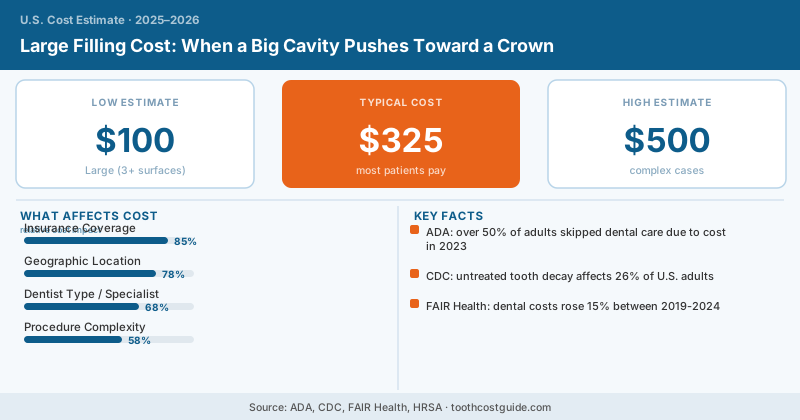
Three surfaces. Maybe four. Your dentist is describing a cavity that wraps across the top of the tooth and down two sides, and the quote keeps climbing. A large filling costs a lot more than a small one — and at some point, paying more for a filling stops making sense and a crown becomes the smarter buy. Knowing where that line falls can save you from redoing the same tooth twice.
Large Filling Costs at a Glance
| Filling Size | Composite (No Insurance) | Amalgam (No Insurance) |
|---|---|---|
| Small (1 surface) | $150–$300 | $100–$200 |
| Medium (2 surfaces) | $200–$450 | $150–$300 |
| Large (3+ surfaces) | $250–$600 | $200–$450 |
| Very large / cusp involved | $350–$700+ | $250–$500 |
A large multi-surface filling typically runs $250–$600. The ADA’s fee surveys show filling costs climb steadily with the number of surfaces, because each added surface means more drilling, more material, and more chair time. The CDC reports about 90% of adults 20–64 have had cavities, and the big ones are where costs really jump.
Why Big Fillings Cost More
A filling is priced by how many surfaces of the tooth it covers — and a large cavity touches more of them. As the cavity grows:
- The dentist removes more decay and shapes a bigger cavity
- More filling material is packed and cured layer by layer
- The bite has to be carefully balanced across a larger restoration
- The procedure simply takes longer
That’s straightforward. The harder question is whether a filling is even the right fix once the cavity gets big.
Here’s the rule dentists use: once a filling replaces too much of the tooth, the remaining walls get thin and prone to cracking. A general guideline is that when a filling would cover more than about half the tooth’s width — or one or more cusps (the pointed corners) are involved — a crown becomes the more durable choice. A huge filling that fractures the tooth a year later can cost you the tooth entirely. Ask your dentist: “Is this tooth strong enough to hold a filling, or does it need a crown?”
Large Filling vs Crown vs Onlay
When a cavity is borderline-large, you’ve got three options:
- Large filling ($250–$600) — Cheapest up front, but thin remaining walls can crack under chewing. Best when enough solid tooth remains.
- Onlay ($650–$1,500) — A lab-made partial cover that’s stronger than a filling but more conservative than a crown. A good middle ground for big cavities.
- Crown ($800–$2,500) — Wraps and protects the whole tooth. Best when little solid structure is left or a cusp is gone.
Paying $500 for a large filling that fails in a year, then $1,500 for the crown you needed anyway, costs more than just doing the crown once. Our crown vs filling guide breaks down exactly when to make the jump.
Does Insurance Cover Large Fillings?
Most dental plans cover fillings at 70–80% after the deductible — a better tier than crowns, which sit at 50%. That’s actually an argument for a filling when one will hold: your share is smaller. But if the tooth genuinely needs a crown, a too-small filling that fails just wastes that benefit. Watch the “alternate benefit” clause that may pay only the amalgam rate on back teeth. See how dental insurance works.
How to Pay Less
Catch it early. A small filling now is a fraction of a large filling — or a crown or root canal — later. Regular checkups are the cheapest dentistry there is.
Dental school clinics place even complex fillings under supervision at 40–60% below private fees.
Ask about the right fix once, not the cheapest fix twice. Sometimes spending more on an onlay or crown up front is the budget move. Uninsured patients can use a dental savings plan or CareCredit financing.
If your dentist recommends a crown over a large filling, don’t assume it’s an upsell — a thin-walled filled tooth that cracks can lead to a root canal or extraction. But it’s fair to ask why a filling won’t hold and to get a second opinion if you’re unsure. Always get a written, itemized treatment plan and a predetermination before deciding.
Bottom Line
A large filling costs $200–$600 depending on size and material, with multi-surface composites at the higher end. But past a certain size — when more than half the tooth or a cusp is involved — a filling’s thin remaining walls can crack, and a crown or onlay becomes the more durable, ultimately cheaper choice. Insurance covers fillings at a better rate than crowns, so when one will hold, take it. When it won’t, paying once for the crown beats paying twice. Ask your dentist where your tooth falls, and catch cavities early to avoid the question altogether.
Frequently Asked Questions
A large multi-surface filling typically costs $200–$600 depending on the material and number of surfaces involved. Composite (tooth-colored) fillings are generally more expensive than amalgam fillings, which may cost $150–$400 for a large restoration.
Most dental insurance plans cover 70–80% of filling costs after your deductible is met, leaving you to pay the remaining 20–30% out-of-pocket. However, if your dentist recommends a crown instead of a large filling, insurance may deny coverage for the filling and require the crown, depending on your plan's guidelines.
Once a cavity covers three or more tooth surfaces or extends deep into the tooth, a crown ($800–$1,500) often becomes the better choice than a large filling because it provides greater durability and longevity. A large filling in this situation may fail within 5–10 years and require replacement, whereas a crown typically lasts 10–15 years or longer.