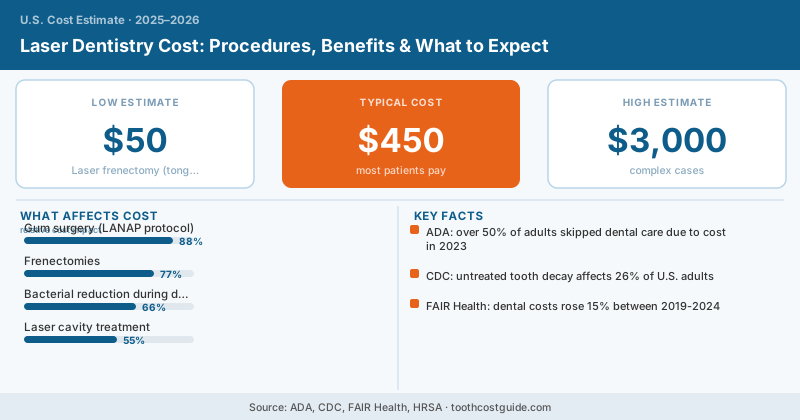
A dental laser system costs the practice $30,000–$100,000. That investment gets passed to patients as per-procedure premiums. Sometimes those premiums are genuinely worth it — laser has real clinical advantages for certain procedures. Other times, you’re paying for equipment that makes the dentist’s job easier without meaningfully changing your outcome. Let’s sort those two categories out.
Laser Dentistry Cost by Procedure
| Procedure | Conventional Cost | With Laser | Premium |
|---|---|---|---|
| Gum contouring (per tooth) | $50–$150 | $200–$400 | $150–$250 |
| Laser bacterial reduction (scaling add-on) | Not applicable | $75–$150 per quadrant | — |
| Laser cavity treatment (small decay) | $150–$200 | $250–$500 | $100–$300 |
| Laser frenectomy (tongue/lip tie) | $300–$600 | $600–$1,500 | $300–$900 |
| Laser gum surgery (LANAP protocol) | N/A (vs. $1,000–$3,000 conventional) | $1,500–$4,000 per arch | Varies |
| Laser teeth whitening (in-office) | $400–$600 chairside | $500–$900 | $100–$300 |
The “laser premium” isn’t a flat markup — it depends heavily on the procedure type and how much the technology genuinely changes what the dentist can accomplish.
Where Laser Has Real Clinical Value
Gum surgery (LANAP protocol). Laser-Assisted New Attachment Procedure uses a specific Nd:YAG laser to treat moderate-to-severe gum disease without cutting and suturing. For patients who’ve been told they need conventional gum surgery, LANAP can achieve comparable bacterial reduction with less bleeding, less swelling, and faster healing. The ADA and FDA have both cleared the technology — this isn’t just marketing. Cost runs $1,500–$4,000 per arch, comparable to conventional periodontal surgery.
Frenectomies. Laser frenectomies (tongue-tie and lip-tie releases) produce less bleeding than scissors-based procedures, require no sutures in most cases, and tend to heal slightly faster in infants. The premium is real but so is the clinical difference.
Bacterial reduction during deep cleaning. Adding laser bacterial reduction to a dental deep cleaning targets bacteria in the pockets after scaling. The evidence is mixed — some studies show modest reduction in pocket depths; others show no significant difference. Discuss whether your specific pocket depths actually justify the $75–$150 per quadrant add-on.
Ask your dentist: “What specifically will the laser do for this procedure that conventional treatment wouldn’t?” and “Is there a peer-reviewed reason to choose laser for my situation?” A dentist who answers these clearly is likely using laser appropriately. One who answers vaguely with “it’s better and more comfortable” may be selling you equipment cost recovery.
Where the Premium Is Harder to Justify
Laser cavity treatment. For very small cavities in accessible areas, some practices use laser to remove decay without a drill — no needle, no vibration. It sounds appealing. But it only works for small, early decay; larger or deeper cavities still need a drill. The premium ($100–$300 over conventional) is real, and for patients without needle anxiety, the clinical outcome is the same either way.
Laser teeth whitening. A 2020 review in the Journal of Dental Research found that the laser or LED light used in in-office whitening doesn’t significantly enhance the whitening effect compared to the bleaching gel alone. The gel does the work. You’re paying for the activating light’s presence, which may be more placebo than chemistry.
“Laser dentistry” isn’t a protected term — a practice can market itself as a “laser dentistry office” after purchasing even basic soft-tissue laser equipment. Ask specifically what type of laser they use (diode, Nd:YAG, Er:YAG, CO2) and for which procedures it’s FDA-cleared. Different lasers have genuinely different capabilities, and the type matters for your specific procedure.
Insurance Coverage for Laser Procedures
Most dental insurance plans cover the procedure, not the method. They’ll pay what they’d pay for conventional gum surgery, a conventional frenectomy, or a conventional filling — and you pay the laser premium out of pocket.
The exception is LANAP, which has enough clinical evidence behind it that some PPO plans have begun covering it at the same level as conventional periodontal surgery. Pre-authorize before scheduling.
For gum-related laser procedures, also see our guide on gum disease treatment cost for the full spectrum of periodontal treatment costs.
Bottom Line
Laser dentistry adds $100–$900 per procedure depending on the application. The technology earns its premium for gum surgery (LANAP), frenectomies, and targeted bacterial reduction in documented periodontal disease. For small cavity removal and in-office whitening, the clinical advantage over conventional methods is marginal at best. Insurance pays for procedures, not for the laser — so the premium typically comes out of your pocket. Ask for a clear clinical rationale before you pay it.
Frequently Asked Questions
Laser dentistry typically adds $100–$300 per procedure on top of the conventional treatment cost. For example, a laser gum treatment might cost $500–$800 total, while the same procedure done conventionally would run $300–$600, depending on your dentist's pricing and your location.
Most dental insurance plans cover only the conventional procedure cost and classify laser treatment as an upgrade or elective add-on, leaving you responsible for the $100–$300 premium out-of-pocket. Check your specific plan's coverage terms, as some insurers may cover laser treatment for medical reasons like severe gum disease.
For simple cavities, conventional filling typically delivers the same clinical outcome, making the laser premium harder to justify. Laser becomes more worthwhile for cosmetic cavity removal on front teeth or cases involving anxiety, since it reduces noise and vibration, though you'll pay $100–$200 extra for that comfort benefit.