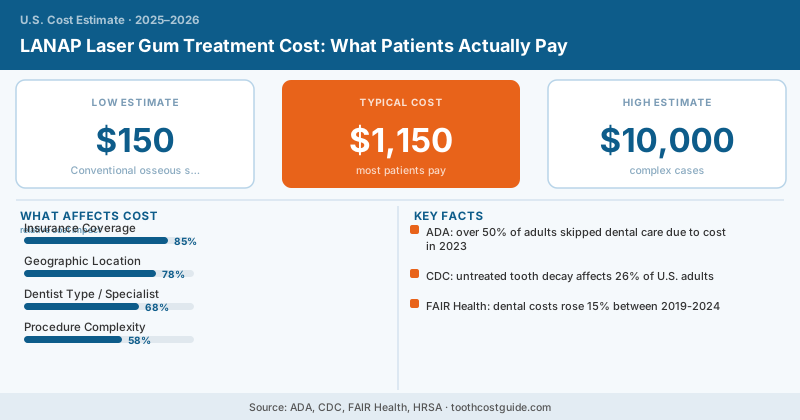
The quote that stopped one Atlanta patient cold: $6,800 for two arches of LANAP. Her periodontist had told her conventional gum surgery would cost roughly the same — so why was she hesitating? Because “laser” sounds expensive even when the numbers are nearly identical. Here’s what the data actually shows about LANAP costs, outcomes, and whether your insurance will pitch in.
What LANAP Is — and Isn’t
LANAP stands for Laser-Assisted New Attachment Procedure. It uses a specific Nd:YAG laser (the PerioLase MVP-7) to target and remove diseased gum tissue and bacteria inside periodontal pockets without cutting. The laser’s wavelength preferentially destroys diseased tissue while leaving healthy tissue largely intact. No scalpel, no stitches in most cases.
It’s FDA-cleared and has been around since the 1990s. The American Academy of Periodontology recognizes it as a viable treatment option for moderate-to-severe periodontitis. The CDC estimates that 47% of adults over 30 in the U.S. have some form of periodontal disease — so there’s no shortage of potential candidates.
LANAP Cost Breakdown
| Treatment Scope | Typical Cost Range |
|---|---|
| LANAP — single quadrant | $500–$1,200 |
| LANAP — one arch (upper or lower) | $1,500–$4,000 |
| LANAP — full mouth (both arches) | $3,000–$8,000 |
| Conventional osseous surgery — per quadrant | $800–$1,500 |
| Conventional full-mouth surgery | $4,000–$10,000 |
| Follow-up maintenance visits (per visit) | $150–$300 |
Prices vary based on the severity of your bone loss, the number of teeth involved, and whether your provider charges a per-arch or per-quadrant fee. Major metro areas — New York, LA, Chicago — tend to sit at the upper end. Rural practices and smaller cities often come in lower.
Does Insurance Cover LANAP?
This is where it gets complicated. Most dental PPO plans cover the procedure type — periodontal surgery — not the specific method. If your plan pays 50% for conventional osseous surgery, it will typically pay 50% of what it considers a “usual and customary” fee for periodontal surgery and you cover the rest, including any premium for the laser approach.
The good news: enough PPO carriers now have LANAP-specific codes (D4261, D4262 for osseous surgery; sometimes submitted under D4341/D4342 with supplemental documentation) that pre-authorization is genuinely worth pursuing. Some carriers, including certain Delta Dental and Cigna PPO plans, have reimbursed LANAP at osseous surgery rates when documentation of pocket depths and bone loss is submitted.
Submit a predetermination request to your insurance carrier with full periodontal charting (pocket depths, bleeding on probing, bone loss on X-rays). Ask your periodontist to use procedure code D4261 or D4262. A written pre-auth doesn’t guarantee payment but gives you a realistic cost estimate before you commit.
LANAP vs. Conventional Surgery: Real Differences
The clinical literature shows LANAP achieves comparable pocket-depth reduction to conventional surgery in patients with moderate-to-severe periodontitis. A 2014 study in the International Journal of Periodontics & Restorative Dentistry found similar clinical attachment levels between LANAP and open-flap debridement at 12 months.
The practical differences patients care about:
- Recovery time. Most LANAP patients return to normal activity within 24 hours. Conventional surgery typically involves 2–7 days of significant discomfort and dietary restriction.
- Sutures. LANAP usually requires none. Conventional surgery almost always does.
- Bone regeneration claims. Some providers claim LANAP promotes bone regrowth. The evidence here is less conclusive — some case studies show bone fill; controlled trials are limited.
“LANAP-certified” doesn’t mean every provider using a laser is performing the actual FDA-cleared LANAP protocol. The PerioLase MVP-7 is the only laser cleared for the full LANAP protocol. Ask your provider specifically whether they’re using the PerioLase and are trained through the Institute for Advanced Laser Dentistry (IALD). Other diode lasers sold as “LANAP-equivalent” are not the same procedure.
Who’s a Good Candidate?
LANAP works best for patients with:
- Moderate-to-severe periodontitis (pocket depths of 4mm or greater)
- Some remaining bone height (LANAP can’t restore severely destroyed bone)
- Systemic conditions that make conventional surgery higher-risk (diabetes, anticoagulant use, immunosuppression)
- Strong preference to avoid cutting and suturing
It’s not a replacement for every gum situation. Mild gingivitis responds well to deep cleaning alone. Severe bone loss may require conventional bone grafting that LANAP can’t address.
Bottom Line
LANAP costs $1,500–$4,000 per arch, which puts it in the same ballpark as conventional gum surgery when you account for the faster recovery and typically no-suture experience. Insurance coverage is possible with proper pre-authorization. The technology is FDA-cleared and clinically validated for moderate-to-severe periodontitis. Just make sure you’re seeing a provider using the actual PerioLase system — not a generic laser marketed under the LANAP name.
Frequently Asked Questions
LANAP costs between $1,500 and $4,000 per arch, with most patients paying $3,000–$6,800 for treatment of both upper and lower teeth. This price is typically comparable to conventional gum surgery, though it varies by periodontist location, severity of gum disease, and number of teeth treated.
Most dental insurance plans cover LANAP similarly to conventional gum surgery—typically 50% of the cost after your deductible, since it treats the same periodontal disease. However, coverage varies by plan; some insurers classify it as cosmetic and deny claims, so contact your provider before scheduling to confirm your out-of-pocket responsibility.
Yes, LANAP generally offers faster recovery with minimal bleeding and swelling compared to scalpel surgery, with most patients returning to normal eating within 1–2 weeks versus 3–4 weeks for traditional gum surgery. Results are comparable between both methods, making LANAP a good option if you want a less invasive approach with similar effectiveness.