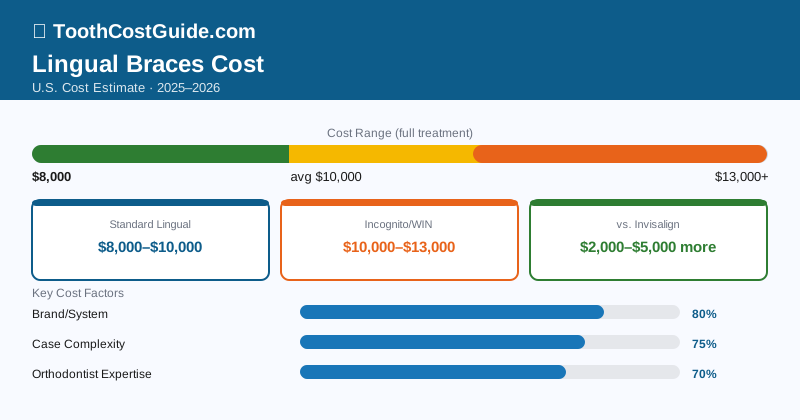
Lingual braces are the most expensive fixed orthodontic option available — and the only one that’s completely invisible from the front. The brackets live on the tongue side of the teeth. When you smile, there’s nothing to see. That’s the entire value proposition, and for a specific type of patient, it’s worth every dollar of the $8,000–$13,000 price tag.
But the premium isn’t arbitrary. This article explains exactly why lingual braces cost 2–3x more than traditional braces, who the right candidate actually is, and when Invisalign or ceramic braces can give you similar results for a fraction of the price.
| Lingual Braces Type | Cost Without Insurance |
|---|---|
| Full upper and lower lingual braces | $8,000–$13,000 |
| Upper arch only (lower = clear aligners) | $5,000–$8,000 |
| Incognito (3M) lingual system | $9,000–$13,000 |
| WIN Lingual Braces | $8,000–$12,000 |
| eBrace (CAD/CAM lingual) | $8,000–$12,000 |
| Traditional metal braces (for comparison) | $3,000–$7,500 |
| Invisalign Full (for comparison) | $3,000–$8,000 |
Why Lingual Braces Cost So Much
This isn’t cosmetic markup. The price reflects genuine technical costs at every stage of treatment.
Lab fabrication. Lingual brackets are custom-milled for each individual tooth using digital scans and CAD/CAM technology. Lab fees alone run $1,500–$3,000 for a full case — roughly 5–10x the lab cost of standard brackets. For systems like Incognito, the archwires are robotically bent to patient-specific prescriptions, not pulled from stock inventory. Each case is essentially a unique manufactured product.
Specialist training, limited supply. Few orthodontists are certified in lingual techniques. Training courses for Incognito or WIN systems cost the orthodontist $5,000–$10,000 to attend. That investment plus the limited provider pool means you’re in a low-competition market — and prices reflect that. In some cities, one or two providers offer lingual braces total.
Longer chair time per appointment. Working behind the teeth in a confined space requires significantly more time per adjustment visit. Each appointment runs 30–60% longer than equivalent labial braces adjustments. That time cost compounds over 18–30 months of treatment.
Case complexity. Mild crowding at the lower end of the range. Severe malocclusion, large overbites, or cases requiring significant molar movement push toward $12,000–$13,000.
The Systems Available
Incognito (3M) — $9,000–$13,000: The most widely used fully customized lingual system in the US. Each bracket is milled from gold alloy, fitted precisely to the individual tooth. Archwires are robotically bent per patient. The gold standard in lingual orthodontics, with the highest lab costs and most rigorous clinical training requirements.
WIN Lingual Braces — $8,000–$12,000: German-engineered, using custom brackets and prefabricated or custom wires. Results comparable to Incognito. Slightly lower lab fees in some cases. Fewer certified US providers than Incognito.
eBrace — $8,000–$12,000: A CAD/CAM lingual system with self-ligating bracket capability. Fully digital workflow from impressions through fabrication. Available primarily through urban market providers.
STb Light Lingual System — $7,000–$10,000: A smaller, lower-profile bracket suited to mild-to-moderate crowding. Less expensive than Incognito for appropriate cases. Not the right choice for severe malocclusion.
Hybrid approach (upper lingual + lower Invisalign) — $7,000–$11,000: Lingual braces on the upper arch (the arch you see when someone smiles) with clear aligners on the lower. Reduces cost by $1,500–$3,000 versus full lingual treatment. A pragmatic option when the lower case doesn’t require lingual precision.
Lingual braces deliver the same clinical results as labial braces for most case types while remaining completely invisible. The 2–3x price premium over traditional braces reflects genuine technical costs — custom lab fabrication and specialized clinical training — not simply a cosmetic markup.
Who Should Actually Consider Lingual Braces
Lingual braces are the right choice in a specific, narrow set of circumstances:
- Adults in high-visibility professional roles (television, public speaking, client-facing work at a senior level) for whom any visible orthodontic appliance would be professionally problematic
- Patients with complex cases requiring fixed-appliance precision who cannot reliably comply with 22 hours/day of aligner wear
- Cases where Invisalign has already failed or is contraindicated due to case complexity
For everyone else — mild crowding, moderate cases, or patients who can manage aligner compliance — ceramic braces or Invisalign deliver comparable aesthetics at $3,000–$8,000 less. An honest orthodontist will tell you if your case falls into this category.
Insurance
Coverage follows the same rules as any orthodontic treatment:
- Lifetime orthodontic maximum: $1,000–$3,000, regardless of appliance type
- Coverage percentage: 50% of allowable costs up to the lifetime maximum
- Allowable cost determination: Many insurance plans cap reimbursement at the cost of standard metal braces — meaning you might get $1,500 toward a $12,000 treatment
Check your plan’s language carefully. Many define coverage as “the least expensive clinically adequate alternative” — which means metal braces. That could limit reimbursement to roughly $1,500 of a $12,000 case. Confirm your plan’s position with a pre-treatment estimate submission before starting treatment.
Financing
In-office payment plans: Most orthodontists who offer lingual braces provide in-house installment plans over 18–30 months. A $10,000 case on a 24-month plan runs approximately $417/month. Ask whether any interest applies.
Third-party financing: CareCredit, Lending Club Patient Solutions, and Proceed Finance offer 0% APR promotional periods of 12–24 months for qualified applicants. After the promotional window, standard rates of 17–27% APR apply. Carrying any balance past the deadline can trigger retroactive interest charges — pay it off before the deadline.
FSA and HSA: Lingual braces are fully eligible. For a $10,000 treatment, using FSA/HSA funds saves $2,200–$3,700 in federal income taxes depending on your bracket. If you know treatment is coming, increasing your FSA election during the prior year’s open enrollment maximizes this benefit.
Ways to Reduce the Cost
Go hybrid. Upper lingual plus lower clear aligners can reduce total cost by $1,500–$3,000 compared to full lingual treatment on both arches. For most patients, the lower arch is less visible anyway.
Get multiple consultations. Because so few providers offer lingual braces, patients often assume prices are fixed. They’re not. Two certified Incognito providers in the same city may quote $9,000 and $12,000 for identical cases.
Consider Invisalign as an alternative. For mild-to-moderate crowding, Invisalign achieves comparable results at $3,000–$8,000. Get an honest case assessment from an orthodontist who offers both — the right answer depends on your actual case, not which system they prefer to sell.
The Bottom Line
Lingual braces are the only fully concealed fixed orthodontic option, and the $8,000–$13,000 price reflects genuine technical complexity — not a vanity premium. Insurance covers up to the orthodontic lifetime maximum but may limit reimbursement to what metal braces cost. For patients with complex cases who need fixed-appliance precision and cannot have any visible hardware, lingual braces justify the price. For most mild-to-moderate cases, Invisalign or ceramic braces give you near-equivalent aesthetics at $3,000–$8,000 less.
Lingual braces are worth the premium for patients with complex cases who cannot achieve compliance with removable aligners and who prioritize invisible treatment. For straightforward cases, Invisalign or ceramic braces provide near-equivalent aesthetics at $3,000–$8,000 less.
Frequently Asked Questions
Lingual braces cost between $8,000 and $13,000 for complete full-mouth treatment. The price is higher than traditional braces ($3,000–$7,000) and comparable to or slightly more expensive than Invisalign ($3,000–$8,000) because they require custom-made brackets and specialized orthodontist expertise.
Most dental insurance plans cover 50% of orthodontic treatment up to a lifetime maximum of $1,500–$2,000, which means you would pay $6,500–$12,000 out-of-pocket for lingual braces. Some plans exclude lingual braces specifically or classify them as cosmetic, so you should verify coverage with your insurance provider before treatment begins.
Lingual braces treatment typically takes 18–24 months, similar to traditional braces, though complex cases may extend to 3 years. The treatment timeline depends on the severity of misalignment and how well you follow your orthodontist's care instructions, including regular adjustments every 4–8 weeks.