Your pediatrician says “lip tie.” Your lactation consultant says “lip tie.” The dentist you were referred to says it’ll cost $400. You’re three weeks postpartum, running on no sleep, and nobody has explained what this procedure actually involves or whether $400 is reasonable. Let’s sort it out.
What a Lip Tie Frenectomy Costs
| Patient Type | Method | Typical Cost |
|---|---|---|
| Infant (breastfeeding concern) | Laser (CO2 or diode) | $300–$800 |
| Infant | Surgical scissors/scalpel | $250–$500 |
| Child or teen | Laser | $400–$900 |
| Child or teen | Surgical | $300–$700 |
| Adult (gap closure/gum recession) | Laser | $600–$1,500 |
| Adult | Surgical | $400–$1,200 |
| With general anesthesia (some young children) | Any | Add $500–$1,500 |
The labial frenum is the small band of tissue connecting your upper lip to your gum above your front teeth. When it’s unusually thick, short, or extends too far down toward the teeth, it’s called a lip tie (technically: a restrictive labial frenulum). A frenectomy simply removes or releases that tissue.
What Drives the Price
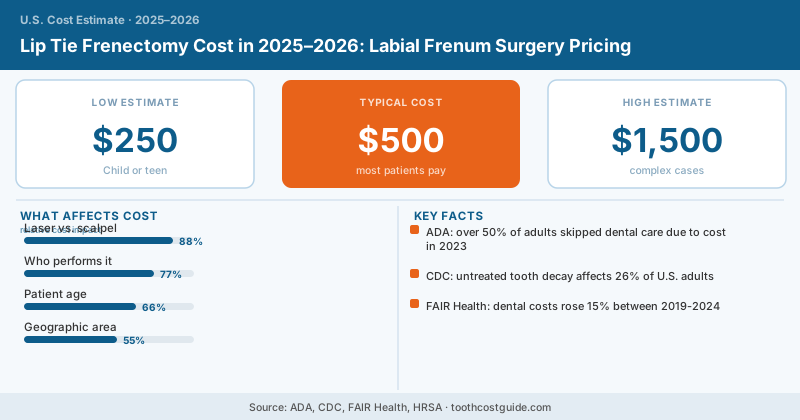
Laser vs. scalpel — Laser frenectomies typically cost $100–$300 more than conventional surgical procedures. The tradeoff: less bleeding, no sutures needed, faster healing, and better precision for infants. Many pediatric dentists and periodontists have moved to laser-only for this procedure.
Who performs it — Pediatric dentists, periodontists, oral surgeons, and some general dentists all perform frenectomies. Periodontists and oral surgeons often charge at the high end. Some pediatric dentists specializing in infant oral ties are priced in the middle range.
Patient age — Infants are quick and simple. Adults need more tissue recontouring, especially if the frenum has caused gum recession or a gap between front teeth (diastema). Adult procedures take longer and cost more.
Geographic area — Urban practices in coastal cities charge significantly more. FAIR Health data from 2024 shows average reimbursements for labial frenectomy (CDT code D7960) ranging from $285 in lower-cost regions to $620+ in major metropolitan areas.
Does Insurance Cover Lip Tie Frenectomies?
Dental insurance sometimes covers frenectomies — but it’s inconsistent and often requires documentation of medical or functional necessity.
- Infant with documented breastfeeding difficulty — get a letter from your pediatrician or lactation consultant describing the feeding problem
- Child with speech delay — speech-language pathologist documentation helps
- Adult with gum recession caused by the frenum — periodontist documentation of recession and attachment
- Adult with midline diastema (gap between front teeth) — if orthodontist has documented the frenum is preventing gap closure
- The CDT code for labial frenectomy is D7960 — ask your dentist to submit with supporting clinical notes
Many medical insurance plans will cover infant frenectomies when a physician documents a breastfeeding or feeding issue. Check with your pediatrician before assuming it’s purely dental — the claim routed through medical insurance sometimes has better outcomes than dental.
The “lip tie” diagnosis for infants is controversial in mainstream medicine. While some infants genuinely benefit from frenectomy for breastfeeding difficulties, others are being diagnosed and treated unnecessarily. The American Academy of Pediatrics has called for more research. Before proceeding, get opinions from your pediatrician, a certified lactation consultant (IBCLC), and the provider recommending the procedure. It’s a quick procedure with low risk, but any surgery on an infant deserves a second opinion.
Infants: The Breastfeeding Scenario
This is where most lip tie conversations start. When a tight upper labial frenum prevents a baby from flanging the upper lip properly during nursing, it can cause:
- Poor latch and milk transfer
- Painful nursing for the mother
- Prolonged feeding sessions
- Inadequate weight gain in severe cases
The AAPD (American Academy of Pediatric Dentistry) notes that feeding difficulties should be the primary indication for frenectomy in newborns — not just the presence of a tight frenum. Many frena loosen naturally as babies grow and begin solid foods.
If your baby is feeding well and gaining weight appropriately, a tight-looking frenum may not need treatment. If nursing is genuinely difficult despite working with a lactation consultant, evaluation by a provider experienced in infant oral function is reasonable.
Adults: The Gap and Recession Scenario
In adults, the main reasons to consider a labial frenectomy are:
Midline diastema — A thick frenum that inserts between the front teeth can maintain or re-open a gap even after orthodontic treatment. Orthodontists typically recommend the frenectomy after braces close the gap, not before.
Gum recession — A frenum with low attachment (close to the gum margin) can pull the gum tissue away from the tooth root over time. When recession is documented, both dental and medical insurance are more likely to cover the procedure.
Denture irritation — Sometimes a frenum creates a pressure point under a denture. Removing it makes the denture fit and feel better.
For adults getting it as part of orthodontic treatment, ask whether it can be done under the same visit as another procedure to save on office fees.
- Call your medical insurance first — infant feeding cases sometimes route through medical coverage
- Ask for the CDT code (D7960) and check your dental plan’s fee schedule before booking
- Request prior authorization in writing before the procedure
- Dental schools in your state perform frenectomies at reduced cost under faculty supervision
- If paired with orthodontic treatment, ask whether the orthodontist’s office can coordinate with a periodontist for combined pricing
Recovery and What It Actually Involves
The procedure itself takes 10–20 minutes. Infants usually need only topical anesthetic or a small amount of local anesthetic. Children and adults receive local anesthetic; general anesthesia is reserved for very young children or anxious patients.
Recovery for infants: 1–3 days of soreness; active wound care (stretching exercises) recommended by most providers for 2–4 weeks to prevent reattachment. Adults: 3–7 days of mild soreness; soft diet briefly; dissolvable sutures if used.
The cost of not treating a genuinely problematic frenum — ongoing breastfeeding failure, re-opening orthodontic gaps, progressive gum recession — can easily exceed the frenectomy cost several times over.
Frequently Asked Questions
A laser frenectomy for infants typically costs $300–$800, while surgical frenectomy ranges from $400–$1,200, depending on the provider's location and whether it's performed by a dentist or pediatric surgeon. Costs may be higher in urban areas or at specialized pediatric facilities compared to general dental practices.
Most health insurance plans do not cover frenectomy when it's performed for breastfeeding concerns, classifying it as elective or cosmetic, leaving most families with the full out-of-pocket cost of $250–$1,500. However, some plans may cover it if deemed medically necessary by a pediatrician, so it's worth checking your specific policy and requesting pre-authorization before scheduling.
Lip tie frenectomy is typically performed in the first few weeks of life if breastfeeding problems persist despite lactation support, though some infants nurse without difficulty despite having a lip tie. Recovery is quick—usually just a few days—and the procedure takes 5–10 minutes, but it should only be done after evaluation by a lactation consultant and pediatrician to confirm it's the underlying issue.