Most adults assume palate expansion is something that only works on kids with growing bones. That assumption is exactly why MARPE exists — and why it costs more than the expander your orthodontist used on you at age 10.
MARPE stands for Mini-implant Assisted Rapid Palatal Expansion. It uses 4 tiny titanium mini-implants anchored directly into the bone of the palate, rather than relying on the teeth to transmit expansion force. That difference is what makes it possible to widen an adult’s palate — whose midpalatal suture has fused — without surgery to physically cut the bone (a procedure called SARPE). The cost for MARPE typically runs $2,500–$6,000.
| Expansion Method | Typical Total Cost | Candidate |
|---|---|---|
| Traditional tooth-borne expander | $1,500–$3,000 | Children, teens (growing suture) |
| MARPE (mini-implant assisted) | $2,500–$6,000 | Adults, teens with fused suture |
| SARPE (surgical, bone-cut) | $6,000–$15,000+ | Adults with severe transverse deficiency |
| CBCT imaging (often separate) | $150–$400 | Required for MARPE/SARPE planning |
| Mini-implant placement fee (if billed separately) | $300–$800 | Sometimes bundled into total quote |
Why MARPE Costs What It Does
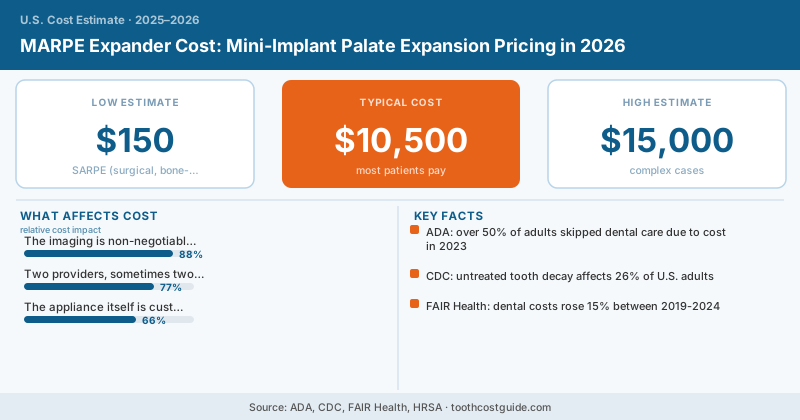
The imaging is non-negotiable. Placing 4 mini-implants into the palate without hitting nerves, the nasal floor, or tooth roots requires a CBCT (cone beam CT) 3D scan, not a standard 2D X-ray. That scan alone runs $150–$400 and is typically billed on top of the orthodontic fee.
Two providers, sometimes two bills. Depending on the practice, either the orthodontist places the mini-implants directly, or a periodontist/oral surgeon places them and the orthodontist manages the expansion. When two specialists are involved, expect two separate line items — and confirm upfront whether the quote you received includes both.
The appliance itself is custom-milled based on the CBCT data, adding a lab fee that traditional Hyrax-style expanders don’t carry.
Who Actually Needs MARPE
Research on adult palatal expansion has grown substantially over the past decade as MARPE moved from research protocol to mainstream orthodontic tool. The technique is typically recommended for:
- Adults with a narrow maxilla and transverse (side-to-side) deficiency
- Patients preparing for jaw surgery who need palate width corrected first, non-surgically
- Adults with airway or sleep apnea concerns linked to a narrow palate, sometimes co-managed with an ENT
- Teens whose growth plates have already fused, ruling out a traditional expander
MARPE is not typically the right choice for someone whose expansion needs are mild — a traditional tooth-borne expander is cheaper and works fine as long as the suture hasn’t fused.
Because MARPE relies entirely on precise implant placement, ask your orthodontist to walk you through the CBCT scan and show you exactly where the 4 mini-implants will go relative to your nasal floor and tooth roots. A provider who can’t clearly explain this planning step from imaging is not someone who should be placing mini-implants in your palate.
Insurance and Financing
Dental insurance treatment of MARPE is inconsistent because it’s a relatively newer technique compared to standard expanders. Some plans process it identically to a standard orthodontic expander claim; others treat the mini-implant placement as a separate oral surgery procedure that falls outside orthodontic benefits entirely.
Get a pre-treatment estimate submitted to your insurer in writing before signing anything. Ask the billing office specifically: “Will you submit a pre-authorization request that separates the appliance fee from the mini-implant placement fee?” That breakdown matters if only one portion is covered.
Mini-implant failure — where an implant loosens or falls out before expansion is complete — happens in a meaningful minority of MARPE cases, often due to thin bone density at the placement site. Ask upfront whether implant replacement, if needed, is included in your quoted fee or billed separately. This detail is frequently left out of initial estimates.
The Bottom Line
MARPE fills a real gap: adults with narrow palates finally have a non-surgical alternative to SARPE, at roughly half the cost. The $2,500–$6,000 price reflects the CBCT imaging, the mini-implant placement, and the custom appliance — all steps a traditional expander skips. If you’re an adult being told your only option is surgical expansion, ask specifically whether you’re a MARPE candidate before agreeing to a more invasive (and more expensive) surgical procedure.
Frequently Asked Questions
MARPE (Mini-implant Assisted Rapid Palatal Expansion) typically costs $2,500–$6,000, which includes the custom appliance, mini-implant placement, imaging, and follow-up adjustments. This is generally more expensive than a traditional tooth-borne palatal expander because of the surgical component and the CBCT imaging required for implant planning.
MARPE requires 4 mini-implants surgically placed into the palate, a CBCT 3D scan for precise implant planning (often $150–$400 alone), and typically a specialist or oral surgeon co-treating with the orthodontist. Traditional tooth-borne expanders skip the implants and surgical step entirely, keeping costs lower at $1,500–$3,000.
Coverage is inconsistent. Some dental plans cover MARPE under the same orthodontic benefit as traditional expanders, while others classify the mini-implant placement as a separate surgical procedure not covered under orthodontic benefits. Get pre-authorization in writing before starting treatment, since MARPE is a newer technique that not all insurers have standardized policies for yet.