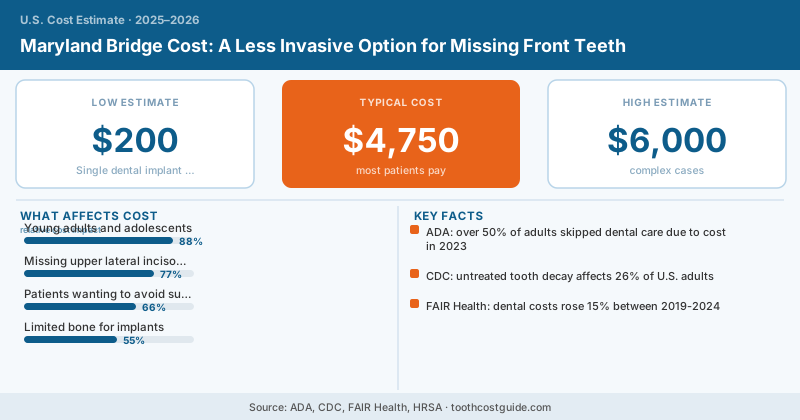
In 2010, a Maryland bridge for a missing front tooth cost around $600. Today that same bridge runs $1,000–$2,300. Still — it’s about a third of what an implant costs, and it doesn’t require surgery or months of healing.
If you’re missing a front tooth and wondering whether this lesser-known option makes sense for your situation, here’s a clear-eyed look at the costs, the trade-offs, and when dentists recommend it.
What Is a Maryland Bridge?
A Maryland bridge (also called a resin-bonded bridge) replaces a single missing tooth using a false tooth — called a pontic — flanked by thin metal or ceramic wings. Those wings bond to the back surfaces of the adjacent teeth without requiring the teeth to be ground down for crowns.
That’s the key distinction from a traditional 3-unit dental bridge: a traditional bridge requires drilling down two perfectly healthy adjacent teeth to serve as crown-capped supports. A Maryland bridge preserves those adjacent teeth. The wings bond to them with minimal or no preparation — just a small amount of enamel roughening to help adhesion.
This makes it a genuinely tooth-conserving option. For replacing a front tooth in an adult who wants to avoid surgery, it’s often the most conservative choice available.
Maryland Bridge Cost Breakdown
| Component | Cost Range |
|---|---|
| Maryland bridge (one pontic, two wings) | $1,000–$2,300 |
| Traditional 3-unit bridge (for comparison) | $2,500–$6,000 |
| Single dental implant with crown | $3,500–$6,000 |
| Dental flipper (temporary removable) | $300–$600 |
| Rebonding a debonded Maryland bridge | $200–$500 |
Factors that affect your specific quote:
- Material: Metal-ceramic wings cost less; all-ceramic (zirconia or e.max) cost more but look better
- Location: Practices in major metro areas run $1,800–$2,300; rural areas run $1,000–$1,500
- Lab fees: Dental laboratory quality varies; premium esthetic labs charge more
- Number of teeth replaced: Some cases require replacing two adjacent missing teeth with a longer span (costs significantly more)
When Maryland Bridges Make Sense
Not every missing tooth is a good Maryland bridge candidate. Here’s when it tends to work well:
Young adults and adolescents: Before age 18–20, jaw growth isn’t complete and implants aren’t appropriate. A Maryland bridge serves as an excellent long-term temporary until the patient is implant-eligible.
Missing upper lateral incisors: Upper lateral incisors (the teeth flanking the two front teeth) are among the most commonly congenitally missing teeth — about 1–2% of the population lacks them, according to the American Association of Orthodontists. Maryland bridges are a standard treatment option for this presentation.
Patients wanting to avoid surgery: Some patients simply don’t want implant surgery, the associated healing time, or the cost. A Maryland bridge provides a fixed (non-removable) solution without any surgical procedure.
Limited bone for implants: If there’s inadequate bone at the missing tooth site and the patient doesn’t want grafting, a Maryland bridge avoids the entire bone augmentation pathway.
The whole point of a Maryland bridge is preserving adjacent tooth structure. If the teeth on either side of your gap already have crowns, large fillings, or restorations — or if they’ll need crowns eventually — a traditional bridge may make more sense. Your dentist should factor the existing condition of adjacent teeth into the treatment recommendation. A Maryland bridge on two already-restored teeth offers less benefit than one placed on two pristine teeth.
The Real Failure Risk: Debonding
Here’s the honest trade-off: Maryland bridges can come loose. The resin bond holding the wings to adjacent teeth is strong, but bite forces — especially on front teeth used for biting into hard foods — can cause debonding over time.
Published data from a 2020 systematic review in the Journal of Dentistry reported an annual failure rate of approximately 4–6% for Maryland bridges, with most failures being debonding rather than bridge fracture. Debonding usually means rebonding — not replacement — and costs $200–$500.
Several factors reduce debonding risk:
- Proper tooth preparation (minimal but specific enamel roughening)
- Using newer generation adhesive systems
- Placing the bridge on a patient with a light bite (avoiding heavy bruxers)
- Good occlusal design — the pontic shouldn’t be in heavy contact during chewing
Your dentist’s experience with Maryland bridge placement matters. It’s a technique-sensitive procedure.
Does Insurance Cover Maryland Bridges?
Generally yes — Maryland bridges are typically covered under major restorative benefits, the same category as traditional bridges. Most PPO plans cover 50% after the deductible and waiting period (usually 12 months for major restorative).
If your plan has a missing tooth clause — a provision excluding coverage for teeth missing before your plan’s effective date — that exclusion applies to Maryland bridges just as it does to implants and traditional bridges. Review your plan documents for this language.
The CDT code for a Maryland bridge is D6545 (cast metal retainer) or D6548 (porcelain/ceramic retainer). Knowing these codes helps you verify coverage before treatment.
Maryland Bridge vs. Implant: The Trade-Off
For most missing front teeth in adults with adequate bone, a dental implant is the gold-standard long-term solution. It doesn’t involve adjacent teeth at all and has a documented lifespan of 20+ years.
But implants cost 2–5x more and require surgery, bone evaluation, and 3–6 months of healing. Maryland bridges cost less, involve zero surgery, and can be completed in two appointments over 2–3 weeks.
The right choice depends on your budget, your anatomy, your tolerance for surgery, and how you feel about a 5–10% per-year chance of needing rebonding. For many patients — especially younger ones and those replacing upper anterior teeth — a Maryland bridge is an excellent, conservative, affordable choice.
If a dentist recommends a traditional 3-unit bridge over two healthy, untouched teeth when a Maryland bridge is anatomically feasible, ask why. Grinding down two healthy teeth to support a bridge is an irreversible decision that commits those teeth to crowns for life. A second opinion from a prosthodontist on tooth-replacement options — especially for front teeth — is almost always worth the cost of a consultation.
Frequently Asked Questions
Published clinical studies report Maryland bridge survival rates of 73–91% at 10 years when placed in appropriate cases with proper bonding technique. The most common failure mode is debonding — the wings separate from the adjacent teeth. This usually allows the bridge to be rebonded (rather than fully replaced), often for $200–$500. Ceramic-fused-to-metal Maryland bridges have longer track records than all-ceramic versions in the literature.
It can, but it's rarely recommended. Maryland bridges perform best in the anterior (front) region where bite forces are lighter. In the molar or premolar area, the bite forces on the pontic can cause debonding over time. Traditional 3-unit bridges or implants are preferred for missing back teeth. An exception: some practitioners use Maryland bridges as long-term temporaries for adolescents waiting until jaw growth is complete before placing implants.
Modern all-ceramic Maryland bridges made from zirconia or lithium disilicate look excellent. The main esthetic challenge is the metal or ceramic wing visible through the back surface of the adjacent teeth — in some cases, the metal shows through thin tooth enamel as a gray shadow. Your dentist can evaluate whether your adjacent tooth anatomy and enamel thickness are suitable for an esthetic result. All-zirconia wings minimize this issue significantly.