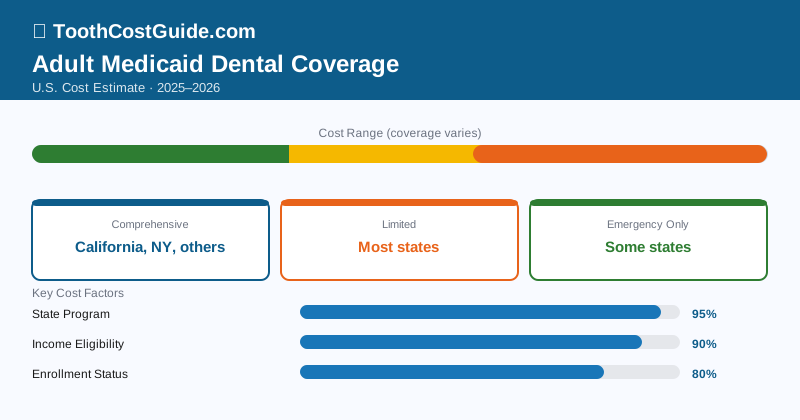
Here’s a fact that surprises a lot of people: if you live in California, New York, or Massachusetts and your income qualifies, you can get comprehensive dental care — cleanings, fillings, crowns, root canals, dentures — for $0 to $3 in copays. Zero. Three dollars. Meanwhile, someone earning the same income in Alabama or Mississippi gets essentially nothing beyond emergency extractions.
Adult dental coverage under Medicaid is one of the starkest state-by-state divides in US healthcare policy. The federal government mandates dental coverage for children through CHIP. For adults, it’s optional — and 16 states have chosen not to provide meaningful benefits. Thirty-four states plus Washington DC offer at least some coverage, ranging from comprehensive care to cleanings-and-fillings-only to emergency extractions alone.
| Coverage Level | States (examples) | What’s Covered | Patient Cost |
|---|---|---|---|
| Comprehensive | CA, NY, MA, WA, IL | Cleanings, fillings, crowns, dentures, root canals | $0–$3 copay |
| Limited | TX, FL, GA, OH | Cleanings, basic fillings, extractions only | $0–$5 copay |
| Emergency-only | AL, MS, SC | Tooth extractions for pain/infection only | $0–$3 copay |
| No adult dental | ~16 states | Nothing | — |
The Basics: How This Program Actually Works
Medicaid is jointly funded by federal and state governments to provide health coverage to low-income Americans. The structural detail that matters here: federal law requires dental coverage for children (via CHIP) but leaves adult dental entirely to state discretion. States that choose to offer adult dental benefits receive federal matching funds — so there’s financial incentive to expand, which is why the trend has moved toward more coverage in recent years. But expansion is slow and uneven.
When you’re enrolled in Medicaid, you receive a member ID card and are enrolled in (or assigned to) a managed care organization in most states. That MCO maintains a network of participating dentists. You bring your card to an in-network dentist, pay whatever copay the state requires (usually $0–$5 for covered services), and the program pays the dentist the rest directly. No claims to file.
Annual caps are common in states that offer coverage — many limit adult dental benefits to $500–$2,000 per year. California’s Denti-Cal program is notable for not imposing an annual cap on most covered services.
What the Savings Actually Look Like by Coverage Tier
Comprehensive states (California, New York, Massachusetts, Washington, Illinois): A full year of dental care — two cleanings, exams, X-rays, fillings, and potentially a crown — might cost you $0 to $15 in copays. Without coverage, that same year of care would run $1,500–$3,000+ out of pocket at private rates.
Limited coverage states (Texas, Florida, Georgia, Ohio): Two cleanings, maybe basic fillings, and an extraction for emergency situations. Patient cost: $0–$10 in copays. Cash value of those services: $300–$600 annually.
Emergency-only states (Alabama, Mississippi, South Carolina): One extraction for an acutely infected or painful tooth. That extraction that would cost $150–$350 privately costs $0–$3 under the emergency provision.
States with standout adult Medicaid dental programs in 2025:
- California (Denti-Cal): Comprehensive, no annual dollar cap on most services, includes crowns and dentures
- New York: Comprehensive with a $1,000–$1,500 annual cap
- Massachusetts: Comprehensive, includes some orthodontic coverage in specific cases
- Washington: Comprehensive with generous annual limits
- Illinois: Full benefits restored in 2018 after years of cuts; comprehensive coverage
- Oregon: Comprehensive under the Oregon Health Plan
- Michigan: Comprehensive coverage restored in recent years
States providing emergency-only or no adult dental as of 2025: Alabama, Mississippi, South Carolina, Wyoming, Utah (limited), and others. State coverage levels do change — sometimes quickly when budgets shift — so verifying your current state’s status directly with the Medicaid agency is worthwhile.
Who Qualifies
Income thresholds are based on the federal poverty level (FPL). For 2025:
- Medicaid expansion states (41 + DC): Adults earning up to 138% FPL qualify — roughly $20,120 annually for an individual, $41,400 for a family of four
- Non-expansion states (10 states): Limits are far more restrictive, often 18–50% FPL, and coverage is typically limited to parents, pregnant women, or people with disabilities — not working-age adults without children
Other categories that often qualify with different rules:
- Pregnant women (dental coverage is frequently more expansive during pregnancy even in states with limited adult benefits)
- Adults receiving SSI or SSDI disability benefits
- Foster care youth up to age 26 in some states
If you don’t qualify for Medicaid: Check eligibility for ACA marketplace plans with income-based subsidies, or look for Federally Qualified Health Centers (FQHCs) in your area — they offer sliding-scale dental fees regardless of insurance status.
Honest Assessment: What Works and What Doesn’t
What works:
- Free or near-free dental care in comprehensive states — genuinely transformative for people who need it
- No premiums in most programs
- Children are covered almost universally through CHIP/Medicaid
- Enrollment is open year-round — no waiting for an open enrollment period
- Preventive care coverage helps avoid the expensive emergency situations that uninsured people often face
What doesn’t work as well:
- Coverage in limited/emergency-only states is inadequate for anyone needing real restorative work
- Dental provider networks are often thin — many dentists don’t accept Medicaid, which creates access gaps even where coverage technically exists
- Annual caps (where they exist) can be exhausted quickly by patients who need major work
- Prior authorization requirements for crowns, dentures, and other major services add bureaucratic delay
- State budget pressures can and do result in benefit cuts
Medicaid dental networks are often thin. Before assuming care is available, search your state’s Medicaid provider directory for dentists near you who are currently accepting new Medicaid patients. Providers can drop out of networks, so verify before your appointment.
How to Enroll: Seven Steps
1. Find out what your state covers. Search “[Your State] Medicaid adult dental benefits 2025” or navigate directly to your state Medicaid agency website. You want to know: does your state offer adult dental? If so, what does it cover and what are the annual limits?
2. Check your eligibility. Use the screening tool at healthcare.gov or benefits.gov. Enter your state, household size, and annual income. The tool will tell you whether you’re likely eligible for Medicaid or whether marketplace subsidies are a better fit.
3. Submit your application. Online at your state Medicaid portal, through healthcare.gov (which routes applications to the appropriate state agency), by phone, by mail, or in person at a Department of Social Services office. Most states have streamlined this significantly — online applications typically take 20–40 minutes.
4. Gather documentation in advance. Having these ready before you start: government-issued photo ID, Social Security numbers for all household members, proof of income (recent pay stubs, last year’s tax return, or an unemployment benefit determination letter), and proof of state residency (utility bill, lease, or bank statement).
5. Enroll in a managed care plan. In most states, you’ll receive information about available Medicaid managed care organizations and either choose one or be auto-assigned. If your preferred dentist or a specific clinic is important to you, verify they’re in the network before finalizing your plan choice.
6. Find a participating dentist. Use your MCO’s online provider directory or your state’s Medicaid dentist locator. Then call the office directly — “Are you currently accepting new Medicaid patients?” Network directories can be outdated.
7. Attend your appointment with your ID card. Know your plan’s covered services before you go. For major work (crowns, dentures), ask the dental office whether prior authorization is required — it usually is, and the office should handle that process on your behalf.
If your state has limited adult Medicaid dental, check whether you live near a Federally Qualified Health Center (FQHC). FQHCs accept Medicaid AND offer sliding-scale fees for services Medicaid doesn’t cover, effectively filling the gap. Find one at findahealthcenter.hrsa.gov.
Bottom Line
Where you live determines everything with adult Medicaid dental. In California, comprehensive coverage at near-zero patient cost is available. In Alabama, you might get an emergency extraction and nothing else. If you’re in a comprehensive state and you qualify, enrolling in Medicaid dental is one of the most valuable financial moves available to you — and it’s available year-round. If you’re in a limited or emergency-only state, combine whatever Medicaid covers with FQHC access for sliding-scale care beyond what Medicaid pays. Start by checking your state’s current coverage and running an eligibility screen at healthcare.gov — both take under five minutes.
Frequently Asked Questions
Out-of-pocket costs vary dramatically by state. In states with comprehensive coverage like California, New York, and Massachusetts, you'll pay $0 to $3 in copays for most services including cleanings, fillings, and crowns. However, 16 states offer little to no adult dental coverage, leaving you responsible for the full cost of care, which can range from $100 to $300+ for basic cleanings and $800 to $2,000 for crowns.
No—coverage varies significantly by state. Of the 34 states offering adult Medicaid dental, some cover comprehensive restorative care including root canals and dentures, while others limit benefits to emergency extractions only. You'll need to check your specific state's Medicaid dental plan details, as even covered services may have annual maximums ($1,000 to $1,500 in most states) that limit access to multiple procedures.
The application process typically takes 1 to 3 weeks from submission to approval, though some states process applications within 5 to 7 business days. You can apply online, by mail, or in person through your state's Medicaid office, and you'll need to provide proof of income (usually within 130 to 200% of the federal poverty line depending on your state) and proof of residency to qualify.