You’re a 32-year-old professional about to start orthodontic treatment. Your orthodontist quotes you $3,800 for metal braces or $5,200 for ceramic. That’s $1,400 more to not feel self-conscious in client meetings. Is it worth it?
For most adults in visible roles, the answer is yes — but only if you understand what you’re actually paying for and whether you can keep ceramic brackets clean. Because stained ceramic braces look far worse than metal ones.
The Price Gap, Explained
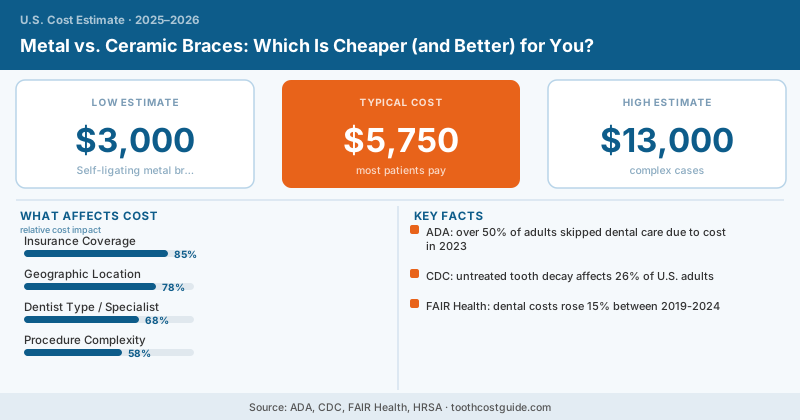
| Brace Type | Typical Cost Range |
|---|---|
| Traditional metal braces | $3,000–$7,000 |
| Ceramic (tooth-colored) braces | $4,500–$8,000 |
| Self-ligating metal braces | $3,500–$8,000 |
| Self-ligating ceramic braces | $5,000–$9,000 |
| Lingual braces (behind teeth) | $8,000–$13,000 |
The $1,000–$1,500 premium for ceramic isn’t just about the brackets themselves, though those do cost more to manufacture. The bigger driver is that ceramic brackets are more fragile — they chip and pop off more often, requiring more adjustment appointments and more chairtime per visit. Orthodontists price that in.
Ceramic brackets are also less forgiving. Metal brackets bond to enamel predictably. Ceramic brackets, depending on the brand and the patient’s bite, can occasionally cause enamel damage when removed if the bond is too aggressive. That’s not a reason to avoid them, but it is why some orthodontists charge extra: there’s more skill involved in the finish work.
What the AAO Says About Outcomes
Here’s the thing neither braces type will tell you in their marketing: treatment outcomes are essentially the same. The American Association of Orthodontists consistently affirms that both metal and ceramic brackets achieve equivalent clinical results when placed by a trained orthodontist. The teeth move the same way. The retention afterward is identical.
A 2021 systematic review published in the Angle Orthodontist found no statistically significant difference in overall treatment duration between metal and ceramic bracket systems. The study did note that ceramic brackets require slightly more force to move teeth in some cases, which is why some orthodontists feel metal is marginally more efficient — but the practical difference for most patients is a matter of weeks, not months.
What does affect outcomes: patient compliance (keeping appointments, wearing rubber bands when prescribed), oral hygiene during treatment, and retention compliance afterward. Whether your brackets are silver or tooth-colored doesn’t enter into it.
The Staining Problem Nobody Warns You About
Ceramic brackets themselves don’t stain — they’re made of polycrystalline alumina or monocrystalline sapphire, neither of which absorbs pigment. What stains is the elastic tie (the tiny rubber band that holds the wire to the bracket). Those are replaced at every appointment, but between visits they can yellow badly if you drink coffee, red wine, or tea daily.
Some orthodontists use metal ties on ceramic brackets, eliminating the staining problem entirely. Ask specifically about this. It’s the same cost.
The other staining issue: ceramic brackets hold onto the wire more than metal does, which means debris can accumulate differently. Patients with ceramic braces need to be more diligent about brushing, especially around the bracket edges.
- Adults in client-facing or professional roles where visible metal feels unprofessional
- Patients who have had Invisalign ruled out due to compliance concerns or complex tooth movement needs
- Teens who are self-conscious about metal braces and for whom that confidence impact matters
- Anyone whose treatment duration is under 18 months (less staining risk, less cumulative food-trap irritation)
Ceramic braces are NOT recommended if you have a deep bite (your upper teeth significantly overlap the lower ones). The lower front teeth can grind against ceramic upper brackets and chip them — your orthodontist may refuse ceramic for lower arch brackets in this case.
When Metal Is the Smarter Call
Metal wins in three situations. First, complex cases: significant crowding, large gaps, severe rotation, or bite correction work. Metal brackets give orthodontists more control, especially when using heavier archwires. Second, grinding and clenching: if you’re a bruxer, ceramic brackets on your lower arch are a liability. Third, tight budgets with long treatment: if you’re looking at 24+ months of treatment, that’s 24+ months of staining elastic ties and extra cleaning time. The $1,400 savings is real money.
For kids and teens getting braces primarily for function, metal is still the standard recommendation — and honestly, colored elastics have made metal braces something most middle schoolers actively want.
How to Bring the Cost Down
Both metal and ceramic braces cost significantly less at dental school orthodontic clinics — typically 30–50% below private practice rates. The work is supervised by licensed orthodontists and the clinical outcomes are equivalent. Treatment does take longer because cases are used for teaching, but for a motivated patient on a budget, it’s a serious option. Learn more at our dental school clinics guide.
Dental insurance with orthodontic coverage typically pays a lifetime maximum of $1,000–$2,000 for braces regardless of type — metal or ceramic. Ask your insurer whether they apply the same benefit to ceramic.
CareCredit and similar dental financing plans offer 12–24 month 0% promotional periods at most orthodontic offices, letting you spread $5,000 over 24 months at roughly $208/month. That changes the math considerably for patients who can manage the monthly payment.
Finally, get at least two quotes. Orthodontic pricing varies by geography and practice more than almost any other dental service. A quote of $5,200 from one practice might be $4,100 at another five miles away for identical treatment.
The Bottom Line
Metal braces cost less — full stop. But for adults in professional settings who want to avoid the self-consciousness that comes with visible metal hardware, the $1,000–$1,500 ceramic premium buys real confidence during treatment. Just go in knowing: maintain your oral hygiene carefully, consider asking for metal ties on ceramic brackets, and confirm ceramic is appropriate for your bite type. Treatment outcomes are the same either way.
Frequently Asked Questions
Ceramic braces typically cost $1,000–$1,500 more than metal braces, with metal ranging from $3,000–$7,000 and ceramic from $4,500–$8,000. The price difference reflects the material cost, aesthetic appeal, and increased chairtime required for ceramic bracket placement and maintenance.
Most dental insurance plans cover orthodontics at 50% of the cost, but many limit coverage to the cost of metal braces only, leaving you to pay the difference out-of-pocket for ceramic. This means if metal costs $5,000 (covered 50% = $2,500 patient pays) and ceramic costs $6,500, you would pay approximately $3,500 instead of $2,500.
Ceramic and metal braces typically achieve results in the same timeframe—usually 18–24 months—since the straightening mechanism is identical; the only difference is the bracket material. However, ceramic brackets require more frequent cleaning during treatment to prevent staining, which can add extra appointment time.