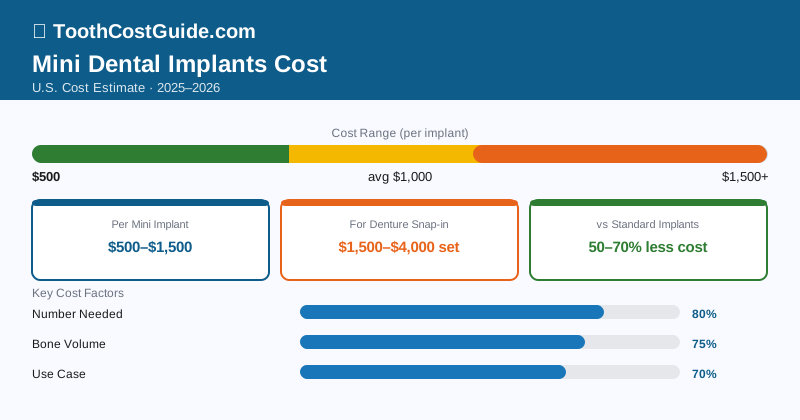
Walk into any dental office that markets to denture wearers and you’ll see it: “Stabilize your dentures with mini implants — same-day results, no surgery!” It sounds almost too convenient. And for the right patient in the right clinical situation, it actually is. Mini dental implants cost $500–$1,500 per implant — significantly less than the $1,500–$3,000 per implant you’d pay for standard-diameter implants. For a lower denture stabilization case requiring four mini implants, total costs land at $2,000–$4,500 versus $6,000–$12,000 for the equivalent in standard implants.
The smaller diameter (under 3mm versus 3.5–5mm for standard) is both the advantage and the limitation. Less invasion, faster healing, accessible where bone is thin — but also less surface area for osseointegration and a shorter long-term track record for heavy biting loads.
Mini Implant Costs by Use Case
| Procedure | Cost |
|---|---|
| Single mini implant (tooth replacement) | $500–$1,500 |
| Mini implant for denture stabilization (2 implants) | $1,000–$2,500 total |
| Mini implant denture stabilization (4 implants) | $2,000–$4,500 total |
| Standard dental implant (for comparison) | $1,500–$3,000 per implant |
| Denture modification for mini implant attachments | $200–$600 |
| New implant-supported denture (with 4 mini implants) | $3,000–$6,500 total |
| Bone graft (if still required) | $200–$600 per site |
What Moves the Price
How many implants. Standard implants go one-per-missing-tooth for single replacements. Mini implants for denture stabilization use 2–6 implants to support a full arch. Four lower-jaw mini implants is the best-studied configuration. You’re paying per implant, so two versus four versus six represents a meaningful cost difference even at the lower per-unit price.
Single tooth versus denture stabilization. These are fundamentally different uses. A single mini implant for a narrow gap (lower incisor, for example) involves one implant and one crown — total case cost of $800–$2,000. Denture stabilization involves multiple implants plus new or modified prosthetics. Know which category your treatment falls into before you compare prices.
Your existing dentures. If you have well-fitting dentures, a dentist can often modify them with locator attachments to snap onto the mini implants — adding $200–$600. If your dentures are worn, ill-fitting, or old enough to warrant replacement, add $1,000–$3,000 for the prosthesis. Some providers bundle the full case (implants + new denture) into a package price; ask specifically.
General dentist versus specialist. Mini implants are placed by general dentists, periodontists, and oral surgeons. A trained general dentist typically charges $500–$1,000 per mini implant. Oral surgeons charge more — $800–$1,500 per implant — but bring additional surgical expertise for complex or compromised bone cases. For a routine denture stabilization case with adequate bone and a cooperative patient, an experienced general dentist is often the most cost-efficient choice without compromising the outcome.
Mini implants are not a universally superior alternative to standard implants — they’re a clinically appropriate tool for specific situations: narrow bone spaces, denture stabilization, patients who cannot tolerate more invasive surgery, or patients for whom cost is a significant factor. For single-tooth replacement in adequate bone, a standard implant typically has better long-term data and survival rates.
Mini Implants vs. Standard Implants: An Honest Comparison
Diameter. Standard implants: 3.5–5mm. Mini implants: under 3mm, most commonly 1.8–2.9mm. The narrower profile means less bone contact area and lower biomechanical capacity. This matters more for some uses (high-force single-tooth replacement) than others (multi-implant denture stabilization where load is distributed).
Bone requirements. Standard implants need enough bone width to accommodate the wider diameter — insufficient bone typically means a graft first, then months of healing, then placement. Mini implants sidestep this in many cases, placing directly into narrower ridges. For patients who’ve been told they need extensive bone grafting before standard implants, mini implants may be a legitimate alternative without that step.
Procedure and recovery. Standard implant placement involves incisions, sutures, and an osseointegration wait of 3–6 months before loading. Mini implants are frequently placed with a flapless technique — no incisions, no sutures — and can often be loaded the same day or within a few days. For older patients who are wary of a drawn-out surgical process, this matters.
Long-term evidence. Standard implants have decades of published data with survival rates of 95–98% at 10 years across large patient populations. Mini implants have a shorter published track record, particularly for single-tooth replacements under full occlusal load. For denture stabilization specifically — where load is distributed across multiple implants and the prosthesis isn’t cemented in place — mini implants have a solid evidence base and are considered mainstream treatment.
When one fails. Standard implant failures can be complex to address. Mini implant failures tend to be simpler — removal and replacement at the same or adjacent site is usually straightforward, and the lower per-unit cost makes replacement less catastrophic.
With vs. Without Dental Insurance
With insurance. Traditional dental insurance generally excludes implants or covers them with significant limitations. Mini implants receive the same limited coverage as standard implants. If your plan has implant benefits, annual maximums ($1,000–$3,000) rarely cover a complete multi-implant case.
Denture benefits are different. If your case involves new implant-supported dentures, the prosthesis itself may be covered under your plan’s denture or prosthetic benefits — typically 50% of allowed cost. Claim the denture and implants separately. You may recover meaningful benefit on the denture portion even when the implants aren’t covered.
Without insurance. The math here is where mini implants genuinely shine. At $500–$1,500 per mini implant, a four-implant denture case at $2,000–$4,500 total is achievable for patients on fixed incomes who could never swing $6,000–$12,000 for the same number of standard implants. This is one of mini implants’ most legitimate selling points.
Submit your treatment plan to insurance before proceeding. Some plans have expanded implant benefits that patients don’t know about. Even a partial reimbursement of $500–$1,000 is meaningful. Ask your dentist’s billing team to use the most favorable coding (standard implant codes may apply) and to submit a narrative explaining the clinical necessity.
Five Ways to Spend Less
Compare general dentists and specialists. For straightforward denture stabilization cases, an experienced general dentist with documented mini implant training can match specialist outcomes at $200–$600 less per implant. Ask about certifications — AAID, ICOI, or manufacturer-specific mini implant training — and ask how many mini implant cases they’ve placed. Volume matters.
Dental school implant clinics. Schools with oral surgery programs place mini implants at 40–60% reduced cost. A four-implant lower denture stabilization case: $1,200–$2,500 at a dental school versus $2,500–$4,500 in private practice. The tradeoff is appointment frequency and chair time — dental school cases are slower. Worth it for many patients.
Modify your existing dentures if they fit. A well-fitting existing denture modified with locator attachments ($200–$600) costs far less than fabricating new dentures. Have your dentist evaluate the fit and condition first. If the dentures are close to replacement age anyway, the calculus changes.
Get multiple consultations. Mini implant pricing varies significantly across providers in the same zip code. Three consultations revealing prices of $600, $900, and $1,200 per implant — which is entirely realistic — means 50–100% pricing variation for the same procedure. Most practices offer free consultations for denture stabilization cases.
Package pricing. Practices specializing in denture stabilization frequently offer package pricing: consultation, CBCT scan, four mini implant placements, and denture modification as a single bundled fee. Package pricing is typically more favorable than itemized billing. Ask specifically whether package pricing is available.
Financing Options
CareCredit. Widely available. For a $3,000 mini implant case on an 18-month promotional period: approximately $167/month with no interest if paid off in time. Be clear on the deferred interest terms — failing to pay the full balance before the promotional period expires triggers retroactive interest at 26–29% APR from purchase date.
In-house payment plans. Practices targeting denture patients (frequently older adults on Social Security and fixed incomes) often have their own installment plans — sometimes more flexible and more affordable than third-party financing. Ask whether a 0% in-house option exists before signing up with a credit product.
HSA/FSA funds. Mini dental implants are qualified medical expenses. Whatever portion you can pay with pre-tax dollars reduces your effective cost by 22–37% depending on your tax bracket.
Sunbit. A newer dental financing option with faster approval and generally more transparent interest terms than CareCredit for longer repayment periods (12–36 months). Available at a growing number of practices.
Bottom Line
Mini dental implants at $500–$1,500 per implant represent genuine value for patients who need denture stabilization, have limited bone volume, or can’t tolerate the more invasive standard implant procedure. For an older adult with a loose lower denture, four mini implants can transform the quality of daily life at a cost that’s actually achievable.
Standard implants remain the preferred choice for single-tooth replacement in adequate bone — the long-term data is simply better, and the load-bearing capacity for full occlusal force is stronger. Mini implants work best when matched to the right clinical situation.
Choose a provider who can show documented mini implant experience, ask for case references if you want them, and be clear about what your existing dentures’ condition means for the total case cost. The difference between modifying workable dentures and starting from scratch is $1,000–$3,000.
Dental cost estimates in this guide reflect U.S. national averages for 2024–2025 and may vary significantly by geographic region, provider type, and individual treatment needs. Mini implant suitability depends on bone quality, bite forces, and the intended prosthesis — consult with a qualified dental professional to determine whether mini implants are appropriate for your specific situation.
Frequently Asked Questions
Mini dental implants typically cost $500–$1,500 per implant, making them significantly cheaper than standard implants which run $1,500–$3,000 per implant. The final price depends on the number of implants needed, your location, and whether bone grafting or additional procedures are required. Many patients choose mini implants to stabilize dentures, which requires 2–4 implants per arch.
Most dental insurance plans classify mini implants as major restorative care, typically covering 40–50% of the cost after you meet your deductible. However, many plans have annual maximums of $1,000–$1,500, which may not cover the full cost of multiple implants. You should contact your insurer directly, as some plans exclude implants entirely or cover them only for specific medical reasons.
Mini implants can often be placed and loaded with a denture on the same day, with some patients able to leave the office with a stabilized denture immediately. However, full osseointegration (bone bonding) typically takes 3–6 months, during which you should follow your dentist's care instructions to avoid damaging the implants. This makes mini implants attractive for patients who want quick results, though long-term success depends on proper healing and maintenance.