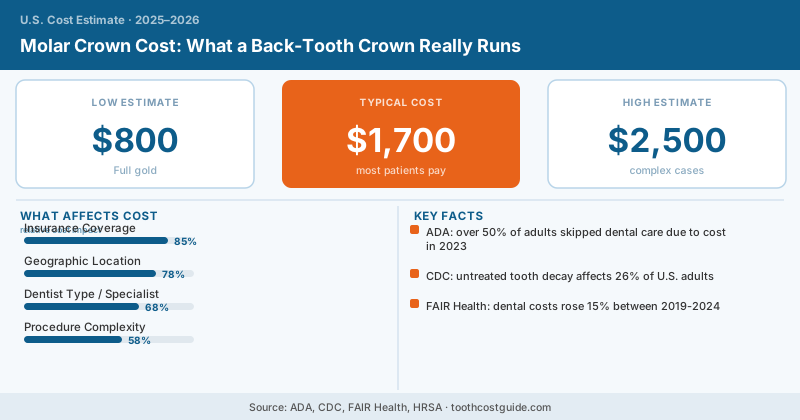
Roughly 90% of American adults aged 20 to 64 have had at least one cavity in their permanent teeth, according to CDC data — and the molars take the worst of it. They’re the big grinders in the back, they do the heavy chewing, and they’re the hardest to clean. So when a molar finally needs more than a filling, a crown is usually the answer. Here’s what that back-tooth crown costs and how to keep the bill in check.
Molar Crown Costs at a Glance
| Crown Material | Cost (No Insurance) | With 50% Insurance |
|---|---|---|
| Porcelain-fused-to-metal (PFM) | $800–$1,800 | $400–$900 |
| Monolithic zirconia | $900–$2,200 | $450–$1,100 |
| Full gold | $900–$2,500 | $450–$1,250 |
| All-ceramic / e.max | $900–$2,000 | $450–$1,000 |
| Same-day CEREC | $1,000–$2,300 | $500–$1,150 |
Most patients land around $1,100–$1,500 without insurance. The ADA’s fee surveys put single crowns squarely in this band nationally. The good news about molars: nobody sees them, so you can pick the toughest, cheapest material without worrying about looks.
Why Molars Get Crowned So Often
Molars take more force than any other teeth — chewing loads can run into the hundreds of pounds of pressure. That force is brutal on a tooth that’s already weakened. The usual paths to a molar crown:
- A large or repeated filling has left too little tooth to hold another filling
- A root canal has made the tooth brittle and prone to splitting
- A crack or fracture needs a crown to wrap and hold the tooth together
- Heavy grinding (bruxism) has worn the tooth down
Once a molar loses enough structure, a filling won’t survive the chewing forces — it’ll fracture or fall out. A crown caps and binds the whole tooth so it can keep working.
Because molars are hidden, durability should drive your choice, not aesthetics. Monolithic zirconia and full gold are the two toughest options, and gold is famously gentle on the opposing tooth and lasts 20–40 years. If you grind your teeth at night, lean toward gold or zirconia over porcelain, which can chip under heavy back-tooth force. Compare materials in our gold vs porcelain crown breakdown.
The Hidden Add-Ons
The crown fee rarely stands alone on a molar. Watch for these extras on your estimate:
Core buildup — If decay or an old filling left a hole, the dentist rebuilds the tooth’s core before crowning it. That’s a separate $150–$450 charge.
Root canal — A molar that’s infected or has an exposed nerve needs a root canal first, often $700–$1,500 on a molar because they have more canals than front teeth.
Post and core — If a root-canaled molar has little structure left, a post anchors the buildup, adding $200–$500.
Add it all up and a “simple” molar crown can become a $2,000–$3,500 project. That’s still usually cheaper than losing the tooth and replacing it with a dental implant later.
How to Pay Less
Get a predetermination. Free and accurate — it tells you your exact out-of-pocket before you commit.
Choose material by function, not name. A monolithic zirconia molar crown costs less than hand-layered porcelain and is tougher. On a hidden tooth, there’s no reason to pay for cosmetic layering.
Dental school clinics run 40–60% below private fees with supervised students. Appointments take longer, but molar crowns are routine teaching cases.
Time it around your annual max. Most PPO plans cap benefits at $1,000–$2,000 a year. If you need a buildup plus a crown plus a root canal, splitting work across two plan years can stretch coverage — see how dental insurance works. Uninsured? A dental savings plan or CareCredit financing helps.
Always ask whether your molar crown quote includes a core buildup, post, or root canal — these are the line items that turn a $1,200 crown into a $3,000 bill. Get a written, itemized treatment plan with each procedure code listed, and submit it for predetermination so nothing surprises you at checkout.
Bottom Line
A molar crown costs $800–$2,500, with most patients paying around $1,100–$1,500 before insurance and roughly half that with a typical PPO plan. Because molars are hidden, pick the toughest material — zirconia or gold — and don’t pay extra for cosmetic layering. Just watch for buildups, posts, and root canals that ride along on the estimate. A protected molar beats the cost and hassle of replacing it with a bridge or implant down the road.
Frequently Asked Questions
A molar crown typically costs $800–$2,500, with most patients paying $1,100–$1,500. The final price depends on the material (porcelain, ceramic, or metal), your location, and whether the tooth needs additional prep work or a buildup before crowning.
Most dental insurance plans cover 50% of crown costs after you meet your deductible, bringing your out-of-pocket cost to $400–$1,250. However, many plans limit coverage to one crown per tooth every 5 years and may exclude crowns for purely cosmetic reasons.
A molar crown typically requires two appointments: the first visit (60–90 minutes) involves preparing the tooth and taking impressions, and the second visit (30–60 minutes) happens 2–3 weeks later for final placement. If your dentist uses same-day crown technology (CAD/CAM), the entire process can be completed in a single appointment.