In 2019, the American Academy of Oral Medicine estimated that oral mucoceles account for roughly 10% of all oral soft-tissue lesions referred to specialists — making them one of the most common benign mouth conditions dentists see. Most people who have one don’t know what it’s called, just that there’s a smooth, bluish bump on the inside of their lip that appeared one day and won’t go away.
The good news: mucoceles are harmless. The slightly annoying news: they rarely resolve on their own and usually need minor removal.
What Is a Mucocele?
A mucocele (myoo-koh-seel) is a painless, fluid-filled cyst that forms when a minor salivary gland duct gets blocked or damaged — usually after accidentally biting your lip or cheek. Mucus backs up and pools beneath the surface tissue, creating a soft dome-shaped bump that can be anywhere from a few millimeters to over a centimeter wide.
They’re most common on the:
- Inner lower lip (by far the most frequent site)
- Floor of the mouth (called a ranula when here — a specific subtype)
- Cheeks, tongue, and palate (less common)
Mucoceles are typically painless, translucent or bluish, and have a smooth surface. They’re not cancerous. They don’t spread. But they can be annoying — they interfere with eating and talking if they get large, and they have a tendency to burst, deflate temporarily, and then refill.
How Much Does Mucocele Removal Cost?
| Treatment Type | Low | Typical | High |
|---|---|---|---|
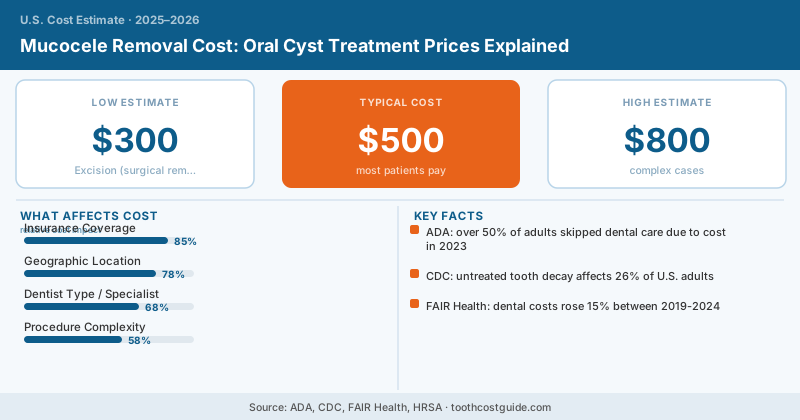
| Excision (surgical removal), small lesion | $300 | $500 | $800 |
| Excision with biopsy submission | $400 | $700 | $1,200 |
| Laser removal (CO2 or diode laser) | $350 | $600 | $1,000 |
| Ranula removal (floor of mouth) | $600 | $1,200 | $2,500 |
| Biopsy alone (before treatment decision) | $150 | $300 | $600 |
Location and size are the main cost drivers. A small mucocele on the lower lip is the simplest — often done in-office in under 30 minutes under local anesthesia. A ranula on the floor of the mouth involves deeper tissue dissection and costs more.
Treatment Options
Watchful Waiting
Mucoceles occasionally resolve on their own — particularly in children. Some resolve within a few weeks after a trauma-induced duct rupture. If it’s small, hasn’t been there long, and isn’t bothering you, a dentist might recommend just watching it for 4–6 weeks.
But most don’t disappear. And if they keep rupturing and refilling, that’s the gland repeatedly trying to drain and failing.
Surgical Excision (Most Common)
This is the standard treatment. Under local anesthesia (usually 1–2 carpules of lidocaine), the surgeon uses a scalpel to carefully excise the mucocele along with the underlying salivary gland that’s causing it. Removing the gland is key — if you just drain the fluid, it’ll come back.
The excised tissue is typically sent to a pathology lab for biopsy (even though it almost always comes back as expected — a benign mucocele). That pathology fee adds $100–$300 to the bill.
Healing takes 1–2 weeks. Stitches dissolve on their own. Most patients describe post-procedure discomfort as mild.
Laser Removal
Soft-tissue lasers (CO2 or diode lasers) vaporize the mucocele and surrounding gland tissue without a scalpel. The advantages: less bleeding, often no sutures needed, and potentially faster healing. The downside: tissue isn’t available for biopsy since it’s vaporized rather than excised.
Laser removal costs slightly more than conventional excision at many offices, but the total experience is often preferable.
Laser removal is faster and more comfortable for most patients, but conventional excision gives your provider a tissue sample for pathology — which is reassuring if there’s any doubt about the diagnosis. For a classic presentation (young patient, lower lip, recent trauma), laser is fine. If the lesion looks unusual, go conventional and get the biopsy.
Marsupialization
For ranulas (floor-of-mouth mucoceles), a technique called marsupialization is sometimes used instead of complete excision. The surgeon creates a permanent opening so the gland can drain continuously. It’s less invasive than full removal and appropriate for superficial ranulas.
Intralesional Injections (Less Common)
Some providers treat mucoceles with corticosteroid or OK-432 (picibanil) injections to shrink and resolve the lesion without surgery. This approach is more common in pediatric patients and in countries outside the U.S. It’s less standard here but available at some academic centers.
Does Dental Insurance Cover Mucocele Removal?
Often, yes — when coded correctly. Mucocele removal is typically classified as an oral surgery procedure (CDT code D7410 or D7411 for excision of a benign lesion). Most dental plans that include basic oral surgery benefits will cover 50–80% after your deductible.
A few caveats:
- Some plans require a predetermination/prior authorization before the procedure
- The pathology biopsy may be covered under medical insurance instead of dental
- If the dentist codes it as a “soft tissue cyst removal,” check that it’s not accidentally classified as a cosmetic procedure
Don’t try to pop or drain a mucocele at home with a pin or needle. You’ll likely get temporary relief, but the cyst will refill — and you risk introducing bacteria into the area, potentially causing a painful infection. Leave drainage to a dental professional.
Ranulas: A Special Case
A ranula is a mucocele specifically on the floor of the mouth. It can grow quite large — sometimes the size of a grape — and may involve the sublingual gland. “Plunging ranulas” extend below the mylohyoid muscle into the neck and require more complex surgery.
Ranulas are harder to treat than typical lip mucoceles because:
- The anatomy is more complex
- Complete gland removal is necessary to prevent recurrence
- Recurrence rates for incomplete excision approach 30–60%
Costs for ranula treatment typically start at $800 and can reach $5,000+ for a plunging ranula requiring an external (submandibular) approach.
Who Performs Mucocele Removal?
- General dentists handle simple, accessible mucoceles in many offices
- Oral and maxillofacial surgeons (OMS) handle larger, deeper, or recurrent cases
- Periodontists sometimes treat small soft-tissue lesions
- ENTs manage ranulas and plunging ranulas
For a classic small lower-lip mucocele, your general dentist may be able to remove it the same day. For anything unusual or recurrent, see an oral surgeon.
Recurrence: Does It Come Back?
Standard excision that includes the feeding minor salivary gland has a low recurrence rate — around 5–10%. If the gland isn’t fully removed, recurrence jumps significantly.
If your mucocele comes back after treatment, ask the provider whether the gland was fully excised. A second surgery by an oral surgeon (if the first was done by a general dentist) may be appropriate.
Bottom Line
Mucocele removal is a minor outpatient procedure that typically costs $300–$800 for a standard case. It’s covered by most dental insurance plans, takes under 30 minutes under local anesthesia, and has a low recurrence rate when done properly. Don’t ignore a persistent bump on your lip — it won’t go away on its own, and the sooner it’s treated, the simpler (and cheaper) the procedure tends to be.
Frequently Asked Questions
Mucocele removal typically costs between $300 and $1,200, depending on the cyst's size, location, and removal method used by your dentist or oral surgeon. Simple procedures performed in a general dental office fall on the lower end, while complex cases requiring surgical intervention at a specialist may cost more.
Most dental insurance plans cover mucocele removal if it's deemed medically necessary rather than purely cosmetic, though coverage varies by plan. You should expect to pay 20-50% of the cost out-of-pocket after your insurance deductible is met, with many plans covering the remainder as a surgical procedure.
The removal procedure typically takes 15-45 minutes depending on complexity, and most patients can resume normal activities within 24-48 hours with minimal discomfort. Complete healing usually occurs within 1-2 weeks, though you may experience slight swelling or tenderness in the first few days.