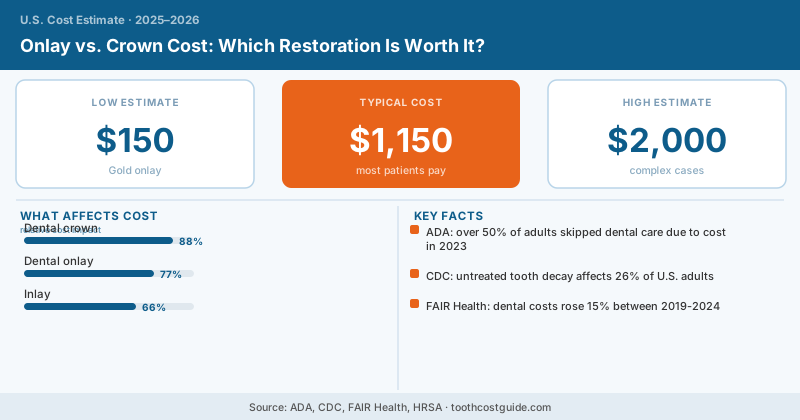
Your dentist says your cracked molar needs a big restoration. They mention a “crown or maybe an onlay.” Most patients nod along — but these are meaningfully different procedures with a $300–$800 price difference and different implications for your tooth’s long-term health.
Here’s the real difference and whether it matters for your wallet.
Crown vs. Onlay: The Key Difference
Both are permanent restorations made in a dental lab (or milled chairside). The difference is how much natural tooth structure they cover:
Dental crown: Caps the entire tooth above the gumline. Requires grinding down 60–70% of the natural tooth to create space. Strong, protective, and appropriate for severely damaged or root-canal-treated teeth.
Dental onlay (sometimes called a “partial crown”): Covers one or more cusps of the tooth without wrapping all the way down the sides. Far less tooth structure removed — often just the damaged portion. Appropriate for large cavities or fractures that extend over a cusp but don’t require full coverage.
Inlay: Even smaller — fits inside the cusps without covering them. Think of it as a very large filling shaped in a lab. Used for damage confined to the chewing surface between cusps.
The clinical choice should be based on how much healthy tooth structure remains. More remaining structure = onlay may suffice. Extensive damage, previous root canal, or significant fractures = crown makes more sense.
Cost Comparison
| Restoration | Material | Estimated Cost |
|---|---|---|
| Composite filling (large) | Composite resin | $150–$350 |
| Ceramic inlay | Porcelain/E.max | $500–$900 |
| Ceramic onlay | Porcelain/E.max | $650–$1,200 |
| Gold onlay | Gold alloy | $800–$1,500 |
| Porcelain-fused-to-metal crown | PFM | $800–$1,500 |
| All-ceramic crown (E.max/zirconia) | Ceramic | $1,000–$2,000 |
| Gold crown | Gold alloy | $900–$1,800 |
Onlays generally cost $200–$600 less than full crowns, reflecting the smaller amount of material used and (in some cases) less chair time. That gap matters — but it’s not the only factor.
Insurance Coverage: Where It Gets Complicated
Most dental insurance plans cover inlays and onlays as major restorations at 50% — the same benefit tier as crowns. So if your plan pays 50% of either procedure after deductible, the dollar amount you save on the onlay is roughly half the $300–$600 price difference. That’s $150–$300 in your pocket, which still adds up.
The complication: some insurance plans pay the same fixed fee for inlays, onlays, and crowns based on the tooth location, not the procedure. Others specifically limit what they’ll pay per surface. Always get a pre-authorization so you know what you’re actually getting reimbursed before you agree to treatment.
According to the American Dental Association’s Health Policy Institute, Americans spend over $136 billion annually on dental services, with restorative procedures like crowns and onlays among the most common major expenditures. Understanding the cost difference between restorations can meaningfully reduce what you spend.
When an Onlay Makes More Sense
An onlay is the better choice when:
- The cavity or fracture is large but at least one or two cusps remain intact and healthy
- You want to conserve tooth structure — this matters long-term because repeatedly crowning a tooth removes more structure with each replacement cycle
- The tooth hasn’t had a root canal (vital teeth with good structure are great onlay candidates)
- Your dentist or a restorative specialist confirms occlusion (bite) won’t cause excessive stress on a partial coverage restoration
The dental profession has increasingly embraced “minimal intervention dentistry” — the idea that preserving natural tooth structure leads to better long-term outcomes. The ADA supports onlays as a tooth-conserving alternative to crowns when the clinical situation allows. If your dentist mentions both options, ask why they prefer one over the other. A good answer involves your specific tooth anatomy, not just habit.
When a Crown Is the Right Call
A crown is better when:
- The tooth has had a root canal (brittle, more fracture risk without full coverage)
- Damage is extensive — large cracks, multiple broken cusps, or a tooth that’s been heavily restored before
- The tooth has a very large existing filling that would leave insufficient structure for an onlay
- You have heavy bite forces (bruxism) that place high stress on partial-coverage restorations
Crowns aren’t inherently inferior or wasteful — they’re the right tool for the right situation. The problem is when they’re used routinely for teeth that could have been restored more conservatively.
Same-Day (CEREC) Onlays and Crowns
Some practices offer same-day onlays and crowns milled chairside from a ceramic block (CAD/CAM). This eliminates the temporary restoration and second appointment. Prices for same-day work are typically similar to lab-fabricated restorations ($700–$1,400 for onlays, $1,000–$1,800 for crowns) — sometimes slightly higher due to equipment overhead, sometimes the same.
Bottom Line
If your dentist presents both options and the clinical situation supports an onlay, it’s worth the conversation. You’ll pay $200–$600 less, preserve more natural tooth, and potentially have a comparable long-term outcome. Ask explicitly: “Would an onlay work for this tooth, or is there a reason a full crown is necessary?”
If the answer is a clear clinical explanation (root canal history, fracture extent, occlusal forces), trust the crown recommendation. If the answer is vague, a second opinion from a prosthodontist is a reasonable next step before committing to the more expensive option.
Frequently Asked Questions
A dental onlay typically costs $650–$1,200, while a crown ranges from $1,000–$2,000, making onlays $300–$800 cheaper on average. The final price depends on tooth location, material (composite vs. ceramic), and whether your dentist uses in-office milling or sends the restoration to a lab.
Most dental insurance plans cover 50% of crown costs after meeting your deductible, leaving you responsible for $500–$1,000 out-of-pocket. Onlays receive similar coverage but may be classified differently by some insurers; check your plan's summary or call your provider to confirm coverage percentages before treatment.
A traditional crown typically requires 2–3 visits over 2–3 weeks (tooth prep, temporary crown, lab work, then permanent placement), while an onlay follows the same timeline if sent to a lab. Same-day crowns and onlays milled in-office take 1–2 hours in a single visit but cost $100–$300 more and may not be available for all tooth locations.