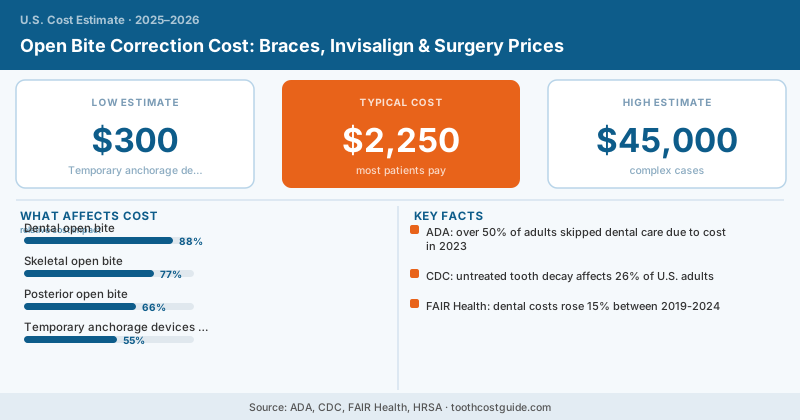
Front teeth that don’t touch when you bite down. That gap — the open bite — makes biting into a sandwich awkward, can affect speech, and often signals a deeper skeletal issue. What it costs to fix depends on whether the problem is in the teeth, the habits, or the jawbones themselves.
Here’s the real-world cost breakdown.
Cost by Treatment Approach
| Treatment | Typical Cost | Best Indication |
|---|---|---|
| Habit appliance (thumb/tongue) | $600–$2,000 | Children with active habit |
| Braces (dental open bite) | $4,000–$8,000 | Mild-moderate, growing patients |
| Invisalign with attachments | $5,000–$9,500 | Mild dental, adults/teens |
| Temporary anchorage devices (TADs) | $1,500–$3,000 added | Braces adjunct for intrusion |
| Orthognathic surgery + braces | $25,000–$45,000 | Skeletal open bite, adults |
| Retainer/retention after treatment | $300–$800 | All cases |
What Causes an Open Bite?
Understanding the cause determines the treatment — and the price.
Dental open bite: Teeth are tipped or positioned so the front teeth don’t contact. Common causes include prolonged thumb sucking, pacifier use beyond age 3–4, or tongue thrusting. This type responds well to orthodontics.
Skeletal open bite: The jaw bones themselves are shaped or positioned so the front teeth can’t meet even when teeth are perfectly aligned. This requires jaw surgery in adults, or growth modification in growing children.
Posterior open bite: Back teeth don’t meet instead of front teeth — rarer, but occurs with certain jaw joint conditions or TMJ issues.
The AAPD (American Academy of Pediatric Dentistry) recommends evaluating digit-sucking habits by age 3 and breaking them before permanent teeth erupt, typically around age 6–7. Early intervention can prevent a minor habit from becoming an expensive skeletal problem.
Habit Appliances: Cheapest When Done Early
For young children (ages 5–9) whose open bite is caused by thumb sucking or tongue thrusting, a fixed habit-breaking appliance (cribs, spurs, or a TPA — transpalatal arch) can be the entire treatment. The appliance prevents the thumb or tongue from resting between the teeth, allowing the bite to close naturally as the child grows.
Cost: $600–$2,000, often covered partially by orthodontic insurance benefits.
If the habit is addressed before permanent teeth erupt, some children need no further treatment. That’s the best-case scenario and the cheapest outcome.
Tongue thrust — pushing the tongue forward between front teeth when swallowing — is both a cause and a consequence of anterior open bite. Even after orthodontic treatment, a persistent tongue thrust habit can reopen the bite if not addressed. Myofunctional therapy (orofacial exercises to retrain swallowing patterns) costs $1,000–$3,000 but is often essential for long-term stability, especially in adults.
Braces and Invisalign for Dental Open Bite
For dental open bites in growing children and teens, braces or aligners can close the bite by intruding (pushing down) the back teeth and/or flaring the front teeth slightly. Standard treatment takes 18–30 months.
Temporary anchorage devices (TADs) are small titanium screws placed temporarily in the gum or palate to provide a fixed anchor point for tooth movement. They’ve dramatically improved the ability to close open bites without surgery and are now commonly used in adult cases. Expect an additional $1,500–$3,000 for TAD placement on top of standard orthodontic fees.
Invisalign has improved significantly for open bite treatment. With precision bite ramps and attachments, it can close mild-to-moderate dental open bites effectively in many patients.
Orthognathic Surgery: The Adult Skeletal Case
If your jaw bone grows with a steep vertical angle — the upper jaw tilts down in the back, pushing the front teeth open — no amount of tooth movement will close the bite permanently. In adults, this requires orthognathic surgery (jaw repositioning surgery).
The typical approach is a Le Fort I osteotomy to impact (raise) the posterior maxilla, allowing the front teeth to contact. In some cases, a BSSO (bilateral sagittal split osteotomy) of the lower jaw is also performed.
Total cost: $25,000–$45,000, covering:
- Pre-surgical orthodontics (12–18 months): $4,000–$8,000
- Surgical fees: $8,000–$20,000
- Hospital/anesthesia: $5,000–$12,000
- Post-surgical orthodontics and retainers: $2,000–$4,000
Medical insurance frequently covers the surgical portion when functional impairment is documented. Dental insurance covers the orthodontic components. Many patients pay $5,000–$10,000 out of pocket after coverage — a big number, but far less than the full sticker price.
Open bites have among the highest relapse rates of any orthodontic problem. Patients who close an open bite with braces alone (no surgery, no habit correction, no myofunctional therapy) often see it reopen within 2–5 years. Before committing to expensive treatment, discuss the long-term stability plan with your orthodontist — including retention protocol and whether myofunctional therapy is recommended.
Who Pays What?
Children under 18 with a habit-related open bite: Phase 1 treatment (habit appliance) often gets covered under orthodontic benefits. Full braces later may consume the plan’s lifetime maximum ($1,000–$2,500).
Adults with dental open bite: Orthodontic coverage is less common for adults, but many plans do include it. TADs may be billed as a separate oral surgery procedure and covered separately.
Adults with skeletal open bite needing surgery: Medical insurance is often the bigger player here. Document TMJ symptoms, chewing difficulty, or speech impairment — these justify coverage under medical plans.
Saving on Treatment
Early evaluation. If you have young children who suck their thumb or have a persistent pacifier habit, get an orthodontic evaluation by age 7. The AAPD and AAO both recommend this.
Orthodontic school programs. Graduate orthodontic programs provide supervised treatment at 40–60% below private rates. Open bites are excellent teaching cases.
Consider phased insurance use. If you have dental insurance with a new plan year coming, schedule the initial exam and appliance placement before year-end, then continue treatment in the new year to potentially use two years of benefits.
The earlier an open bite is caught and its cause addressed, the simpler and less expensive the fix. Don’t let a childhood habit become adult jaw surgery.
Frequently Asked Questions
Invisalign for open bite typically costs $4,000–$8,500, depending on severity and treatment duration (usually 18–24 months). This is generally $1,000–$2,000 more than traditional braces because Invisalign requires custom aligner trays and more frequent adjustments to address the vertical bite gap.
Most dental insurance plans cover 50% of orthodontic treatment after you meet the deductible, with a lifetime orthodontic benefit cap of $1,500–$2,000. Open bite correction is usually considered medically necessary if it affects function or speech, but cosmetic-only cases may face lower coverage or exclusions—check your specific plan documents.
Traditional braces typically correct open bite in 24–36 months, though mild cases may resolve in 18–24 months. Surgical correction for severe skeletal open bites requires 6–12 months of pre-surgery bracing, the surgical procedure itself, and another 12–18 months of post-operative orthodontics for final alignment.