Your dentist spotted a white patch on the inside of your cheek. It’s been there for three weeks. She wants to biopsy it.
That word alone is alarming to most people. It shouldn’t be — most oral biopsies come back benign. But the reason to do one is the same as the reason to check a suspicious mole: the only way to know for certain what something is, is to look at it under a microscope.
Here’s what an oral biopsy costs, what it involves, and what happens next.
What Is an Oral Biopsy?
An oral biopsy removes a small piece of tissue from a suspicious lesion in the mouth for laboratory analysis by an oral pathologist. It’s the definitive diagnostic test for oral lesions that can’t be explained by obvious causes — a bite injury, infection, or recent irritation.
The CDC and the American Cancer Society estimate that approximately 58,450 Americans are diagnosed with oral cavity or oropharyngeal cancers annually. Early-stage oral cancer detected before it spreads has a 5-year survival rate above 85%. Late-stage detection drops that figure dramatically. Biopsy is the only way to detect or rule out early oral cancer.
Types of Oral Biopsy
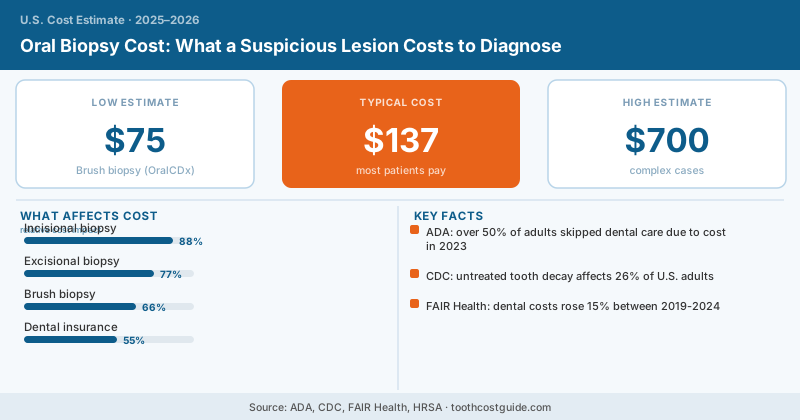
| Type | Cost Range | When Used |
|---|---|---|
| Incisional biopsy (partial removal) | $200–$600 | Large lesions; removes a representative sample |
| Excisional biopsy (complete removal) | $250–$700 | Small lesions; removes the entire suspicious area |
| Brush biopsy (OralCDx) | $75–$200 | Screening tool for low-suspicion white patches |
| Fine-needle aspiration (FNA) | $200–$500 | Neck lumps, salivary gland masses |
| Pathology lab fee (often separate) | $75–$200 | Always sent to oral pathology laboratory |
The biopsy fee your dentist charges and the lab fee may appear as separate line items on your bill. Ask upfront whether the quoted price includes the pathology fee.
Incisional biopsy: The surgeon removes a small wedge or punch of tissue from part of the lesion. Used when the lesion is large enough that removing the whole thing would leave a significant wound, or when the goal is diagnosis before planning further treatment.
Excisional biopsy: The entire suspicious area is removed during the biopsy. Used for smaller lesions where removal is also the treatment if the diagnosis is benign. This is the preferred approach when feasible — it solves the diagnostic question and treats the problem in one step.
Brush biopsy: A small rotating brush collects cells from the surface of a lesion, similar to a Pap smear. The OralCDx system is the most common brand. It’s less definitive than a tissue biopsy but useful as a screening step for white patches that appear low-risk.
Who Performs an Oral Biopsy
Your general dentist may perform a biopsy for accessible, straightforward lesions on the lip, cheek, or gingiva. For lesions on the tongue, floor of mouth, soft palate, or throat — higher-risk locations — referral to an oral and maxillofacial surgeon (OMS) or oral medicine specialist is standard.
OMS practices typically charge at the higher end of the cost range: $400–$700 including pathology. General dental offices may charge $200–$400.
The American Dental Association recommends that any oral lesion persisting more than 2 weeks without an obvious benign cause be evaluated. This doesn’t mean every canker sore needs a biopsy — canker sores resolve on their own and have a characteristic appearance. What requires attention: ulcers that don’t heal, red or white patches that can’t be explained, a lump or thickening in the cheek or on the tongue, or difficulty swallowing. If your dentist mentions the word “biopsy,” don’t delay the appointment.
What to Expect at the Biopsy Appointment
Most oral biopsies take 20–40 minutes from start to finish.
- Local anesthesia: The site is numbed with one or two injections. You’ll feel a brief sting, then nothing from the biopsy itself.
- Tissue removal: The surgeon uses a scalpel, laser, or biopsy punch to remove the sample. Typically 3–10mm.
- Closure: Small lesions may not need stitches. Larger sites get absorbable sutures that dissolve in 7–14 days.
- Sample labeling and shipping: The tissue goes into formalin solution and is sent to an oral pathology lab.
Post-procedure: mild soreness for 3–7 days, managed with ibuprofen or acetaminophen. Avoid hot, spicy, or hard foods at the biopsy site. Results come back in 7–14 business days.
Does Insurance Cover Oral Biopsies?
Yes, in most cases. An oral biopsy is a diagnostic medical procedure — not cosmetic or elective — and most dental insurance plans and medical insurance plans cover it.
Dental insurance: Typically covered under diagnostic benefits at 80–100% after deductible. The key CDT codes are D7285 (incisional biopsy) and D7286 (exfoliative cytological sample — brush biopsy).
Medical insurance: Because oral cancer evaluation has clear medical necessity, oral biopsies performed by an oral surgeon are often also covered under medical insurance. If you’re scheduled with an OMS, ask their office whether to bill dental or medical insurance — some practices have arrangements with both. Billing medical insurance may actually yield better coverage in some cases.
Medicare: Medicare Part B covers oral biopsies performed by oral surgeons as outpatient surgical procedures.
After the Results
Most biopsied lesions come back as benign reactive tissue, fibroma, or low-risk epithelial changes. Your dentist explains the findings and any follow-up.
If the results show:
- Benign lesion: Often no further treatment needed. Follow-up exam in 3–6 months to confirm resolution.
- Dysplasia (precancerous): Graded mild, moderate, or severe. Severe dysplasia typically requires excision; mild dysplasia may be monitored.
- Carcinoma in situ or early-stage cancer: Referral to a head and neck oncology team. Early-stage oral cancers are often treated successfully with surgery alone.
If your biopsy comes back benign but the lesion persists or changes, follow up. Benign biopsy results don’t mean “ignore this forever” — they mean the sampled tissue was benign at the time of sampling. Oral lesions can evolve. A lesion that recurs or changes after a benign biopsy deserves re-evaluation, not dismissal.
The cost of an oral biopsy — $200–$600, often covered by insurance — is a reasonable price for certainty about something that looks unusual in your mouth. Most findings are benign. But the ones that aren’t are the reason this test matters.
Frequently Asked Questions
A dentist or oral surgeon recommends a biopsy when a lesion in the mouth doesn't resolve within 2 weeks, has irregular borders, appears red (erythroplakia) or red-and-white (erythroleukoplakia), is firm or indurated on palpation, or is in a high-risk location (floor of mouth, lateral tongue, soft palate). White patches (leukoplakia) that can't be rubbed off are also routinely biopsied. Most biopsied lesions turn out to be benign — but the only way to know is pathological analysis.
The biopsy itself is performed under local anesthesia — you'll feel the injection (the most uncomfortable part) but shouldn't feel the tissue removal. Afterward, mild soreness at the site is normal for 3–7 days. The area is typically 2–10mm in size; stitches may be placed depending on the size and location. Most patients manage post-procedure discomfort with over-the-counter pain relievers.
The tissue sample is sent to an oral pathology laboratory. Results typically come back in 7–14 business days. Your dentist or oral surgeon will contact you with the results and explain next steps. If results are borderline or ambiguous, a second opinion from an oral pathologist — a specialist in diagnosing oral disease from tissue — may be requested.