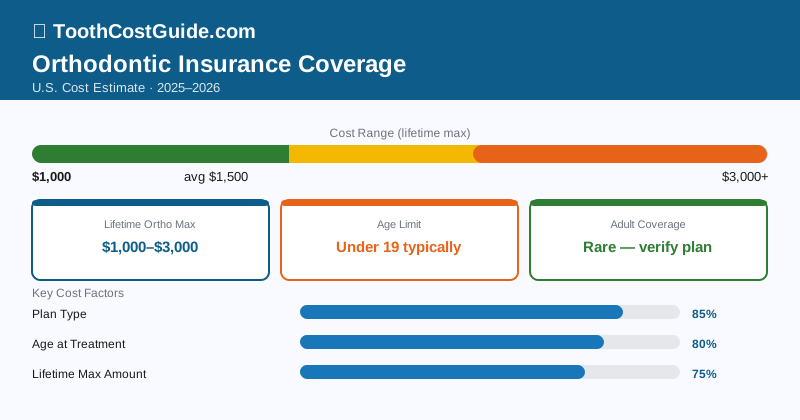
Before you sign an orthodontic treatment contract, spend 20 minutes with your insurance plan documents. Orthodontic insurance has three features that routinely blindside patients: the benefit is a lifetime maximum (not annual), it doesn’t reset when you change plans, and age cutoffs can eliminate the benefit entirely if you miss the window by even a few months.
Most dental insurance plans with orthodontic benefits cover 50% of orthodontic treatment costs up to a lifetime maximum of $1,000–$3,000. That maximum applies once per covered patient — ever. Understanding exactly how your plan works before starting treatment can mean the difference between a $1,500 insurance benefit and a zero-dollar payout.
| Coverage Component | Typical Range |
|---|---|
| Lifetime orthodontic maximum (children) | $1,000–$3,000 |
| Lifetime orthodontic maximum (adults, if covered) | $500–$2,000 |
| Coverage percentage | 50% (standard) |
| Age limit for children’s coverage | 18–19 (most plans) |
| Waiting period for ortho benefits | 0–12 months |
| Deductible for orthodontic treatment | $0–$100 (varies) |
| Coverage for Invisalign | Same as braces (most plans) |
| CHIP orthodontic coverage (medically necessary) | Varies by state |
Three Ways Orthodontic Insurance Differs From Regular Dental Benefits
1. Lifetime maximum, not annual maximum. Your annual dental maximum ($1,000–$2,000 typically) resets every January. The orthodontic lifetime maximum ($1,000–$3,000) does not. It’s a one-time benefit per covered person. Once used, it’s gone — even if you switch to a different insurer.
2. Payments spread over the course of treatment. Most insurance companies don’t cut a check for the full benefit at case start. They pay a portion at banding (when treatment begins), then monthly payments over the treatment period. A plan with a $1,500 maximum for 24-month treatment might send $62.50 per month. Your orthodontist coordinates this billing directly with the insurer.
3. Separate from the regular dental benefit. Orthodontic coverage is an add-on benefit — not every dental plan includes it. A bare-bones dental plan may cover cleanings, X-rays, and fillings but have zero orthodontic coverage. Check your specific plan, not the general insurance category.
Finding Your Actual Benefit
Read your Summary of Benefits and Coverage (SBC). Required under the ACA for employer-sponsored plans, this document lists all benefits including orthodontic coverage, the lifetime maximum, the coverage percentage, age limits, and any waiting periods. It’s your most accurate source — more reliable than asking your HR department.
Terms to look for:
- “Orthodontia” or “Orthodontic treatment”
- “Lifetime maximum” or “Orthodontic maximum”
- “Class IV services” (many plans classify orthodontics here)
- Age limit or “dependent age limit for orthodontic coverage”
- “Waiting period” for orthodontic benefits
The orthodontic lifetime maximum is the most important number. A $1,500 lifetime maximum means that’s the maximum the plan will ever pay for orthodontic treatment — not $1,500/year. If your family has three children who all need braces, the $1,500 maximum applies once per child (not collectively), but it’s finite for each child and never resets.
Age Limits: The Coverage Cliff
Under 18: Virtually every dental plan that includes orthodontic benefits covers patients under 18. Some plans set the cutoff at 19 or 21.
Ages 18–26 (dependents): Under the ACA, dependents can remain on a parent’s health insurance through age 26. But dental insurance doesn’t follow the same rule automatically — it depends on the specific dental plan. A 22-year-old dependent might have health insurance through a parent but no dental orthodontic coverage past age 18. Check the dental plan separately.
Adults over 26: Most employer-sponsored dental plans do not cover orthodontic treatment for adults. Exceptions exist in:
- Premium employer benefits packages
- Union-negotiated dental plans
- Certain individual market dental plans (through healthcare exchanges)
- Plans specifically marketed as including adult orthodontic coverage
If you’re an adult unsure about your coverage, call the member services number on your dental insurance card and ask: “Does my plan cover orthodontic treatment for adults over age 26? What is the lifetime maximum and the coverage percentage?”
Waiting Periods
Some plans impose a waiting period — typically 6–12 months — before orthodontic benefits begin. This prevents people from signing up for coverage, using the orthodontic benefit, and canceling.
If you just enrolled in a new dental plan with a 12-month orthodontic waiting period, wait until the period ends before starting treatment. Otherwise you get no benefit on treatment you’re already paying for.
One nuance: if orthodontic treatment was already in progress when your new plan began, some plans will cover the remaining treatment. Others exclude it as a pre-existing condition. Always verify with the new insurer before assuming coverage carries over.
What’s Covered, What Isn’t
Typically covered:
- Traditional metal braces (comprehensive)
- Ceramic braces (up to the allowable fee for metal, usually)
- Invisalign and in-office clear aligners (same terms as braces at most plans)
- Phase 1 early orthodontic treatment
- Phase 2 comprehensive treatment
- Necessary palate expanders
Typically not covered:
- Retainers after treatment (often excluded as maintenance)
- Replacement retainers for lost or broken appliances
- Cosmetic-only procedures
- Direct-to-consumer aligners (Byte, etc.) — not supervised by in-network providers
- Whitening after orthodontic treatment
- Anything the plan classifies as purely cosmetic
Many plans state they cover “orthodontia” but define it as treatment for “functional necessity” rather than cosmetic alignment. In practice, most orthodontic cases are approved. But if your plan denies a claim as cosmetic, you can appeal with documentation from your orthodontist showing functional impairment — difficulty chewing, speech issues, documented bite problems.
Medicaid and CHIP Coverage
Children and teens who qualify for Medicaid or the Children’s Health Insurance Program (CHIP) may have orthodontic coverage when treatment is “medically necessary.”
Medical necessity criteria vary by state but typically include:
- Severe malocclusion score (many states use the Handicapping Labio-lingual Deviation — HLD — index)
- Documented functional impairment (chewing, speech, breathing)
- Cleft palate and craniofacial conditions
- Cases scoring above a threshold on a standardized severity scale
Cosmetic and mild orthodontic treatment is not covered. State programs often have waiting lists. Contact your state’s Medicaid office for eligibility specifics.
Strategies for Getting the Most From Your Benefit
Don’t let the benefit expire at the age cutoff. If a plan covers orthodontics through age 18 and your teenager turns 18 in 6 months, start treatment now or risk losing the benefit entirely. Missing the window by one month costs you $1,000–$3,000.
Submit a predetermination of benefits before starting. Have your orthodontist submit a pre-treatment estimate to your insurer. This confirms the expected coverage in writing before you sign any treatment contracts. Takes one billing cycle. Worth it.
Coordinate timing if multiple family members need braces. Each person’s lifetime maximum is their own — coordinate treatment timing to ensure each person’s benefit is available when needed, not burned by a prior Phase 1 claim.
Apply your benefit to the most expensive treatment option. If you’re choosing between metal ($4,500) and Invisalign ($5,500), the $1,500 insurance maximum applies to either. But it leaves you with $3,000 out-of-pocket for metal versus $4,000 for Invisalign. Factor that into your appliance choice.
Stack FSA funds on top of insurance. After insurance, use FSA dollars for the out-of-pocket remainder. Combined, insurance plus FSA provides the deepest discount available on orthodontic treatment.
Financing the Patient Portion
In-office payment plans + insurance coordination: Most orthodontic offices bill your insurer directly and apply insurance payments to your account as they arrive. Your monthly installment is calculated on the patient-pay portion after insurance.
FSA/HSA: Fully eligible for the patient-paid amount. Maximize FSA elections before the treatment year begins.
CareCredit: Available for the patient portion not covered by insurance. Use promotional 0% periods only if you can pay the balance in full before the deadline.
The Bottom Line
Orthodontic insurance pays 50% up to a $1,000–$3,000 lifetime maximum for most covered patients under 18. Adult coverage is the exception, not the rule. The lifetime maximum doesn’t reset, waiting periods can delay benefits, and treatment classified as cosmetic can be denied. Before any orthodontic treatment begins: review your Summary of Benefits, verify the lifetime maximum and remaining balance, confirm the age limit, and get a predetermination of benefits in writing. Those steps take one billing cycle and can clarify thousands of dollars of expected costs.
Get a predetermination of benefits from your insurer before starting treatment — it takes one request from your orthodontist’s billing department and tells you exactly how much the insurer will pay. Never assume coverage; verify it in writing. The lifetime maximum is the most important number to confirm, especially if any orthodontic benefits were used in childhood.
Frequently Asked Questions
The total cost of orthodontics typically ranges from $3,000 to $7,000, but with insurance covering 50%, your out-of-pocket cost is usually $1,500 to $3,500 after your lifetime maximum ($1,000–$3,000) is exhausted. If your plan has a $2,000 lifetime maximum and covers 50%, you'd pay approximately $1,000–$3,500 total depending on your plan's coinsurance terms.
No—your orthodontic lifetime maximum does not reset when you switch insurance plans; it follows you permanently across all carriers. This means if you used $1,500 of a $2,000 lifetime benefit under your old plan, you only have $500 remaining under your new plan, even if that plan offers a higher nominal maximum.
Many dental plans impose age cutoffs (commonly age 18–19) for orthodontic coverage, meaning you must begin treatment before that date to qualify for the benefit. Missing the age cutoff by even a few months can eliminate your entire orthodontic benefit, so verify your plan's eligibility window immediately if you're approaching the deadline.