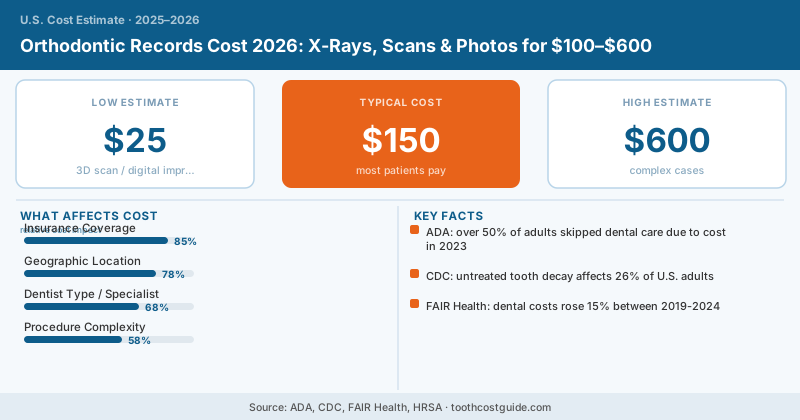
Before a single bracket goes on, your orthodontist needs a full picture of what’s happening inside your mouth. That diagnostic workup — called orthodontic records — runs $100 to $600, and it’s the unglamorous step nobody mentions when they quote you a braces price. Understanding it can save you from sticker shock at the front desk.
Records are the X-rays, 3D scans, photographs, and impressions that map your teeth, jaws, and bite in detail. They’re how the orthodontist diagnoses your case and builds your treatment plan. Skip them and you’re essentially asking someone to fix your car without lifting the hood.
| Records Component | Typical Cost | What It Shows |
|---|---|---|
| Panoramic X-ray | $75–$200 | All teeth, roots, jawbone overview |
| Cephalometric X-ray | $75–$200 | Jaw and facial bone relationships |
| 3D scan / digital impressions | $50–$250 | Precise tooth positions for planning |
| Photos & study models | $25–$150 | Records of starting position |
| Full records package | $100–$600 | Often bundled or waived with treatment |
What Each Record Reveals
The panoramic X-ray is the wide shot — it captures every tooth, the roots, the jawbone, and any hidden issues like impacted wisdom teeth or extra teeth lurking below the gumline. The cephalometric X-ray is the side profile, showing how your jaws and facial bones relate, which is critical for diagnosing skeletal problems versus simple crowding.
The 3D scan (or old-school impressions) creates a precise digital model of your teeth, used to design appliances and aligners. Photos and study models document where you started, so progress can be measured and, frankly, so there’s a record if anything is ever disputed.
Many orthodontists waive the records fee if you proceed with treatment, or fold it into the total. The standalone charge usually appears when you only want a diagnostic opinion. Always ask at your orthodontist consultation whether records are separate or included before you commit.
Why Records Are Non-Negotiable
This is where the safety story matters. The American Association of Orthodontists has been emphatic that proper diagnosis requires imaging — you can’t see a tooth’s root angle or hidden pathology by looking at the crowns. This is exactly why the AAO has criticized direct-to-consumer aligner models that move teeth based only on a surface scan, with no X-rays to check root and bone health.
Records catch the things that surface impressions miss: a root pointing the wrong way, bone loss from gum disease, an unerupted tooth, or a cyst. Moving teeth without knowing these things can cause permanent damage. The CDC has reported that periodontal (gum) disease affects a large share of American adults — and active gum disease changes how orthodontics should proceed, something only proper records would reveal.
What Affects the Price
The level of imaging drives the cost. A simple case might need only a panoramic X-ray and a scan. A complex skeletal case — like one heading toward surgical orthodontics — needs the full cephalometric workup and detailed records, pushing toward the high end.
Technology matters too. Practices with modern in-house 3D scanners and digital X-rays often bundle records cheaply because the marginal cost is low. Offices that send you out for imaging may pass along higher fees.
These records feed directly into whatever you choose next — braces, clear aligners, or an appliance. They’re the foundation of the whole plan.
Insurance and Payment
Diagnostic records often fall under your dental insurance’s diagnostic category, separate from the orthodontic benefit — meaning X-rays may be partially covered even if orthodontics isn’t. Understanding how dental insurance works helps you predict this. The orthodontic treatment itself draws on a separate lifetime cap, usually $1,000–$2,500.
For any out-of-pocket records cost, an FSA for dental expenses covers diagnostic imaging as an eligible expense.
If you’re getting a second opinion, ask whether you can reuse recent records rather than paying for a fresh set. Many X-rays and scans are valid for months. Paying twice for the same imaging is a common, avoidable expense when shopping orthodontists.
Bottom Line
Orthodontic records are the cheap, essential first step that makes safe treatment possible. At $100–$600 — and often free with treatment — they’re not where you cut corners. Any provider willing to move your teeth without proper records is one to walk away from.
Frequently Asked Questions
Orthodontic records typically cost $100 to $600, depending on what your orthodontist needs to create a treatment plan. This can include X-rays, 3D scans, photographs, and dental impressions. Many practices bundle this fee into your total braces or aligner cost, so ask if it's already included in your quote.
Most dental insurance plans do not cover diagnostic orthodontic records as a separate fee, though some plans may cover them if they are part of an approved orthodontic treatment plan. You typically pay $100–$600 out-of-pocket upfront, and that cost may be credited toward your total treatment cost if you proceed. Always verify with your insurance provider before your appointment.
Orthodontic records usually take 30 to 60 minutes to complete during your initial consultation visit. Your orthodontist will take digital X-rays, photographs, 3D scans, and impressions of your teeth and bite, and results are typically available within a few days for your treatment planning meeting.