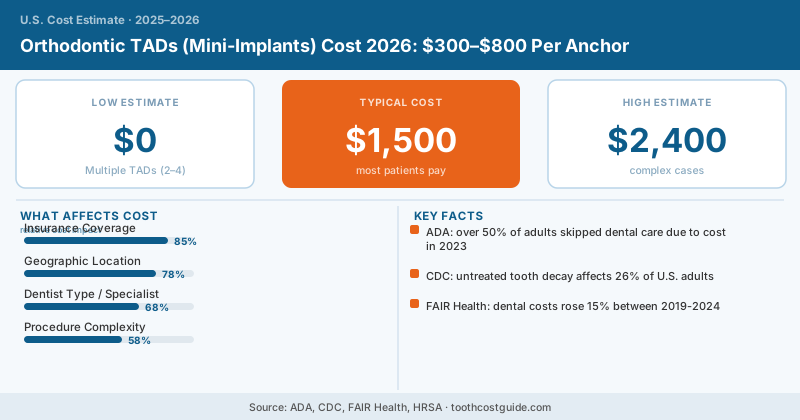
Ever wonder how an orthodontist pulls a single stubborn tooth into place without dragging its neighbors along for the ride? The answer is often a tiny titanium screw about the size of a grain of rice. They’re called TADs — temporary anchorage devices — and each one typically runs $300 to $800.
TADs, also known as mini-implants or micro-screws, are temporary anchors placed directly into the jawbone. They give the orthodontist a fixed point to push or pull against, so teeth move exactly where they’re supposed to without the unwanted side effects of using other teeth as anchors.
| TAD Service | Typical Cost | Notes |
|---|---|---|
| Single TAD placement | $300–$800 | Per screw, includes placement |
| Multiple TADs (2–4) | $600–$2,400 | Common in complex cases |
| Sometimes bundled into treatment | $0 added | Some orthodontists include in flat fee |
| Removal | Usually included | Quick, often no extra charge |
What TADs Actually Do
Picture trying to pull a heavy box across the floor while standing on a skateboard. You’d roll backward. That’s the anchorage problem in orthodontics — when you use teeth to move other teeth, the “anchor” teeth tend to drift too. A TAD is like nailing your feet to the floor. It’s anchored in bone, not teeth, so it doesn’t budge.
That stability lets orthodontists do things that used to require headgear or extractions: close large gaps, intrude teeth that have over-erupted, or correct an asymmetric bite. Placement takes minutes under local anesthetic, and the screw comes out just as easily once it’s done its job.
You don’t get TADs by themselves — they support braces or Invisalign treatment. So price your base case first, then add TADs as needed. A complex adult braces case with two TADs might run $5,500 base plus $800–$1,200 for the anchors.
Why Some Patients Need Them and Others Don’t
Not every case calls for TADs. Simple crowding usually doesn’t. But the American Association of Orthodontists has noted the steady rise of TAD use over the past two decades because they solve problems that older methods handled poorly — and they often eliminate the need for bulky headgear that teenagers famously refuse to wear.
They’re especially valuable when a patient is missing teeth (no natural anchor available), when large spaces need closing, or when the orthodontist wants precise three-dimensional control. The CDC reports that tooth loss remains common among American adults, which is one reason TADs show up so often in adult treatment — there simply aren’t enough natural anchor teeth.
What Affects the Price
The number of screws is the biggest driver — one TAD versus four is a meaningful spread. Placement complexity matters too; a TAD in dense lower-jaw bone may cost more than one in the upper palate.
Some orthodontists fold TADs into a flat treatment fee, so you never see a separate charge. Others itemize each screw. Always ask which model your provider uses, because “TADs included” versus “TADs extra” can swing your total by $1,000 or more.
The good news: TADs don’t add to your retention costs. You’ll still need a retainer at $150–$500 to hold your result, but the TADs come out before that stage.
Insurance and Payment
Orthodontic insurance doesn’t break out TADs as a separate covered item. If you have an ortho benefit — typically a $1,000–$2,500 lifetime cap — it applies to the overall treatment, and TADs ride along inside that.
For the out-of-pocket portion, an FSA for dental expenses covers TADs as part of eligible orthodontic care, and a CareCredit dental plan can finance a complex case with multiple anchors.
A small percentage of TADs loosen or fail before treatment is complete and need replacement. Ask your orthodontist upfront whether replacement is included or billed again — a failed TAD shouldn’t cost you a second full placement fee.
The Takeaway
TADs are one of the best value-adds in modern orthodontics — a $300–$800 screw can replace headgear, avoid extractions, and deliver precision that wasn’t possible a generation ago. If your orthodontist recommends them, they’re usually solving a real anchorage problem. Just confirm at your orthodontist consultation whether they’re bundled into your fee or billed on top.
Frequently Asked Questions
Each TAD typically costs $300 to $800, depending on your orthodontist's location, experience level, and whether placement is simple or requires bone grafting. Most patients need 1–4 TADs during treatment, bringing the total TAD expense to $300–$3,200 for a full case.
Most dental insurance plans do not cover TADs because they are considered an orthodontic add-on or specialty procedure, not a standard treatment. You should expect to pay the full $300–$800 per anchor out-of-pocket; check your policy or call your insurance company to confirm coverage.
TAD placement takes 10–20 minutes per anchor under local anesthesia. You can typically eat soft foods within 1–2 hours after placement and return to normal foods within 3–7 days; your orthodontist will provide specific post-placement care instructions.