A traditional denture that slides when you laugh, or an overdenture that clicks securely into place with a bite force closer to natural teeth — that’s the real choice, and the price difference reflects it. An overdenture costs meaningfully more than a standard denture, but for many patients, it’s the difference between avoiding certain foods and eating normally again.
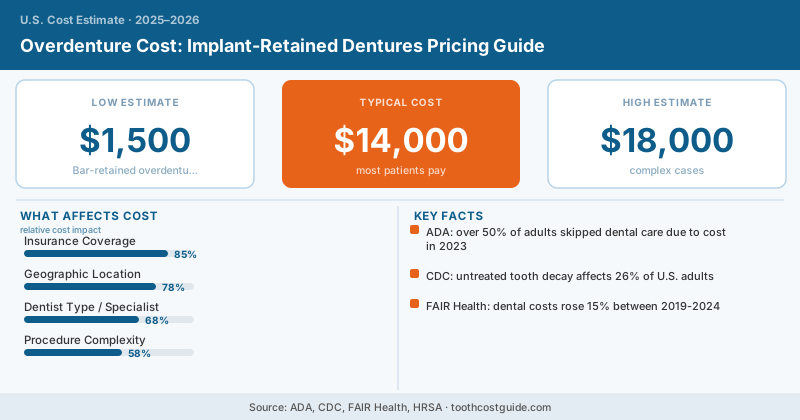
Expect $4,500-$18,000 per arch, with the final number driven almost entirely by how many implants anchor the denture.
| Configuration | Typical Cost Per Arch |
|---|---|
| 2-implant overdenture (ball attachment) | $4,500–$8,000 |
| 4-implant overdenture (locator attachment) | $8,000–$14,000 |
| Bar-retained overdenture (4+ implants) | $10,000–$18,000 |
| Traditional denture (no implants, comparison) | $1,500–$3,500 |
Why Implants Change Everything About Fit
A traditional denture relies on suction and the shape of your gum ridge for retention — which works reasonably well at first but degrades as the underlying bone continues to shrink over the years. An overdenture instead snaps onto small attachment components fixed to 2-4 implants placed in the jawbone. The denture itself is still removable for cleaning each night, but while it’s in your mouth, it’s mechanically locked to a stable, non-shrinking foundation.
The practical difference shows up in bite force and confidence. Patients who switch from a traditional lower denture — which is notoriously less stable than an upper denture due to jaw shape and tongue movement — to a 2-implant overdenture often describe being able to eat foods they’d avoided for years, like apples or steak.
Two Implants vs. Four: What Changes
A 2-implant overdenture with ball or locator attachments is the most common and affordable configuration, particularly for the lower jaw where stability is the biggest problem with traditional dentures. It dramatically improves retention compared to a standard denture, though there’s still some minor movement during heavy chewing.
A 4-implant configuration, especially with a bar connecting the implants, provides even more stability and is often recommended for the upper jaw or for patients with more demanding chewing needs. The additional implants and the bar fabrication add $3,000-$8,000 to the total compared to the 2-implant option.
Ball attachments are simpler and less expensive but wear out faster, typically needing replacement of the small rubber or plastic inserts every 1-2 years ($50-$150). Locator attachments offer more consistent retention and are generally the more popular modern choice. Bar attachments cost the most but provide the most even, splinted support across multiple implants.
The Replacement Parts You’ll Budget For
Unlike a traditional denture, an overdenture has small components inside the appliance — inserts or clips — that wear down from the repeated snapping in and out. These typically need replacement every 12-24 months at $50-$200 depending on the attachment type, a maintenance cost worth factoring into your long-term budget alongside the upfront implant and denture expense.
Insurance and the Coverage Gap
This is where overdentures get complicated financially. Many dental insurance plans will cover the denture portion at rates similar to a traditional denture, but implant placement itself is frequently excluded, capped, or covered at a lower percentage than other major services — some plans explicitly list dental implants as a non-covered service regardless of the reason for placement.
Always get a detailed, itemized pre-treatment estimate broken into implant placement fees and denture fabrication fees separately, since your coverage percentage may differ significantly between the two components.
Who Overdentures Make the Most Sense For
Overdentures are frequently recommended for patients who’ve struggled with a loose or uncomfortable traditional lower denture, patients who have adequate bone for implant placement but don’t want or can’t afford a full set of individual implants for every missing tooth, and patients transitioning from failing natural teeth who want a stable, long-term solution without the cost of All-on-4 style fixed implant bridges.
Not everyone has enough jawbone density for implant placement without additional grafting, which adds cost and time to the timeline. Get a CT scan evaluation before committing to an overdenture plan — a 2D X-ray alone often isn’t sufficient to assess bone volume accurately.
The Bottom Line
An overdenture costs significantly more than a traditional denture — $4,500-$18,000 per arch depending on implant count and attachment system — but delivers a level of stability and chewing confidence that traditional dentures generally can’t match. Get separate estimates for the implant and denture components, ask about attachment type trade-offs, and budget for periodic insert replacement as part of the real long-term cost.
Frequently Asked Questions
An implant-retained overdenture typically costs $4,500-$18,000 per arch, depending on how many implants are placed (usually 2-4) and the type of attachment system used. This is more than a traditional denture but significantly less than a full set of individual implants.
A traditional denture rests on the gums alone, held by suction and adhesive. An overdenture snaps onto 2-4 implants embedded in the jawbone, providing dramatically more stability and chewing force, while still being removable for cleaning like a traditional denture.
Dental insurance may cover the denture portion of an overdenture similarly to a traditional denture, but the implant placement itself is often excluded or covered at a lower percentage, since many plans still categorize implants separately or exclude them entirely.