Most parents assume a cavity means a filling. So when a pediatric dentist says their 4-year-old needs a crown — on a baby tooth that’s going to fall out anyway — the reaction is usually: “Is that really necessary?”
It often is. Here’s why, what it costs, and when a different option makes more sense.
Why Baby Teeth Get Crowns
Primary molars are harder to restore with fillings than adult teeth for several reasons. The enamel is thinner, the pulp chamber is proportionally larger (making decay reach the nerve faster), and small children have limited cooperation that makes precise filling placement difficult. The American Academy of Pediatric Dentistry (AAPD) specifically recommends stainless steel crowns over multi-surface fillings on primary molars because the crown failure rate is significantly lower.
Common reasons a pediatric dentist recommends an SSC:
- Decay involving two or more surfaces of a primary molar
- Tooth has had a pulpotomy (partial nerve treatment — the “baby root canal”)
- Developmental enamel defects (hypoplasia) that leave the tooth structurally weak
- Tooth fractured due to trauma
- Child is receiving dental treatment under general anesthesia (dentist restores everything at once, and crowns last without needing future retreatment)
When a young child needs multiple restorations under general anesthesia in a hospital or surgical center, the pediatric dentist almost always places SSCs rather than fillings — even on teeth that might otherwise qualify for a filling. The reason: if a filling fails while the child is still too young to cooperate for chair-side retreatment, you’d need another anesthesia appointment. SSCs eliminate that risk. The crown cost is minor compared to a second surgical facility bill.
What Stainless Steel Crowns Cost
| Service | Typical Cost (Before Insurance) |
|---|---|
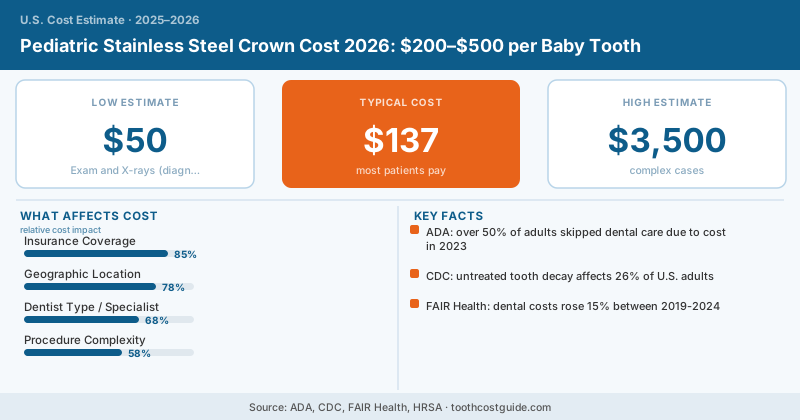
| Stainless steel crown — primary tooth | $200–$500 per tooth |
| Tooth-colored (composite resin) crown — primary front | $250–$550 per tooth |
| Pulpotomy (baby root canal) — often done before crown | $150–$300 per tooth |
| Exam and X-rays (diagnostic visit) | $75–$200 |
| Nitrous oxide sedation (per appointment) | $50–$150 |
| General anesthesia at surgical center | $1,000–$3,500 (facility fee) |
Insurance coverage for kids is generally excellent. Under the Affordable Care Act, pediatric dental care is an essential health benefit on marketplace plans. Most children’s PPO plans cover SSCs at 80–100% as a basic or major restorative benefit. Many parents pay $0–$100 per crown after insurance.
Medicaid and CHIP cover SSC placement for eligible children at no out-of-pocket cost to families in most states. If your child is enrolled in either program, coverage is essentially guaranteed for medically necessary crowns.
Hall Technique vs. Traditional Preparation
Two methods exist for placing SSCs on primary molars. The cost is similar, but the experience is very different for the child.
Traditional technique: The dentist drills away decay, shapes the tooth, selects the appropriately sized crown, and cements it. Local anesthesia is required. The procedure takes 20–40 minutes per tooth.
Hall Technique: No drilling, no anesthesia in many cases. The dentist selects an SSC slightly larger than the tooth and cements it over the tooth — decay and all — allowing the sealed environment under the crown to arrest bacterial activity. Multiple clinical studies confirm the Hall Technique has equivalent or better outcomes compared to traditional SSCs on primary molars, with significantly higher child acceptance and less parental anxiety.
The AAPD recognizes Hall Technique as an evidence-based option. Ask your pediatric dentist if they use it — a younger child who tolerates a 10-minute Hall crown placement is a very different experience from a 40-minute drill-and-restore appointment.
Tooth-Colored Alternatives
Stainless steel crowns are silver and visible, especially on front teeth. Alternatives exist:
Zirconia crowns (NuSmile, Kinder Krowns): White, strong, aesthetically excellent. Cost: $400–$800 per tooth. Insurance often covers them at the SSC rate, leaving you to pay the difference ($150–$350 per tooth). Many parents choose these for upper front teeth where appearance matters.
Strip crowns (composite resin): Tooth-colored temporary crowns built up with composite resin in a plastic shell. Good aesthetics, lower cost ($250–$450), but higher failure rate than SSC or zirconia. Best for front teeth with moderate decay in cooperative children.
Don’t skip treatment on a baby tooth because “it’ll fall out anyway.” An untreated infected primary molar can spread infection to adjacent permanent teeth developing below it, require emergency extraction (disrupting space for permanent teeth), and cause your child significant pain in the meantime. Primary molars in a 4-year-old won’t fall out until age 10–12 — that’s 6–8 years of potential problems if left untreated.
How to Reduce Costs if You’re Uninsured
Federally Qualified Health Centers (FQHCs) provide pediatric dental care on sliding-scale fees based on family income. Many charge $0–$50 for restorations for low-income families. Find locations at findahealthcenter.hrsa.gov.
Dental school pediatric clinics charge 40–60% less than private practices. The resident dentists are supervised, and pediatric dental programs are well-equipped for child behavior management.
State CHIP programs cover children in families earning up to 200–300% of the federal poverty level, depending on the state. If you’re uninsured and your family income qualifies, enrolling in CHIP before the appointment covers the crowns at no cost.
According to AAPD data, dental caries (cavities) remain the most common chronic childhood disease in the US — five times more prevalent than asthma. If your child has active decay, treating it now is always less expensive than managing its consequences later.
Frequently Asked Questions
Stainless steel crowns (SSCs) for primary (baby) teeth typically cost $200–$500 per tooth at a general dentist or pediatric dentist, before insurance. Most children's PPO dental plans cover SSCs at 80–100% when medically necessary, making out-of-pocket costs $0–$100 in many cases. Medicaid and CHIP cover SSCs for eligible children, often at no cost.
Baby teeth need crowns when decay is too extensive for a filling, when a tooth has had a pulpotomy (baby root canal), when enamel is structurally weak (hypoplasia), or after a traumatic fracture. The AAPD recommends crowns over large fillings on primary molars because fillings fail at much higher rates — especially in young children who can't cooperate with precise filling placement.
A properly placed SSC should last until the baby tooth falls out naturally, typically 3–8 years depending on the child's age at placement. They're considered permanent restorations for primary teeth — the metal crown stays in place until the permanent tooth pushes it out. They don't require replacement unless the crown becomes loose or the tooth is extracted early.