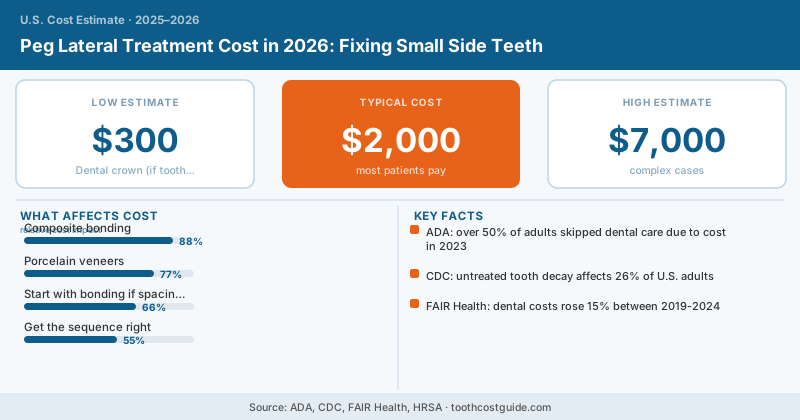
Ever notice someone whose teeth on either side of their two front teeth look small, pointed, or cone-shaped? Those are peg laterals — undersized lateral incisors — and they’re more common than you’d guess. Fixing them costs $300 to $600 per tooth with bonding, or $900 to $2,500 per tooth with porcelain veneers. The right choice depends on the gaps around them, your bite, and how natural you want the result. Here’s the full breakdown.
| Peg Lateral Treatment | Cost Per Tooth |
|---|---|
| Composite bonding build-up | $300–$600 |
| Porcelain veneer | $900–$2,500 |
| Emax veneer | $1,300–$2,500 |
| Dental crown (if tooth is weak) | $1,000–$3,000 |
| Orthodontics first (to space teeth) | $3,000–$7,000 |
| Both laterals (bonding, typical) | $600–$1,200 total |
What Causes Peg Laterals
Peg laterals are a developmental thing — the lateral incisor simply didn’t grow to full size, often a genetic trait that runs in families. It’s purely about size and shape, not decay or damage. Sometimes one side is affected, sometimes both. Because the teeth are smaller than normal, there’s often extra space around them, which is part of what makes them stand out.
That spacing matters for picking a treatment, and it’s where a lot of people make an expensive mistake.
If your peg laterals have gaps on both sides, simply bulking them up with bonding can leave the teeth looking too wide and unnatural. In those cases, moving the teeth into the right position with orthodontics first — then building up the size — gives a far better result than adding material alone.
Bonding vs. Veneers for Peg Laterals
Composite bonding is the budget route. Your dentist sculpts tooth-colored resin onto the small tooth to build it up to a normal size and shape. One visit, no enamel removal in most cases, $300–$600 per tooth. The downside is composite stains and wears over time. Our dental bonding guide covers the lifespan details.
Porcelain veneers give a longer-lasting, stain-resistant, more natural-looking result, but cost more and remove a thin layer of enamel. For visible front-zone teeth that you want to look perfect for 10+ years, many people choose porcelain. See the full dental veneers comparison.
If a peg lateral is structurally weak or has had a root canal, a dental crown might be more appropriate than a veneer.
The Orthodontics Question
Here’s where peg laterals get interesting. The American Association of Orthodontists points out that undersized lateral incisors are a common scenario in cosmetic and orthodontic planning, precisely because the surrounding spacing has to be managed. If you have gaps around your peg laterals, an orthodontist can either close the spaces or distribute them evenly so the built-up teeth end up proportionate. Doing the cosmetic build-up after the teeth are positioned correctly gives a natural result that bonding-alone simply can’t.
If you’re considering moving teeth first, our Invisalign and braces guides break down those costs.
Does Insurance Help?
Peg lateral correction is usually considered cosmetic, so coverage is limited. But because it’s a developmental condition, some plans — especially those with orthodontic benefits — may cover part of the orthodontic phase. Ask your dentist how the work will be coded.
Saving Money
Start with bonding if spacing is minimal. When there’s little or no gap, bonding gives a great result for a quarter of the veneer price.
Get the sequence right. Spending on orthodontics first can prevent paying twice for cosmetic work that looks wrong.
Use pre-tax dollars where eligible. An FSA can cover qualifying restorative portions.
Finance larger plans. CareCredit offers 0% promotional periods for orthodontics-plus-cosmetic cases.
Ask your dentist to mock up both laterals with composite before committing to permanent veneers. A reversible bonding build-up lets you live with the new size and shape for a while. If you love it, keep the bonding or upgrade to porcelain later; if the proportions feel off, you’ve lost nothing but a small fee.
Building up a peg lateral without addressing surrounding gaps or bite issues often produces a tooth that looks too wide or sits awkwardly. Get a full diagnosis of the spacing and bite first, ask whether orthodontics should come before cosmetic work, and request a written treatment plan that covers the whole sequence, not just the visible build-up.
Frequently Asked Questions
Bonding costs $300 to $600 per tooth and is the most affordable option, while porcelain veneers run $900 to $2,500 per tooth for a more durable, natural-looking result. If you have two peg laterals treated with bonding, expect $600 to $1,200 total; with veneers, plan for $1,800 to $5,000.
Most dental insurance plans classify peg lateral treatment as cosmetic and do not cover bonding or veneers, leaving you responsible for the full cost out-of-pocket. Some plans may cover a portion if the treatment is deemed medically necessary due to bite problems or decay, so contact your insurer with your dentist's clinical notes to confirm coverage.
Bonding typically lasts 3 to 7 years before needing touch-ups or replacement due to wear and staining, while veneers are more durable and can last 10 to 15 years with proper care. Veneers are a better long-term investment if you want to avoid repeat procedures, but bonding offers a quicker, reversible option if you want to test the cosmetic change first.