You paid $3,000–$5,000 for a dental implant. Five years later, your dentist is telling you the implant is failing due to peri-implantitis. Now what?
This is the conversation nobody wants to have — but it’s more common than the dental industry likes to admit. A 2022 systematic review published in the Journal of Clinical Periodontology found peri-implantitis affects roughly 22% of implant patients over a 5–10 year period. That’s nearly 1 in 4.
Understanding what treatment costs — and when to act — can mean the difference between saving your implant and losing it entirely.
What Is Peri-Implantitis?
Peri-implantitis is an infection of the tissues around a dental implant — essentially gum disease at the implant site. Bacteria colonize the implant surface, causing inflammation, pocket formation, and progressive bone loss around the implant post.
It starts as peri-implant mucositis (reversible gum inflammation) and can progress to peri-implantitis (bone loss, implant destabilization). Early-stage disease is treatable; late-stage disease may mean losing the implant.
Risk factors include poor oral hygiene, smoking, history of periodontal disease, uncontrolled diabetes, and poorly designed prosthetics that trap plaque.
Peri-Implantitis Treatment Costs
| Treatment Type | Severity | Estimated Cost |
|---|---|---|
| Professional cleaning + debridement | Early (mucositis) | $150–$400 |
| Antibiotic therapy (local or systemic) | Early–Moderate | $50–$300 |
| Non-surgical implant debridement | Moderate | $500–$1,200 |
| Surgical resective therapy | Moderate–Severe | $1,000–$3,000 |
| Regenerative surgery with bone graft | Severe | $2,000–$5,000+ |
| Implant removal + site preparation | Failed implant | $500–$1,500 |
| Replacement implant (after healing) | Full restart | $3,000–$5,000 |
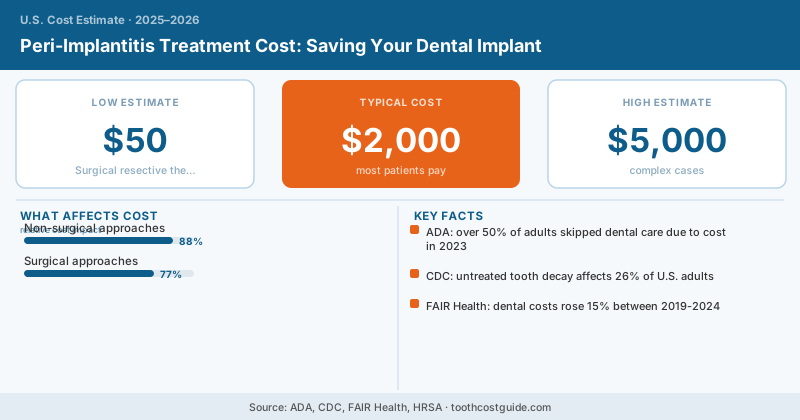
Early treatment is dramatically cheaper than late-stage treatment. A $200 professional cleaning and antibiotic therapy can stop peri-implant mucositis cold. Waiting until there’s significant bone loss pushes you into surgical territory — $2,000–$5,000 — with no guarantee the implant survives.
Non-Surgical vs. Surgical Treatment
Non-surgical approaches work best for early disease with shallow pockets (4–5mm or less) and minimal bone loss. They include:
- Mechanical debridement using ultrasonic scalers or specialized implant instruments (titanium or carbon-fiber tips that won’t scratch the implant surface)
- Local antibiotics (like minocycline microspheres applied directly into pockets)
- Systemic antibiotics (typically azithromycin or metronidazole)
- Laser decontamination of the implant surface
Surgical approaches become necessary when pockets are deeper, bone loss is significant, or non-surgical treatment hasn’t controlled the infection. Options include:
- Resective surgery: Reshaping bone and soft tissue to eliminate pockets, similar to osseous surgery on natural teeth
- Regenerative surgery: Placing bone graft material and/or membranes to regenerate lost bone around the implant
The 2022 EFP (European Federation of Periodontology) S3-Level Clinical Practice Guidelines recommend a step-by-step protocol — starting with patient education and non-surgical treatment, only escalating to surgery if disease persists.
Not all dentists are equipped to treat peri-implantitis. If your general dentist identifies bone loss around an implant, ask for a referral to a periodontist or the oral surgeon who placed the implant. Improper instrumentation on implant surfaces can damage the titanium and accelerate failure.
Does Insurance Cover Peri-Implantitis Treatment?
Most dental insurance plans explicitly exclude implant-related complications. If your policy says “implant failure” or “implant complications” are excluded, peri-implantitis treatment falls under that exclusion — even though it’s clearly a medical necessity.
Some plans cover the periodontal portions (debridement, surgery) separately from implant coverage, so it’s worth having your periodontist’s billing coordinator review your plan. Submit an itemized treatment plan with clinical documentation before treatment.
There’s no guarantee of coverage, but it’s worth the inquiry. A $1,500 surgical procedure you get even partial reimbursement on is better than nothing.
Protecting Your Implant: What Maintenance Actually Costs
The best treatment for peri-implantitis is prevention. Implant maintenance at the appropriate frequency is a small price compared to the cost of treating established disease.
After implant placement, most periodontists recommend professional cleaning every 3–4 months for the first year, then every 6 months for life if you have no history of periodontal disease. Patients with prior gum disease should stay on 3–4 month intervals indefinitely. Each visit costs $150–$300 and includes implant-specific probing and X-rays to catch early bone changes.
The ADA’s 2024 guidelines on implant maintenance emphasize that home care around implants requires different tools than around natural teeth: floss threaders or implant-specific floss (like Oral-B Superfloss), water flossers, and interdental brushes are all more effective at cleaning implant surfaces than standard floss.
When an Implant Can’t Be Saved
Sometimes peri-implantitis has progressed too far. Signs that an implant may need removal:
- Mobility (an integrated implant should never move)
- Bone loss exceeding 50% of implant length on X-ray
- Persistent suppuration (pus) despite treatment
- Severe pain (unusual, since implants have no pulp)
Implant removal costs $500–$1,500 depending on difficulty. The site then needs months of healing and possible bone grafting ($300–$800) before a new implant can be placed. A replacement implant adds another $3,000–$5,000. Total cost to restart: $4,000–$8,000+.
That math makes early intervention — at $200–$500 — a very compelling argument.
Bottom Line
Catch it early. Peri-implant mucositis at $150–$400 to treat is a completely different conversation from full-blown peri-implantitis requiring $3,000–$5,000 in surgery. If your gums around an implant look redder than the surrounding tissue, bleed when you probe them, or feel different than they used to, get it checked immediately. Your implant investment depends on it.
Frequently Asked Questions
Peri-implantitis treatment ranges from $500–$5,000+ depending on severity and treatment approach. Mild cases treated with scaling and antibiotics may cost $500–$1,500, while surgical intervention to save the implant can reach $2,000–$5,000, and implant removal with replacement runs $3,000–$6,000 additional.
Many dental insurance plans cover peri-implantitis treatment at 50% after the deductible if it's deemed medically necessary, though coverage varies significantly by plan. However, most insurance excludes or limits coverage for implant replacement if the original implant fails, leaving you responsible for $3,000–$5,000 out-of-pocket.
Early warning signs include bleeding or swollen gums around the implant, persistent bad breath, a loose implant feeling, or pus discharge from the implant site. Catching these symptoms within the first 3–6 months allows for non-surgical treatment ($500–$1,500), whereas delaying treatment increases the risk of bone loss requiring surgical intervention or implant removal.