Scaling and root planing used to be the end of the road for gum disease treatment. A deep cleaning, antibiotics, better brushing — and hope. Now, when pockets reach 5mm or deeper and non-surgical treatment hasn’t brought them under control, surgery is often what actually stops the disease.
That’s not a scare tactic. The CDC reported that 47.2% of American adults aged 30 and older have some form of periodontitis, with severe cases affecting 8.9% of the adult population. Gum disease left untreated doesn’t plateau — it progresses, destroying the bone support around teeth until extraction becomes unavoidable. Surgery addresses the anatomy that scaling can’t reach and creates an environment where the disease can be managed long-term.
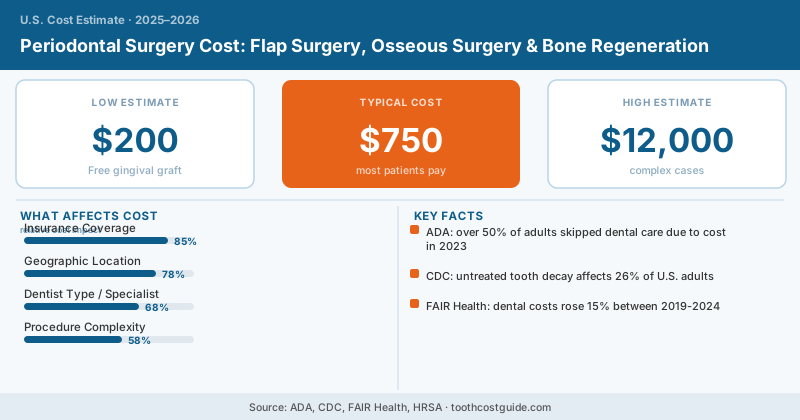
The cost is real: $1,000–$4,000 per quadrant for surgical periodontal treatment. Here’s what that pays for — and what insurance typically covers.
Periodontal Surgery Procedures and Costs
| Procedure | Cost Range | Notes |
|---|---|---|
| Flap surgery (osseous surgery) | $1,000–$3,000 per quadrant | Most common periodontal surgery |
| Guided tissue regeneration (GTR) | $2,000–$4,000 per site | Bone and membrane regeneration |
| Connective tissue graft (soft tissue) | $600–$1,200 per tooth | Covers root exposure |
| Free gingival graft | $500–$1,000 per tooth | Adds attached gum tissue |
| Crown lengthening (surgical) | $1,000–$4,000 | Aesthetic or functional |
| Gingivectomy (disease-related) | $200–$400 per tooth | Removes diseased gum tissue |
| Full-mouth periodontal surgery | $4,000–$12,000 | 4 quadrants, specialist fees |
Why Non-Surgical Treatment Isn’t Always Enough
Scaling and root planing works by physically removing the bacterial biofilm (plaque and calcite) from root surfaces. It’s done through the gum tissue — the instrument goes below the gum line, but the hygienist or dentist is working blind. For pockets of 4–5mm, this is generally sufficient to clean the root and allow healing.
At 5mm or deeper, the anatomy works against you. Deep, irregular bone defects harbor bacteria that instruments simply can’t reach. The gum tissue stays infected. Pockets don’t close. The disease continues.
Surgery solves this by giving the periodontist direct access. The gum tissue is folded back (reflected) like a flap, exposing the roots and underlying bone completely. The periodontist can see everything — irregular bony craters, deep defects, root calculus that was invisible during non-surgical treatment — and clean it thoroughly. Then the gum is sutured back, often repositioned slightly to reduce pocket depth and make future home care more effective.
A 2022 study in the Journal of Periodontology found that patients with pocket depths of 6mm or greater had significantly better disease control outcomes with surgical treatment than continued non-surgical management alone — an approximately 40% greater reduction in pocket depth.
Flap Surgery / Osseous Surgery ($1,000–$3,000 per quadrant)
Osseous surgery combines the access provided by the flap with bone recontouring. After the roots are cleaned, the periodontist reshapes irregular bony defects that would otherwise trap bacteria — smoothing sharp edges, filling craters, and removing ledges that don’t support proper tissue reattachment.
“Osseous” means bone — this procedure actively modifies the shape of the bone to create a more maintainable environment. Done quadrant by quadrant (one quarter of the mouth at a time), with 2–4 week intervals between quadrants. Each quadrant is a separate procedure and a separate charge.
Most patients with moderate-to-severe periodontitis need 2–4 quadrants treated. Full-mouth osseous surgery: $4,000–$12,000 total depending on the number of quadrants and the surgeon’s fees.
Guided Tissue Regeneration ($2,000–$4,000 per site)
Where osseous surgery removes damaged bone to create a flat, manageable architecture, guided tissue regeneration (GTR) attempts to actually grow new bone and attachment tissue back.
The technique: after root cleaning, a barrier membrane is placed over the defect, isolating it from the gum tissue above. The membrane holds the space for bone-forming cells while excluding faster-growing soft tissue cells. Bone graft material — allograft, xenograft, or synthetic — is placed in the defect. Over 4–6 months, bone fill occurs.
GTR is reserved for specific defect geometries that are most amenable to regeneration — typically narrow, three-walled vertical defects. It’s more expensive than osseous surgery alone ($2,000–$4,000 per site versus $1,000–$3,000 per quadrant) and not every defect pattern responds well. Your periodontist’s pre-surgical X-rays and probing will identify whether you’re a good candidate.
Soft Tissue Grafts ($600–$1,200 per tooth)
When recession exposes root surfaces — either from periodontal disease, aggressive brushing, or anatomical factors — a soft tissue graft can cover the exposed root and add volume to thin gum tissue.
Connective tissue graft (subepithelial): The gold standard for root coverage. A small piece of tissue is harvested from the palate (roof of your mouth) and sutured over the exposed root. Excellent long-term results, natural appearance. Two surgical sites — palate and recipient — means a more involved recovery.
Free gingival graft: Tissue is taken directly from the palate surface and placed at the recipient site. Less commonly used for root coverage, more often to add a band of attached gingival tissue in areas with inadequate keratinized tissue. Different texture and color match compared to connective tissue grafts.
Allograft alternatives (Alloderm): Donor tissue from a tissue bank, eliminating the palate harvest. No donor site, faster recovery, similar outcomes in many cases. Slightly more expensive in material cost but eliminates the second surgical site.
Not all gum recession is caused by periodontal disease. Recession from vigorous brushing with a hard-bristle toothbrush or from orthodontic tooth movement is a different problem than recession from bone-destroying periodontitis. The treatment approach overlaps (soft tissue grafts for both) but the underlying cause needs to be addressed or recession returns. Your periodontist should evaluate what caused your recession, not just treat the symptom.
Crown Lengthening ($1,000–$4,000)
Crown lengthening is a periodontal surgical procedure that exposes more of a tooth’s crown — either by removing excess gum tissue, recontouring bone, or both.
Functional crown lengthening: When a tooth has insufficient structure above the gum line for a crown to properly seat — due to decay, fracture, or a short clinical crown — the bone and tissue are surgically repositioned to expose more tooth. This is functionally necessary for a crown to work, and insurance often covers it as part of restorative treatment.
Aesthetic crown lengthening (gum contouring): Purely cosmetic reshaping of the gum line for smile improvement. Insurance almost never covers this use.
The procedure takes 1–2 hours and requires 6–8 weeks of healing before final crown placement — the tissue needs to stabilize in its new position before impressions are taken.
Insurance Coverage: Better Than You’d Expect
Periodontal surgery has more consistent insurance coverage than most restorative dental work, precisely because it treats an active, documented disease.
Most PPO plans cover periodontal surgical procedures at 50–80% after deductible under major restorative benefits. This includes flap surgery, osseous surgery, GTR, and soft tissue grafts when performed for disease management. Crown lengthening coverage depends heavily on whether it’s documented as functional or cosmetic.
The coverage math: if your plan covers osseous surgery at 50% of a $1,500 contracted fee per quadrant, your share is $750 per quadrant. A two-quadrant case: $1,500 out of pocket versus $3,000 without insurance. Not nothing — but considerably better than paying the full surgical fee.
Steps to maximize coverage:
- Request a predetermination before surgery — submit X-rays, pocket depth charts, and narrative supporting medical necessity
- Confirm your remaining annual maximum before each quadrant
- If your annual maximum limits how much can be done this year, schedule quadrants across calendar years to maximize two years of benefits
- Ask your periodontist’s billing team whether they’re in-network with your plan — contracted rates are lower than billed rates
If you’ve been told you need periodontal surgery without first receiving scaling and root planing, ask why. Guidelines from the American Academy of Periodontology recommend non-surgical treatment first for most patients — surgery is indicated when non-surgical treatment is insufficient or when anatomy makes non-surgical care predictably inadequate. A periodontist recommending immediate surgery without a prior deep cleaning (unless the case is clearly surgical at presentation) deserves a question.
Finding a Board-Certified Periodontist
Periodontal surgery is specialist territory. General dentists can perform some gum procedures, but flap surgery, osseous surgery, GTR, and complex grafting should be done by a periodontist — a dentist who completed an additional 3-year residency focused specifically on gum tissue, bone, and implants.
Find a board-certified periodontist through the American Academy of Periodontology’s member finder at perio.org. Board certification (Diplomate, American Board of Periodontology) is an additional credential indicating the periodontist has passed written and oral examinations beyond their residency. It’s not required to be competent, but it signals a commitment to the specialty.
Frequently Asked Questions
Scaling and root planing (deep cleaning) is the first-line treatment for periodontitis and can effectively control the disease in mild-to-moderate cases — typically when pocket depths are 4–5mm and bone loss is minimal. Surgery is recommended when pockets remain at 5mm or deeper after non-surgical treatment, when X-rays show active bone loss, or when the bone architecture is so irregular that it can't be properly cleaned through the gum tissue alone. Your periodontist should re-evaluate pocket depths 6–8 weeks after your deep cleaning before recommending surgery — if they're recommending surgery without trying non-surgical treatment first, ask why.
Expect 1–2 weeks of recovery. The first 2–3 days are the most uncomfortable — soreness, some swelling, and sensitivity. Your periodontist will prescribe chlorhexidine rinse and possibly antibiotics; ibuprofen manages most of the pain effectively. You'll be on soft foods for 1–2 weeks and should avoid smoking, alcohol, and vigorous rinsing for the first several days. Activity restrictions are usually minimal — most patients return to desk work within a day or two. Follow-up appointments are scheduled at 1 week (to remove sutures if non-resorbable were used) and 6–8 weeks (to assess healing and take post-op measurements).
Yes — periodontal surgery has better insurance coverage than most people expect. Most PPO plans cover surgical periodontal treatment at 50–80% of the contracted fee after your deductible because it treats an active disease state. Flap/osseous surgery, guided tissue regeneration, and gingival grafts are typically covered benefits. Crown lengthening is covered when it's functionally necessary (for a crown that needs more tooth structure exposed) but may be excluded when it's primarily cosmetic. Prior authorization is recommended — submit X-rays and pocket depth measurements with the request. Your out-of-pocket cost after insurance might be $300–$1,500 per quadrant depending on your plan's coverage percentage and annual maximum.