Your braces are off. Your orthodontist says you need retainers — and asks if you want “permanent” or removable. That choice affects your cost, your daily routine, and your risk of relapse for years. It deserves more than a 30-second conversation.
| Retainer Type | Cost Per Arch | Lifespan |
|---|---|---|
| Bonded lingual wire (permanent/fixed) | $250–$600 | 10–20+ years |
| Hawley retainer (wire + acrylic) | $150–$350 | 5–10 years |
| Essix/clear retainer (vacuum-formed) | $100–$300 | 1–5 years |
| Vivera retainer (Invisalign brand) | $350–$600 (set of 4) | Variable |
| Bonded retainer repair or re-bond | $50–$200 | N/A |
| Replacement clear retainer | $100–$250 | N/A |
What “Permanent” Actually Means
A permanent or bonded retainer is a thin metal wire — usually twisted multi-strand wire — bonded to the back (lingual) surfaces of your front teeth with dental adhesive. It’s not visible from the front, it doesn’t come in and out, and you can’t lose it.
“Permanent” is a bit of an overstatement. The wire can break or debond. Flossing requires a floss threader or water flosser. If the wire breaks and you don’t notice, teeth can shift immediately. But for patients who know they won’t reliably wear removable retainers, a bonded wire is often the more reliable choice.
They’re most common on the lower front teeth (lower arch), where relapse risk is highest. Upper bonded retainers are used less often because bite forces make the bond more prone to failure.
Why the Price Varies
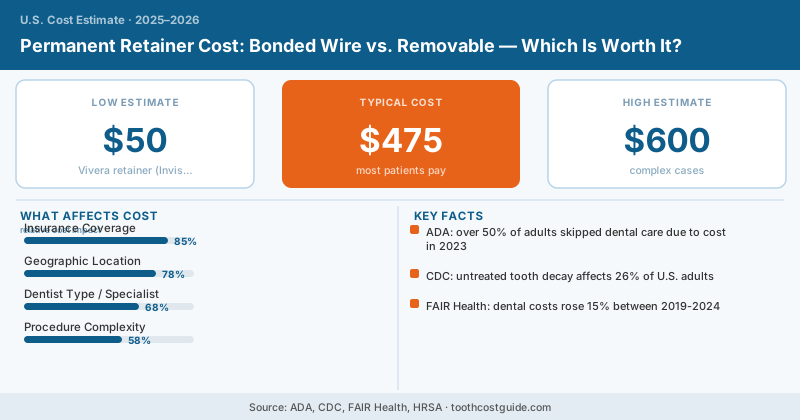
The $250–$600 range for a single arch reflects:
- Geographic market: Urban practices in high-cost cities charge more
- Orthodontist vs. general dentist: Orthodontists typically charge more but have more experience with placement
- Wire gauge and material: Standard twisted wire vs. braided or thicker wire
- Whether it’s included in your original treatment: Many orthodontists bundle one set of retainers (bonded or removable) into the overall braces price; additional sets or different types cost extra
Ask before your debond appointment what’s included in your original treatment fee. Don’t assume.
The American Association of Orthodontists estimates that 25–50% of patients don’t wear removable retainers consistently enough to prevent relapse. Bonded retainers eliminate this problem entirely — they work passively, 24/7. For teenagers, patients who travel frequently, or anyone who knows they’re not reliable with removable appliances, the fixed wire is often the smarter long-term investment despite the higher upfront cost.
Bonded vs. Clear Retainer: The Real Tradeoffs
Bonded wire advantages:
- You literally can’t forget to wear it
- Works continuously, including while sleeping
- No need to carry a case
- One-time cost lasts a decade or more if cared for
Bonded wire disadvantages:
- Flossing requires a floss threader or water flosser — it’s harder, and some patients do it less
- If it breaks without you noticing, teeth can shift quickly
- Calculus (tartar) builds up around the wire if oral hygiene lapses
- Removal is needed for some dental procedures (MRI, certain X-rays)
Clear retainer advantages:
- Easy to clean
- Simple to remove for eating and hygiene
- Inexpensive to replace ($100–$250)
Clear retainer disadvantages:
- You have to actually wear it
- Wears out faster (1–5 years)
- Easy to lose or forget when traveling
- Can crack if you grind your teeth
Most orthodontists recommend wearing clear retainers full-time for the first 6–12 months post-treatment, then nightly indefinitely. The compliance requirement is real.
Insurance and Coverage
Most dental plans cover retainers as part of orthodontic treatment — but coverage is usually a lifetime maximum on orthodontic benefits (typically $1,000–$2,000), and it may already be exhausted by the cost of braces or aligners.
Ask your orthodontist:
- Are retainers included in my original treatment fee?
- If not, what’s the cost per arch?
- What’s covered if I need a repair or replacement?
Replacements due to loss or damage are rarely covered by insurance.
Maintenance Costs Over Time
Here’s what you’re really comparing on a 10-year horizon:
Bonded wire: $400–$600 upfront + potential repair of $50–$200 if it breaks = $400–$800 over 10 years
Clear retainer, replaced every 2–3 years: $200 initial + 3 replacements × $200 = $800 over 10 years (if you wear them consistently)
The cost difference is smaller than most patients expect. The real difference is in compliance — and your honest self-assessment of whether you’ll actually wear a removable device every night for a decade.
Retainer wear is not optional. Once braces or aligners are removed, teeth want to drift back to their original positions. The American Association of Orthodontists confirms that relapse can begin within weeks of removing appliances without retention. Correcting relapse typically requires a new course of orthodontic treatment — costing thousands of dollars. Wearing your retainer is the cheapest orthodontic decision you’ll ever make.
Frequently Asked Questions
A permanent bonded lingual wire retainer typically costs $250–$600 per arch, depending on your orthodontist's location and experience. If you need both upper and lower arches bonded, expect to pay $500–$1,200 total for the complete treatment.
Most dental insurance plans do not cover permanent retainers because they are considered a cosmetic or elective orthodontic follow-up treatment, not a medically necessary procedure. You will typically pay the full $250–$600 per arch out-of-pocket, though some plans may cover a portion if retainers are deemed necessary for bite correction.
Bonded retainer placement takes 15–30 minutes per arch and requires no downtime or recovery period. You can eat and drink immediately after the procedure, though your orthodontist may recommend waiting 1–2 hours to allow the bonding adhesive to fully cure before consuming hot foods or beverages.