Skip a cleaning, save $150. That’s the logic. Here’s where it goes wrong.
The patient who skips cleanings for three years to save $450 doesn’t end up $450 ahead. They end up with decay that’s progressed from enamel to the nerve, facing a root canal and crown that runs $2,200–$2,800. The “saved” $450 cost them $2,400.
This pattern repeats so consistently in dentistry that it has a name: the escalation principle. Dental disease doesn’t stay the same size. It grows. And every stage of growth costs significantly more to treat than the one before it.
| Preventive vs. Reactive Cost Comparison | Preventive Cost | If Neglected (typical escalation) | Extra Cost of Neglect |
|---|---|---|---|
| Cavity caught at cleaning → filling | $150–$300 | Root canal + crown: $2,200–$2,800 | $1,900–$2,500 |
| Gum disease caught early → deep cleaning | $250–$400 | Gum surgery: $3,000–$8,000 | $2,600–$7,600 |
| Cracked tooth detected → crown | $1,200–$1,800 | Extraction + implant: $4,000–$6,000 | $2,200–$4,200 |
| Annual cleanings × 10 years | $2,800–$3,500 | 1 infection/tooth loss event | $3,000–$7,000 |
| Child sealants (all 4 molars) | $120–$240 | 4 fillings if decay sets in | $600–$1,200 |
| Fluoride varnish (child, annual) | $30–$50 | Cavity prevention value | $150–$300/cavity |
The Five Stages of a Cavity — and What Each One Costs
A small cavity doesn’t get better on its own. Here’s where it goes if you ignore it:
Stage 1 — Enamel cavity: The decay hasn’t reached the softer dentin beneath the enamel yet. Cost to fix: $150–$300 filling. This is the cheapest it ever gets.
Stage 2 — Dentin cavity: Decay has penetrated the enamel and reached the dentin layer. The filling is now deeper and more complex. Cost: $200–$400.
Stage 3 — Pulp involvement: Decay has reached the nerve chamber. Now it’s not a filling — it’s a root canal ($800–$1,500) plus a crown ($1,200–$1,800). Total: $2,000–$3,300.
Stage 4 — Abscess or infection: Bacterial infection spreads to the root tip or surrounding tissue. Emergency visit plus antibiotics plus root canal or extraction: $500–$2,500. Some abscesses become medical emergencies requiring hospitalization.
Stage 5 — Tooth loss: Extraction ($200–$350) plus an implant ($4,000–$5,500) or bridge ($3,500–$5,000) equals $4,200–$5,850 — for a tooth that started as a $200 cavity.
Each stage costs roughly 5–10 times more than the previous one. The algebra is brutal and unambiguous.
Why Cleanings Do More Than Clean
Professional cleanings aren’t mainly about polishing. The single most important thing that happens at a cleaning appointment is the dentist’s examination.
During that exam, a dentist looks at bite-wing X-rays that reveal decay between teeth invisible to the eye. They probe around each tooth to measure bone loss — the first sign of gum disease. They examine soft tissue for early oral cancer indicators. They identify cracks before cracks become fractures.
You cannot replicate that exam at home. Brushing and flossing are essential, but they don’t remove calculus — hardened plaque that accumulates below the gumline and creates the bacterial environment that causes bone loss. Only professional instrumentation removes it. Skip cleanings, and calculus builds up unchecked.
That calculus accumulation is the mechanism behind periodontitis — the advanced gum disease that causes bone loss, loose teeth, and ultimately tooth loss. The ADA estimates that nearly half of Americans over 30 have some form of gum disease. The majority don’t know it, because early gum disease causes no pain.
The 10-Year Math: Two Scenarios
Scenario A — Consistent preventive care (2 cleanings/year):
- Cleaning cost: $280/year × 10 years = $2,800
- Dental issues caught and treated early: 1–2 small fillings = $300–$600
- Total 10-year dental spend: $3,100–$3,400
Scenario B — Skipping cleanings entirely for 10 years:
- Cleanings skipped: “saving” $2,800
- Likely consequences: 2 root canals, 2 crowns, 1 extraction, 1 implant
- Conservative cost estimate: $2,000 + $2,000 + $2,400 + $300 + $4,500 = $11,200
- Extra cost from not cleaning: $8,100 — nearly 3x more
This isn’t worst-case math. It’s a conservative estimate of what dental disease progression looks like over a decade without professional intervention.
High-ROI Preventive Procedures Beyond Cleanings
Dental sealants for children ($30–$60 per tooth): Sealants are thin protective coatings applied to the chewing surfaces of back molars. Research shows they reduce cavity incidence in treated teeth by up to 80%. A full set of four sealants costs $120–$240 and can prevent $600–$1,200 in fillings. If your child is 6–12 and their permanent molars have come in, ask about sealants at the next appointment.
Fluoride varnish ($30–$50 per application): Applied in about two minutes at a cleaning, fluoride varnish strengthens enamel and has been shown to reduce cavity incidence by 30–45% in high-risk patients. Most dental insurance covers it for children; many adult plans now cover it as well.
Scaling and root planing for early gum disease ($250–$400 per quadrant): If your dentist recommends a deep cleaning because your probing depths are elevated and you have early bone loss, don’t defer it. The $600–$1,200 cost of treating early-stage periodontitis is far more manageable than $3,000–$8,000 for periodontal surgery or $10,000+ for the tooth replacements that eventually follow untreated gum disease.
Custom night guard for bruxism ($300–$600): If you grind your teeth at night, a custom night guard can save thousands in destroyed crowns, cracked teeth, and temporomandibular joint problems. Signs of grinding: worn-down teeth, jaw soreness in the morning, frequent headaches, cracked or chipped teeth without a clear cause.
Preventive Care Is Affordable Even Without Insurance
Most dental insurance covers preventive care at 100% because insurers know it reduces their back-end costs. But even without insurance, preventive care doesn’t have to break the budget:
- Two annual cleanings at an FQHC: $0–$30 total for income-qualifying patients
- Dental school cleanings: $25–$50 each
- In-house dental membership plans: 2 cleanings typically included in $150–$400 annual fee
The cost of prevention is measurable and low. The cost of treatment is unpredictable and high.
Many patients think dental cleanings are only about clean teeth. In reality, the most important thing that happens at a cleaning is the dentist’s examination — they look at bite X-rays, probe around teeth for bone loss, check for oral cancer, and identify problems at the earliest (cheapest) stage. Skipping cleanings means skipping early detection.
A Practical Maintenance Protocol
Twice a year: schedule your cleanings. Set a recurring calendar reminder for January and July. Rescheduling twice a year is easier than rebuilding dental health after years of neglect.
Annually: don’t skip X-rays. Bitewing X-rays detect decay between teeth that’s invisible to the naked eye. Declining X-rays to save $50–$100 risks missing cavities until they’ve progressed to root canal territory. The tradeoff isn’t worth it.
At the cleaning: ask about sealants for kids. If your children are in the 6–12 year range and their first permanent molars have erupted, ask the dentist whether sealants are appropriate. The answer is almost always yes.
When gum disease is diagnosed: treat it. Scaling and root planing is recommended for a reason. Do it promptly.
When a cavity is found: fill it within 1–2 months. Every month of delay allows decay to deepen. A $200 filling today versus a $2,400 root canal and crown in 18 months isn’t a close call.
If you grind: get a night guard. The $400 guard is dramatically cheaper than replacing the crowns and cracked teeth that grinding eventually causes.
At home: brush twice daily with fluoride toothpaste, floss daily. Professional cleanings work best when you’re maintaining good hygiene in between. Plaque that’s not removed by brushing and flossing within 24–48 hours begins mineralizing into calculus that only a professional can remove.
The single best cost-saving dental move for anyone, insured or not, is this: go to every cleaning appointment, have X-rays taken annually, and treat every cavity immediately when found. A patient who does this consistently will spend 3–5x less on dental care over a lifetime than one who defers and avoids. Prevention is not an expense — it’s the cheapest dental insurance that exists.
The Case, Simply Stated
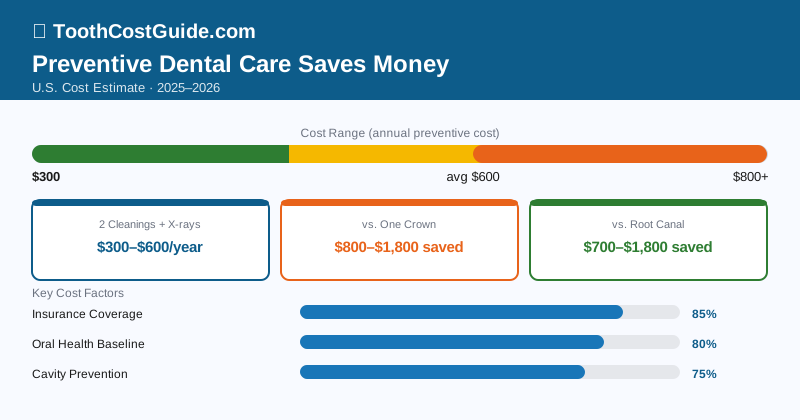
Two cleanings a year cost $280–$350. Over ten years, that’s $3,000. The alternative — reactive treatment after problems have progressed — typically runs $8,000–$15,000 for the same decade. That gap grows larger the longer preventive care is deferred.
The logic of skipping dental appointments to save money is exactly backward. The money is saved by going, not by staying home.
Frequently Asked Questions
A routine prophylactic cleaning (prophy) typically costs $75–$200 per visit at most US dental practices, with most patients paying $100–$150. Since the American Dental Association recommends two cleanings per year, annual out-of-pocket cost for preventive care alone runs $150–$400 for uninsured patients.
Yes—most dental insurance plans cover two preventive cleanings and exams per year at 100% with no copay after meeting your deductible (typically $25–$50). However, if you skip cleanings and develop decay requiring a root canal and crown ($2,200–$2,800), insurance usually covers only 50–80% of major restorative work, leaving you responsible for $400–$1,400 out-of-pocket.
The standard recommendation is two cleanings per year (every 6 months), which catches decay and plaque buildup before they escalate to cavities, root canals, or extractions. Patients who skip cleanings for 3+ years significantly increase their risk of enamel decay progressing to the tooth nerve, requiring emergency treatment costing 5–10 times more than preventive care.